A GLP-1 receptor agonist is a molecule that binds and activates the glucagon-like peptide-1 receptor (GLP-1R), a class B G protein-coupled receptor that signals mainly through Gs and cyclic AMP. Most are peptides engineered from native GLP-1 or from exendin-4, modified to resist enzymatic cleavage and to stay in circulation for hours or days instead of minutes. Approved examples include exenatide, liraglutide, dulaglutide and semaglutide, and newer molecules such as tirzepatide and retatrutide combine GLP-1R agonism with activity at related receptors.
This primer covers the receptor, the native hormone, the chemical strategies that separate one agonist from another, and how these peptides are handled as in-vitro reagents. It is written for researchers and does not cover use in people.
The receptor: GLP-1R
The human GLP-1 receptor is encoded by the GLP1R gene (UniProt P43220) and is a 463-residue protein. It belongs to the class B, or secretin, family of GPCRs, which also includes the receptors for GIP, glucagon, GLP-2, secretin and calcitonin. Class B receptors share a two-domain architecture:
- A large extracellular domain (ECD) at the N-terminus that captures the C-terminal, helical part of the peptide ligand.
- A seven-transmembrane domain whose central pocket receives the peptide's N-terminal residues. Those residues trigger the conformational change that couples the receptor to Gs.
This two-step binding model explains why the first few residues of a GLP-1R agonist are so sensitive to change, and why stabilizing changes near the N-terminus are kept to single-residue swaps, while bulky additions such as lipid chains are placed further along the helix.
Once activated, GLP-1R stimulates adenylyl cyclase through Gs, raising intracellular cAMP. In laboratory systems the most common readouts are cAMP accumulation, receptor binding (competition against a labeled ligand), β-arrestin recruitment and receptor internalization. Each readout can rank the same set of agonists differently, which is one reason potency values vary between papers.
The native hormone
GLP-1 is cut from proglucagon, the same precursor that yields glucagon, oxyntomodulin and GLP-2. UniProt entry P01275 lists the processed forms:
| Peptide | Sequence |
|---|---|
| GLP-1(7-37) | HAEGTFTSDVSSYLEGQAAKEFIAWLVKGRG |
| GLP-1(7-36) | HAEGTFTSDVSSYLEGQAAKEFIAWLVKGR (C-terminal amide in the native form) |
| Glucagon | HSQGTFTSDYSKYLDSRRAQDFVQWLMNT |
The numbering starts at 7 because the first six residues of the longer proglucagon-derived GLP-1 are removed during processing. The two active forms are 31 and 30 residues long.
Native GLP-1 has two properties that make it a poor tool compound for long experiments:
- DPP-4 cleavage. Dipeptidyl peptidase-4 removes the N-terminal dipeptide, His7 and Ala8, which is the part of the hormone that enters the receptor's transmembrane core.
- Fast renal clearance. A 3.3 kDa peptide with no carrier binding is filtered by the kidney.
Almost every GLP-1R agonist is a response to those two problems.
How agonists are engineered
There are four main strategies, and several approved molecules combine two of them.
| Strategy | How it works | Example |
|---|---|---|
| Protease-resistant position 2 | Replace Ala8 with Gly or with the non-coded α-aminoisobutyric acid (Aib), which DPP-4 cannot cleave | Exenatide (Gly), semaglutide (Aib) |
| Fatty acid acylation | Attach a fatty acid or fatty diacid to a lysine through a spacer, so the peptide binds serum albumin | Liraglutide (C16), semaglutide (C18 diacid), tirzepatide (C20 diacid) |
| Protein fusion | Fuse a GLP-1 analog to a large carrier such as an IgG4 Fc fragment | Dulaglutide |
| Absorption enhancer | Co-formulate with an enhancer such as salcaprozate sodium (SNAC) | Oral semaglutide |
Exendin-4 and exenatide
Exenatide is a 39-residue peptide amide originally identified in the Gila monster, Heloderma suspectum. Aligned against GLP-1(7-37), it is identical at 16 of 31 positions, carries Gly at position 2 in place of Ala, and adds a C-terminal extension ending in GGPSSGAPPPS. The FDA label for Byetta gives a formula of C184H282N50O60S, a molecular weight of 4186.6 Da and a mean terminal half-life of 2.4 hours. The same C-terminal extension reappears in tirzepatide and retatrutide.
Liraglutide
Liraglutide is an acylated GLP-1 analog. According to the Victoza label, it is 97% homologous to native GLP-1: Lys34 is replaced with Arg, and a C16 palmitic acid is attached through a glutamic acid spacer to the remaining lysine at position 26. Its molecular weight is 3751.2 Da, and its elimination half-life is about 13 hours.
Semaglutide
Semaglutide was designed at Novo Nordisk to increase albumin affinity beyond liraglutide's. The 2015 discovery paper in the Journal of Medicinal Chemistry describes two substitutions relative to GLP-1(7-37), Aib8 and Arg34, with derivatization at Lys26. The FDA label describes a hydrophilic spacer and a C18 fatty diacid on Lys26. The discovery paper reports a GLP-1R affinity of 0.38 nM, three-fold lower than liraglutide, offset by higher albumin affinity. The label gives an elimination half-life of about one week.
| Property | Semaglutide |
|---|---|
| Developer | Novo Nordisk |
| Main chain length | 31 amino acids (GLP-1(7-37) numbering) |
| Substitutions | Aib8, Arg34 |
| Lipidation | Lys26, hydrophilic spacer and C18 fatty diacid |
| Molecular formula | C187H291N45O59 |
| Molecular weight | 4113.58 g/mol (FDA label) |
| CAS number | 910463-68-2 |
| PubChem CID | 56843331 |
| FDA-approved products | Ozempic (2017) and Rybelsus (2019) for type 2 diabetes; Wegovy (2021) for chronic weight management and cardiovascular risk reduction |
In the Anhydrolabs catalog, semaglutide is listed as GLP-1 SM.
Dulaglutide
Dulaglutide takes a different route. The Trulicity label describes a fusion protein of two identical, disulfide-linked chains. Each chain has a GLP-1 analog, 90% homologous to GLP-1(7-37), joined through a short peptide linker to a modified human IgG4 Fc. The label gives an overall molecular weight of approximately 63 kDa, well above the size the kidney filters efficiently, and a half-life of about 5 days. Because it is a recombinant protein, it is not supplied as a synthetic lyophilized peptide in the way the other agonists here are.
Beyond selective agonists: multi-receptor peptides
Because GLP-1, GIP and glucagon share an N-terminal motif and a helical binding mode, one peptide can be designed to activate more than one of their receptors. Two such molecules are relevant to in-vitro GLP-1R work:
| Compound | Receptors | Status |
|---|---|---|
| Tirzepatide (LY3298176) | GIPR and GLP-1R | FDA-approved as Mounjaro (type 2 diabetes) and Zepbound (chronic weight management; obstructive sleep apnea in adults with obesity) |
| Retatrutide (LY3437943) | GIPR, GLP-1R and glucagon receptor | Investigational, in Phase 3 trials |
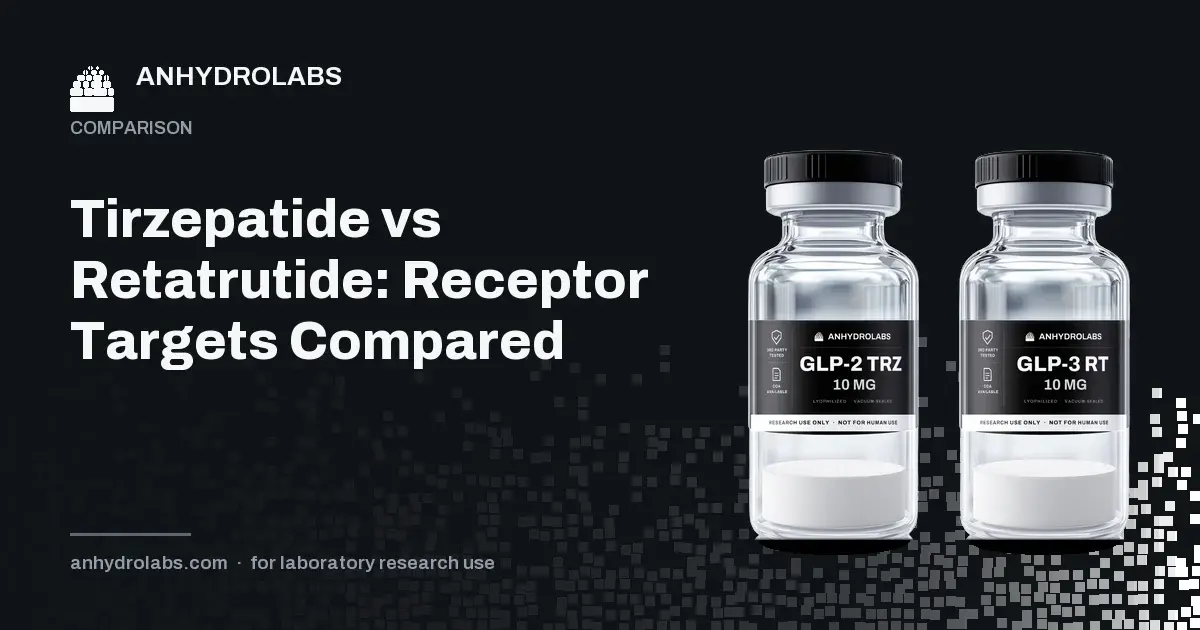
Both are GIP-based, which is why neither is a GLP-1 analog in the strict sense even though both are GLP-1 receptor agonists. In the tirzepatide discovery paper, tirzepatide's cAMP potency at GLP-1R was about 13-fold weaker than native GLP-1, while its GIPR potency matched native GIP. For retatrutide, see what is retatrutide, and for the two side by side, tirzepatide vs retatrutide. They are listed in the catalog as GLP-2 TRZ and GLP-3 RT.
Amylin analogs such as cagrilintide act on a different receptor family (the calcitonin receptor paired with RAMP proteins) and are studied alongside GLP-1R agonists, but they are not GLP-1R agonists themselves.
Comparing agonists in the lab
A few design choices decide whether data from different GLP-1R agonists can be compared:
- Albumin in the buffer. Acylated agonists bind albumin, so adding serum or bovine serum albumin lowers their apparent potency, while non-acylated peptides such as exenatide are largely unaffected. Report the albumin concentration, and consider testing with and without it.
- Cell background. Receptor expression level changes EC50 values through receptor reserve. A high-expressing recombinant line can make a partial agonist look full.
- Receptor species. Human, mouse and rat GLP-1R differ in sequence. Multi-agonists in particular can show different receptor balance across species.
- Pathway. cAMP, β-arrestin and internalization readouts can rank agonists differently. Some papers use this to describe signaling bias.
- Molar, not mass, concentrations. These peptides range from about 3.3 to 4.8 kDa, so equal masses are not equal amounts. Convert using the formula weight of the salt form on the certificate.
Handling GLP-1R agonist peptides
Lyophilized GLP-1R agonists are stable when kept cold and dry. Once dissolved, they need more care.
- Storage. Keep the sealed vial at −20 °C or below, away from light and moisture. Warm it to room temperature before opening. See storage and handling.
- Solvent. Acylated agonists such as semaglutide and tirzepatide usually dissolve best in slightly basic aqueous buffer. Non-acylated peptides such as exenatide are more tolerant of neutral or slightly acidic water. Avoid vigorous vortexing, which can promote aggregation of amphipathic helical peptides.
- Surfaces. Use low-binding tubes and tips, especially for dilutions below about 1 µg/mL.
- Aliquots. Freeze single-use aliquots, and avoid repeated freezing and thawing.
- Verification. Check identity by mass spectrometry and purity by reversed-phase HPLC. Our guide to reading a certificate of analysis explains each field.
Anhydrolabs supplies semaglutide, tirzepatide and retatrutide as lyophilized powders in vacuum-sealed vials, and as 10-vial kits, for laboratory research only. For the basics of what a peptide is and how residues are numbered, see what are peptides.