NAD+
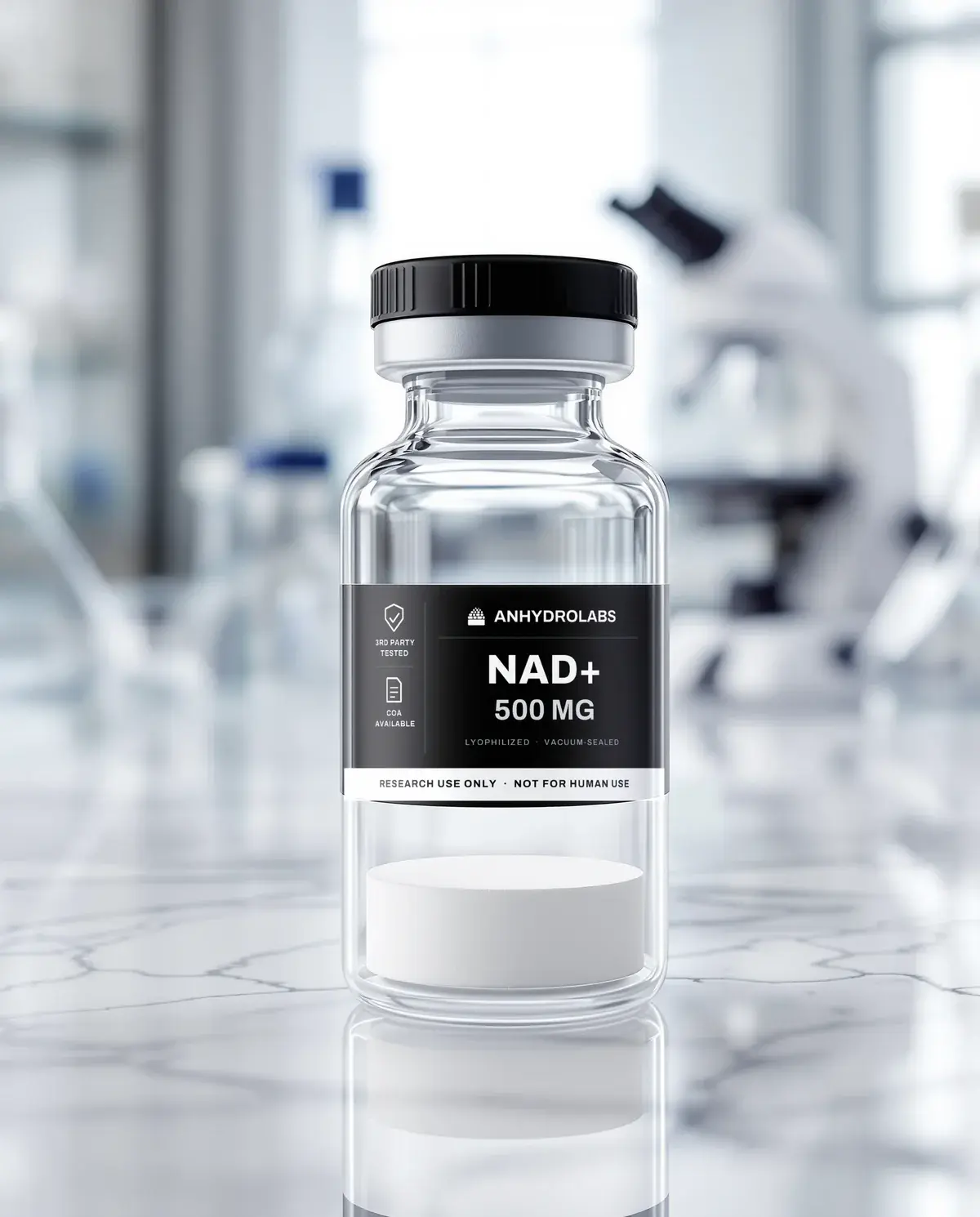
Lyophilized, vacuum-sealed, single vial.
- CAS
- 53-84-9
- Form
- Lyophilized powder
- Storage
- Frozen, in the dark
- Ships
- Vials within 1 business day, kits by Dec 12, 2026
- In stock
- Ships within the US
- Pay by card or crypto
- All sales final
NAD+ is nicotinamide adenine dinucleotide in its oxidized form, a coenzyme built from an adenine nucleotide and a nicotinamide nucleotide joined through their phosphate groups. It is a small molecule, not a peptide. In the literature it is known as the major hydride acceptor in cellular redox reactions and as the substrate consumed by sirtuins, poly(ADP-ribose) polymerases and the glycohydrolase CD38. PubChem lists it under the name nadide.
Supplied for laboratory research use only. Not for human or veterinary use, and not for diagnostic or therapeutic application.
NAD+: compound data
- Molecular formula
- C21H27N7O14P2
- Molecular weight
- 663.4 g/mol
- CAS number
- 53-84-9
- PubChem
- CID 5892
- Form supplied
- Lyophilized powder, vacuum-sealed
- Concentration
- mg/mL and molarity calculator
Reference values from PubChem, the chemistry database of the US National Library of Medicine, for the compound as registered there.
About NAD+
Structure of NAD+
NAD+ is a dinucleotide. One half is adenosine monophosphate; the other is nicotinamide mononucleotide, in which nicotinamide is attached to ribose through its ring nitrogen as a positively charged pyridinium. The two 5-prime phosphates are linked to each other as a diphosphate. PubChem's systematic name for CID 5892 shows the pyridinium paired with a negatively charged phosphate, so the record describes an inner salt, and older synonyms there include coenzyme I, cozymase and diphosphopyridine nucleotide. Accepting a hydride at the nicotinamide ring gives the reduced form, NADH. Phosphorylation gives NADP+, a separate coenzyme with its own reduced form, NADPH.
Where NAD+ comes from
NAD+ was not designed; it was found in living cells. A 2020 review in Signal Transduction and Targeted Therapy states that it was first described in 1906 as a component that could increase the fermentation rate in yeast, and a review in Nature Reviews Molecular Cell Biology likewise traces it to work on metabolic rates in yeast extracts. The same review notes that in 1937 Conrad Elvehjem tied the deficiency disease pellagra to a lack of dietary niacin, with low NAD+ and NADP+ levels. In 2000 Imai, Armstrong, Kaeberlein and Guarente reported that yeast and mouse Sir2 proteins are NAD-dependent histone deacetylases, which opened the study of NAD+ as a signaling substrate.
What NAD+ binds
NAD+ works in two ways. As a redox coenzyme it accepts a hydride ion to form NADH, which the Nature Reviews article calls critical for metabolic reactions. As a substrate it is cleaved. Sirtuins split NAD+ into nicotinamide and ADP-ribose and transfer the acyl group of a target protein to the ADP-ribose. Poly(ADP-ribose) polymerases use it to attach one or many ADP-ribose units to proteins, releasing nicotinamide. CD38 and CD157 hydrolyze the glycosidic bond to give nicotinamide and ADP-ribose, and SARM1 is described as a glycohydrolase and cyclase. Cells rebuild NAD+ from tryptophan, from nicotinic acid, and by salvaging nicotinamide through NAMPT and the NMNAT enzymes.
NAD+ in the research literature
Biochemical work uses NAD+ as the substrate in assays of sirtuins, poly(ADP-ribose) polymerases and CD38; the 2000 Sir2 study, for example, showed that yeast and mouse Sir2 proteins deacetylate specific lysines of histones H3 and H4 only when NAD is present. Reviews describe separate pools in the cytoplasm, mitochondria and nucleus that are regulated independently, and follow NAD+ levels in cultured cells and in animal tissues during aging. The human trials summarized in the Nature Reviews article supplied the precursors nicotinamide riboside and nicotinamide mononucleotide instead of NAD+ itself, and measured NAD+ levels among their endpoints.
Regulatory status of NAD+
NAD+ is a natural coenzyme of living cells. In the United States, a search of FDA's Drugs@FDA application data for nadide as an active ingredient returns no approved application. FDA's list of bulk substances nominated for compounding under section 503A, updated May 14, 2026, places nicotinamide adenine dinucleotide and its disodium salt in Category 1, substances under evaluation, and a separate nomination for beta-nicotinamide adenine dinucleotide in Category 3, nominated without adequate support. Here NAD+ is supplied as a reference reagent for in-vitro laboratory research only, not for human or veterinary diagnosis, treatment, or consumption.
Handling NAD+ in the laboratory
NAD+ arrives as a lyophilized powder in a vacuum-sealed vial. Keep the sealed vial frozen at -4 °F and protected from light, and let it reach room temperature before breaking the seal so that moisture does not condense on the powder. Once in solution, hold it at about 39 °F and use it within roughly four weeks; divide a stock into single-use aliquots instead of freezing and thawing one tube repeatedly. Label stocks clearly as the oxidized form, since NAD+ and NADH are different reagents, and record whether a lot is the inner salt or the disodium salt, which FDA's compounding list names separately.
Sources
- Nadide, PubChem CID 5892
- NAD+ metabolism and its roles in cellular processes during ageing (Covarrubias et al., Nat Rev Mol Cell Biol, 2021)
- Xie et al., Signal Transduct Target Ther, 2020. PubMed Central PMC7539288
- Imai et al., Nature, 2000. PubMed 10693811
- Bulk Drug Substances Nominated for Use in Compounding Under Section 503A of the Federal Food, Drug, and Cosmetic Act (FDA, updated May 14, 2026)
- Drugs@FDA application data, search for nadide as an active ingredient (openFDA)
Research notes on NAD+
- NAD+: The Coenzyme Behind Cellular Redox ChemistryNAD+ explained: its dinucleotide structure, formula and CAS number, the three pathways that make it, the enzymes that consume it, and lab handling.
NAD+: common questions
What is NAD+ supplied as?
NAD+ is supplied as a lyophilized (freeze-dried) powder in a vacuum-sealed vial, in 500 mg and 1000 mg, for in-vitro laboratory research use only.
How much does NAD+ cost?
NAD+ is $44.95 for any size, in US dollars. Volume pricing is quoted on request.
Is NAD+ available as a 10-vial kit?
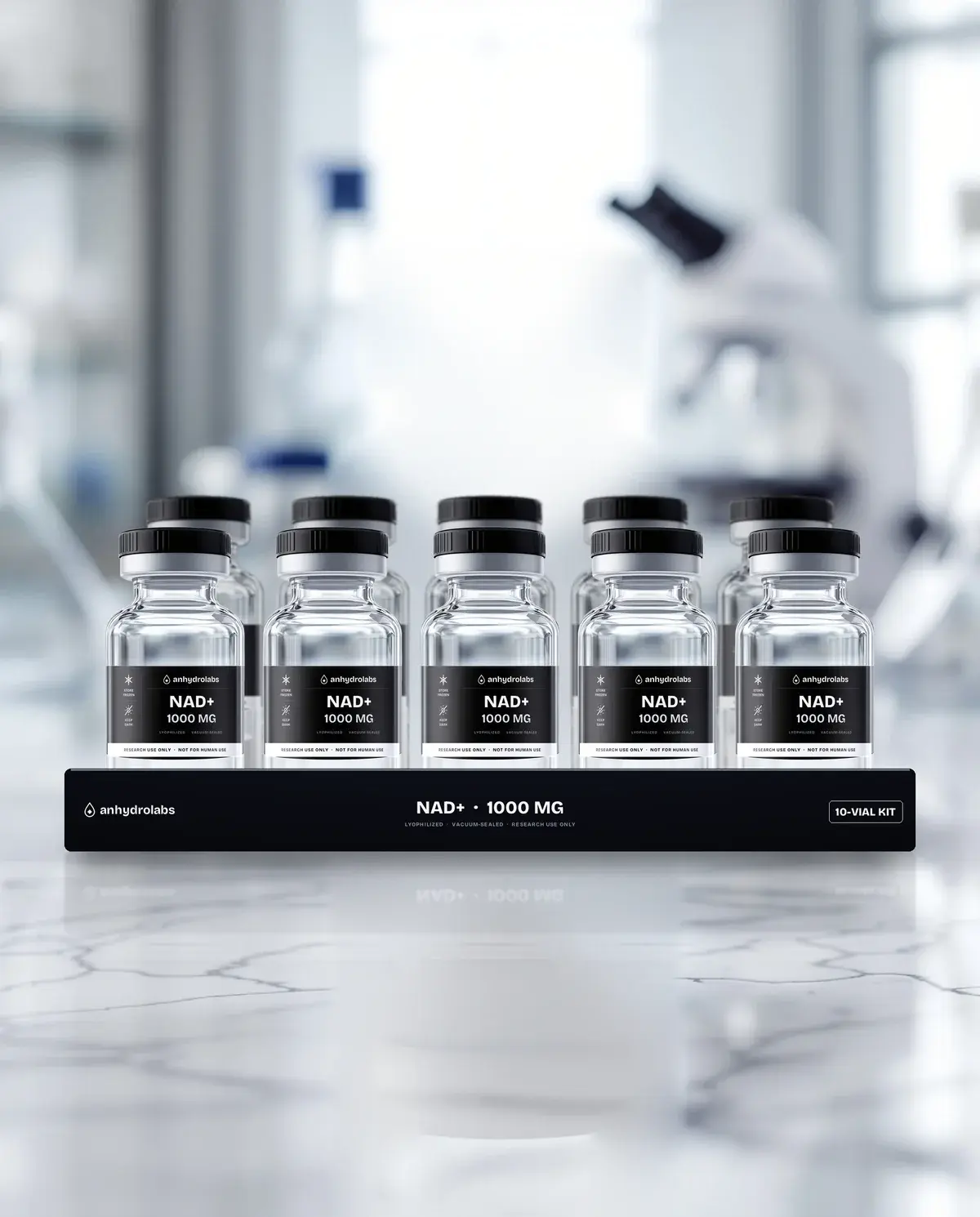
Yes. NAD+ comes in a 10-vial kit: 500 mg for $225.00 ($22.50 per vial); 1000 mg for $337.50 ($33.75 per vial), presale prices. A kit is ten sealed vials of the same size, priced below ten single vials.
When do NAD+ presale kits ship?
By Dec 12, 2026. Presale kits are 10% off. If we cannot ship by Dec 12, 2026, we tell you before that date and you can cancel for a full refund.
What is the CAS number of NAD+?
The CAS registry number of NAD+ is 53-84-9.
How should NAD+ be stored?
Frozen at −4 °F and protected from light, from the day it arrives. Let the vial reach room temperature before breaking the seal; once reconstituted, stability holds for about four weeks refrigerated at 39 °F.
How fast does NAD+ ship?
Presale kits ship from the United States by Dec 12, 2026, to US addresses. Sizes marked in stock ship within 1 business day of payment.
Is NAD+ for human use?
No. It is supplied as a reference reagent for laboratory research use. Not for human or veterinary use, and not for diagnostic or therapeutic application.
What is the difference between NAD+ and NADH?
NAD+ is the oxidized form of nicotinamide adenine dinucleotide and NADH is the reduced form. NAD+ accepts a hydride ion at its nicotinamide ring during redox reactions and becomes NADH. Only NAD+ is the substrate that sirtuins, poly(ADP-ribose) polymerases and CD38 cleave.
Which enzymes consume NAD+ as a substrate?
Three main families are described: sirtuins, which remove acyl groups from proteins; poly(ADP-ribose) polymerases, which attach ADP-ribose to proteins; and the glycohydrolases CD38 and CD157, with SARM1 as a further example. Each reaction releases nicotinamide, which cells salvage back into NAD+ through NAMPT and the NMNAT enzymes.
Is NAD+ a peptide?
No. NAD+ is a dinucleotide, made of adenosine monophosphate and nicotinamide mononucleotide joined through their phosphate groups. It contains no amino acids and no peptide bonds, and PubChem lists it under the nonproprietary name nadide.
$44.95
NAD+ · 500 mg