Tesamorelin
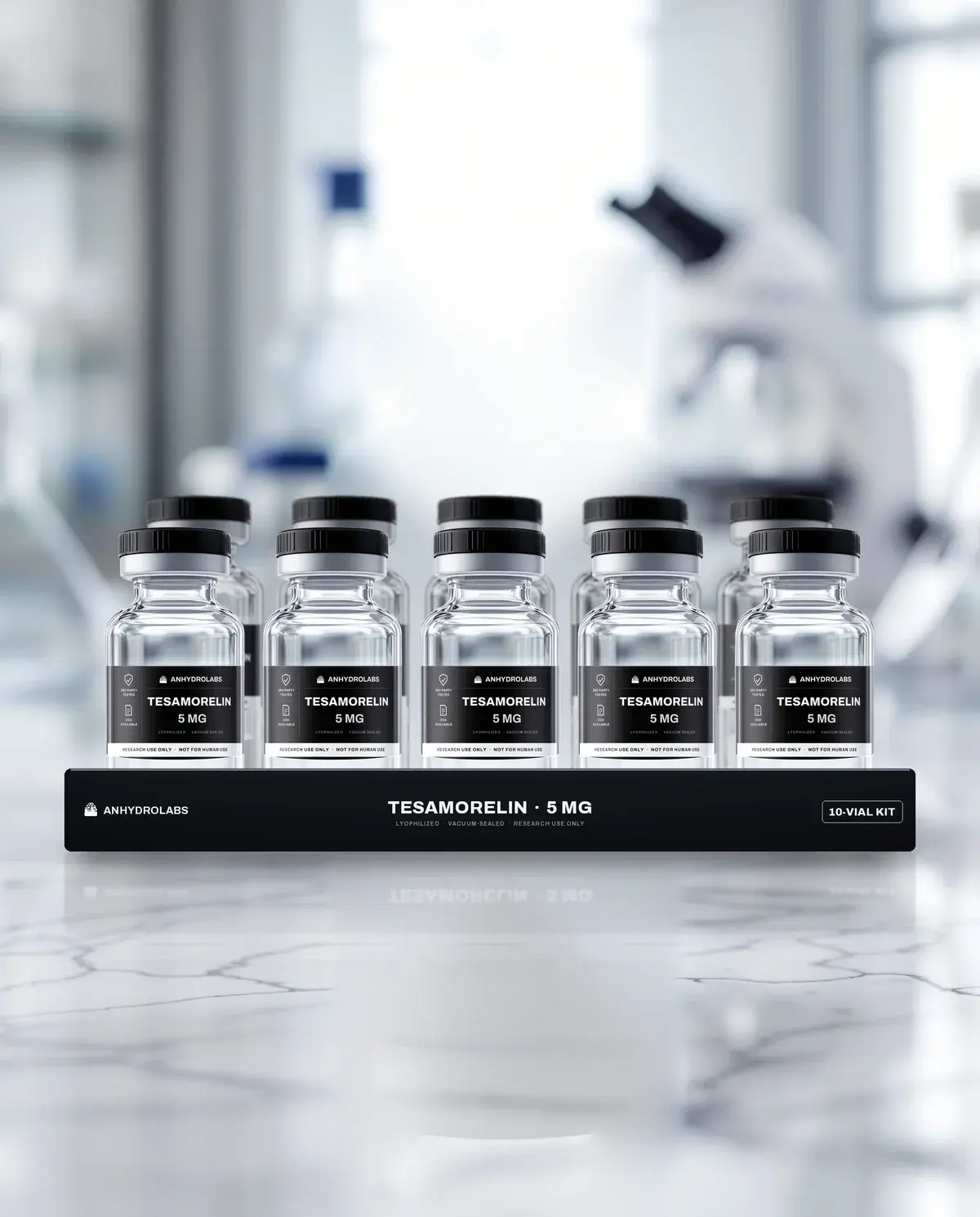
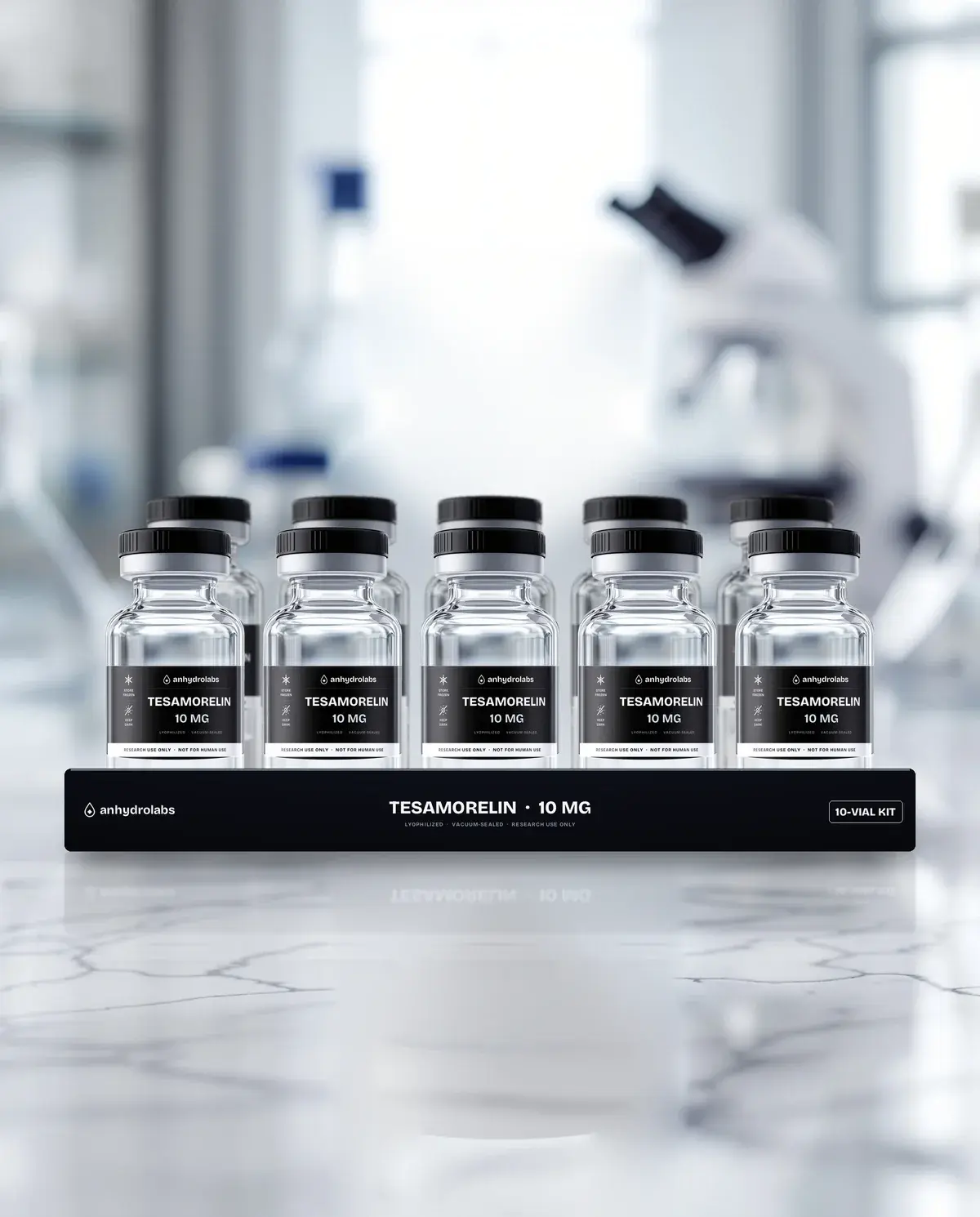
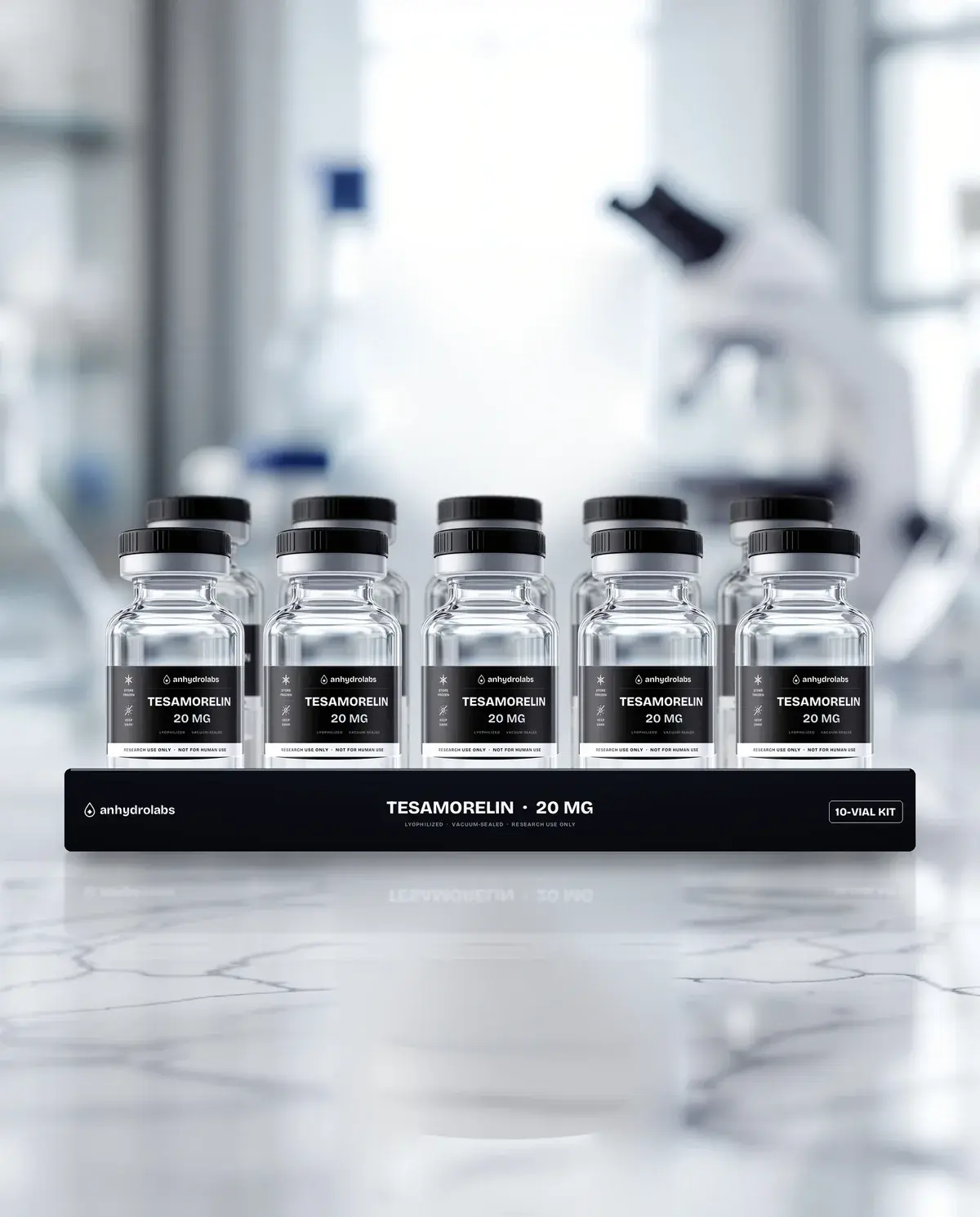
Also known as Tesa and TH9507. Lyophilized, vacuum-sealed, 10-vial kit.
- CAS
- 218949-48-5
- Form
- Lyophilized powder
- Storage
- Frozen, in the dark
- Ships
- Kits by Dec 12, 2026
- Presale
- Ships within the US
- Pay by card or crypto
- All sales final
Tesamorelin is a synthetic analog of human growth hormone-releasing hormone (GHRH): the full 44-residue sequence with a trans-3-hexenoyl group on the N-terminal tyrosine. Also known by the development code TH9507, it is an agonist of the GHRH receptor and was designed to resist the plasma enzyme that inactivates native GHRH. The FDA approved it in 2010 under the name Egrifta.
Supplied for laboratory research use only. Not for human or veterinary use, and not for diagnostic or therapeutic application.
Tesamorelin: compound data
- Molecular formula
- C221H366N72O67S
- Molecular weight
- 5,136 g/mol
- CAS number
- 218949-48-5
- PubChem
- CID 16137828
- Form supplied
- Lyophilized powder, vacuum-sealed
- Concentration
- mg/mL and molarity calculator
Reference values from PubChem, the chemistry database of the US National Library of Medicine, for the compound as registered there.
About Tesamorelin
Structure of Tesamorelin
The FDA label describes tesamorelin as the 44 amino acid sequence of human growth hormone-releasing factor with a hexenoyl moiety, a six-carbon chain with a double bond at position 3, attached to the tyrosine at the N-terminus. PubChem's name for it, N-((3E)-1-oxo-3-hexenyl) somatoliberin, identifies the double bond as E, that is, trans. The peptide chain itself is that of native GHRH(1-44) amide, running from Tyr-Ala-Asp-Ala-Ile-Phe to a C-terminal leucine amide. The label states that the approved product is prepared as an acetate salt, with roughly seven acetate molecules per peptide.
Where Tesamorelin comes from
GHRH was isolated in 1982 by Guillemin and colleagues from a human pancreatic tumor that had caused acromegaly; they reported a 44-residue peptide ending in a leucine amide. In 1986 Frohman and colleagues showed that plasma removes the first two residues, leaving GRH(3-44)-NH2 with less than a thousandth of the biological activity, and attributed this to a plasma dipeptidylaminopeptidase. Tesamorelin was developed at Theratechnologies in Montreal under the code TH9507. Ferdinandi and colleagues described it in 2007 as human GRF(1-44) amide minimally modified by a trans-3-hexenoyl group on Tyr1.
What Tesamorelin binds
Tesamorelin acts at the GHRH receptor (UniProt Q02643), a 423-residue receptor that UniProt describes as coupled to G proteins which activate adenylyl cyclase, and which drives growth hormone gene transcription and secretion in pituitary somatotroph cells. The FDA label states that in vitro tesamorelin binds and stimulates human GRF receptors with similar potency as endogenous GRF. The hexenoyl group therefore changes stability, not receptor pharmacology. Ferdinandi and colleagues found TH9507 resistant to deactivation by dipeptidyl aminopeptidase-IV and slower to degrade in vitro than native GHRH(1-44) amide in rat, dog and human plasma.
Tesamorelin in the research literature
The published nonclinical work on TH9507 used in-vitro stability assays in rat, dog and human plasma, measurements of plasma growth hormone and insulin-like growth factor-1 in pigs, rats and dogs, and toxicology studies of up to four months in rats and dogs with toxicokinetic sampling. Human trials followed and supported the 2010 approval. In the laboratory, tesamorelin serves as a full-length, peptidase-resistant GHRH receptor agonist that can be compared directly with native GHRH(1-44) amide in receptor-binding, cyclic AMP and plasma stability assays.
Regulatory status of Tesamorelin
Tesamorelin is approved in the United States. The FDA label for Egrifta WR, from Theratechnologies, gives 2010 as the year of initial approval. The approval is for a single, narrowly drawn labeled indication, and the label also sets out limitations of use; the label itself is the primary source for both. That approval applies to the manufacturer's finished product and to no other material. Tesamorelin described on this page is a separate article, supplied as a reference reagent for in-vitro laboratory research only.
Handling Tesamorelin in the laboratory
Tesamorelin is supplied lyophilized in a vacuum-sealed vial. Keep the sealed vial frozen at -4 °F, protected from light, and let it reach room temperature before breaking the seal. In solution it keeps for about four weeks at 39 °F, and a stock is better divided into single-use aliquots than frozen and thawed repeatedly. The label for the approved lyophilized product, a different article with its own excipients, specifies controlled room temperature in the original box to protect it from light. No further compound-specific stability data were taken from a primary source.
Sources
- EGRIFTA WR (tesamorelin) for injection, prescribing information (DailyMed)
- PubChem compound summary: Tesamorelin, CID 16137828
- Ferdinandi et al., Basic Clin Pharmacol Toxicol, 2007. PubMed 17214611
- Growth hormone-releasing factor from a human pancreatic tumor that caused acromegaly (Guillemin et al., Science, 1982)
- Rapid enzymatic degradation of growth hormone-releasing hormone by plasma in vitro and in vivo to a biologically inactive product cleaved at the NH2 terminus (Frohman et al., J Clin Invest, 1986)
- UniProt Q02643: Growth hormone-releasing hormone receptor (GHRHR), human
Tesamorelin: common questions
Is Tesa the same as Tesamorelin?
Yes. Tesa is another name for Tesamorelin, which is also written TH9507 (CAS 218949-48-5). It is the same compound, supplied here as a lyophilized powder for in-vitro laboratory research use only.
What is Tesamorelin supplied as?
Tesamorelin is supplied as a lyophilized (freeze-dried) powder in a vacuum-sealed vial, in 5 mg, 10 mg and 20 mg, for in-vitro laboratory research use only.
Is Tesamorelin available as a 10-vial kit?
Yes. Tesamorelin comes in a 10-vial kit: 5 mg for $202.50 ($20.25 per vial); 10 mg for $328.50 ($32.85 per vial); 20 mg for $558.00 ($55.80 per vial), presale prices. A kit is ten sealed vials of the same size, priced below ten single vials.
When do Tesamorelin presale kits ship?
By Dec 12, 2026. Presale kits are 10% off. If we cannot ship by Dec 12, 2026, we tell you before that date and you can cancel for a full refund.
What is the CAS number of Tesamorelin?
The CAS registry number of Tesamorelin is 218949-48-5.
How should Tesamorelin be stored?
Frozen at −4 °F and protected from light, from the day it arrives. Let the vial reach room temperature before breaking the seal; once reconstituted, stability holds for about four weeks refrigerated at 39 °F.
How fast does Tesamorelin ship?
Presale kits ship from the United States by Dec 12, 2026, to US addresses. Sizes marked in stock ship within 1 business day of payment.
Is Tesamorelin for human use?
No. It is supplied as a reference reagent for laboratory research use. Not for human or veterinary use, and not for diagnostic or therapeutic application.
What does the trans-3-hexenoyl group on tesamorelin do?
It caps the N-terminal tyrosine of the GHRH sequence. Native GHRH loses its first two residues in plasma to a dipeptidylaminopeptidase, which leaves a nearly inactive fragment. A 2007 paper reported that the capped peptide resisted that enzyme and degraded more slowly than native GHRH in rat, dog and human plasma in vitro.
What receptor does tesamorelin bind?
Tesamorelin binds the growth hormone-releasing hormone receptor, a G protein-coupled receptor on pituitary somatotroph cells that activates adenylyl cyclase. The FDA label states that in vitro it binds and stimulates human GRF receptors with similar potency as the endogenous hormone.
Is tesamorelin approved by the FDA?
Yes. The FDA first approved tesamorelin in 2010 as Egrifta, a product of Theratechnologies, for a single, narrowly drawn labeled indication. That approval covers the manufacturer's finished product only. Tesamorelin sold as a reagent is a laboratory material for in-vitro research.
$202.50
Tesamorelin · 5 mg · 10-vial kit