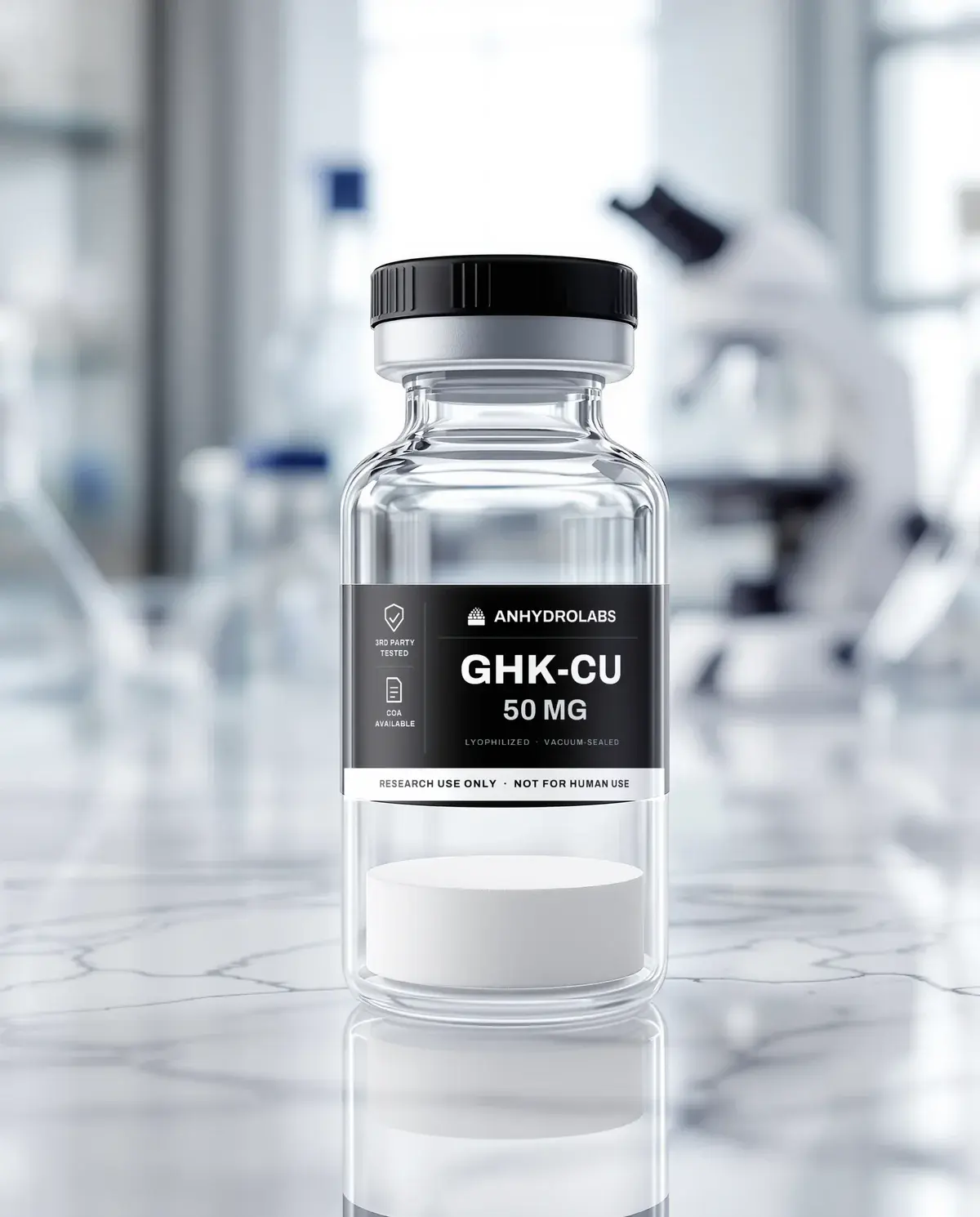
GHK-Cu
Also known as copper tripeptide-1. Lyophilized, vacuum-sealed, single vial.
- CAS
- 89030-95-5
- Form
- Lyophilized powder
- Storage
- Frozen, in the dark
- Ships
- Vials within 1 business day, kits by Dec 12, 2026
- In stock
- Ships within the US
- Pay by card or crypto
- All sales final
GHK-Cu is the copper(II) complex of the tripeptide glycyl-L-histidyl-L-lysine, also known as copper tripeptide-1 or prezatide copper. The peptide occurs naturally in human plasma and was discovered in 1973 by Loren Pickart. It binds copper through three nitrogen atoms with a dissociation constant near 7 x 10^-14 M at pH 7.4, and it is studied both as a copper carrier and for its influence on gene expression in cultured cells.
Supplied for laboratory research use only. Not for human or veterinary use, and not for diagnostic or therapeutic application.
GHK-Cu: compound data
- Molecular formula
- C14H23CuN6O4+
- Molecular weight
- 402.92 g/mol
- CAS number
- 89030-95-5
- PubChem
- CID 71587328
- Form supplied
- Lyophilized powder, vacuum-sealed
- Concentration
- mg/mL and molarity calculator
Reference values from PubChem, the chemistry database of the US National Library of Medicine, for the compound as registered there.
About GHK-Cu
Structure of GHK-Cu
The peptide part is Gly-His-Lys, three residues with a free amino terminus and a free C-terminal acid. PubChem records the copper complex as prezatide copper, with GHK copper and copper tripeptide-1 as synonyms, and holds a separate record for the metal-free tripeptide. Calorimetry shows that copper(II) binds predominantly in a 1:1 ratio. A second copper-chelating sequence found in blood plasma, Asp-Ala-His-Lys, uses four nitrogen donors where GHK uses three. Commercial material may be supplied as a salt, so the form stated for a lot determines the formula weight.
Where GHK-Cu comes from
GHK was discovered in 1973 by Loren Pickart; the doctoral thesis describing a tripeptide in human serum was submitted at the University of California, San Francisco. In 1980 Pickart and Thaler reported that the tripeptide, then abbreviated GHL, is complexed with copper and iron in plasma, and that at physiological pH it associates with copper, cobalt, iron, molybdenum, nickel and zinc but has no affinity for calcium, potassium or sodium. A 2018 review by Pickart and Margolina gives the plasma level as about 200 ng/mL at age 20 and about 80 ng/mL by age 60.
What GHK-Cu binds
The best-defined part of the mechanism is coordination chemistry. Hureau and colleagues found that the complex is monomeric in solution, with copper held by three nitrogen ligands: the terminal amine, an amide nitrogen and the histidine imidazole. The fourth equatorial site is labile, and ternary complexes form with glycine or histidine. Trapaidze and colleagues measured a conditional dissociation constant of 7.0 x 10^-14 M at pH 7.4. The complex was inert at moderate redox potentials, and reduction near -0.62 V against a silver chloride electrode released the copper ion. Beyond metal binding, the 2018 review proposes broad changes in gene expression, drawn from Connectivity Map data.
GHK-Cu in the research literature
The 1980 work used monolayer cultures of the HTC4 hepatoma cell line, where the tripeptide with copper or iron altered cell adhesion and growth at nanomolar concentrations. Structural studies used X-ray crystallography, EPR, X-ray absorption and NMR spectroscopy, cyclic voltammetry and isothermal titration calorimetry. The 2018 review summarizes work in human dermal fibroblasts, epidermal basal cells, SH-SY5Y neuroblastoma cells and U937 lymphoma cells, in rat, mouse and rabbit models, and in the Connectivity Map library of transcriptional responses from the Broad Institute. Much of that literature comes from a small number of laboratories, and the gene-expression data describe transcript changes, not a mechanism.
Regulatory status of GHK-Cu
GHK-Cu is not the active ingredient of an FDA-approved drug. On the FDA page listing bulk drug substances that may present significant safety risks in compounding, current as of April 22, 2026, GHK-Cu for injectable routes appears among substances whose nominations were withdrawn by the nominators. The agency's note says compounded injectable products containing it may pose a risk of immunogenicity because of possible aggregation and peptide-related impurities, and that human data are limited. GHK-Cu is supplied here as a reference reagent for in-vitro laboratory research only.
Handling GHK-Cu in the laboratory
It is a lyophilized powder in a vacuum-sealed vial. Keep it frozen at -4 °F and protected from light, and let the vial reach room temperature before breaking the seal so that moisture does not condense on the cold solid. In solution, plan on about four weeks at 39 °F, and divide a stock into single-use aliquots instead of freezing and thawing one tube. Two points from the coordination chemistry apply. The fourth copper site is labile, and free amino acids such as glycine and histidine form ternary complexes with the bound metal, so the composition of a medium can change the species present. The complex is inert at moderate redox potentials, but strong reduction releases the copper ion.
Sources
- PubChem CID 71587328: Prezatide copper
- Pickart L, Thaler MM. Growth-modulating tripeptide (glycylhistidyllysine): association with copper and iron in plasma, and stimulation of adhesiveness and growth of hepatoma cells in culture by tripeptide-metal ion complexes (J Cell Physiol, 1980)
- Hureau C et al. X-ray and solution structures of Cu(II) GHK and Cu(II) DAHK complexes: influence on their redox properties (Chemistry, 2011)
- Trapaidze A et al. Thermodynamic study of Cu2+ binding to the DAHK and GHK peptides by isothermal titration calorimetry (ITC) with the weaker competitor glycine (J Biol Inorg Chem, 2012)
- Pickart L, Margolina A. Regenerative and Protective Actions of the GHK-Cu Peptide in the Light of the New Gene Data (Int J Mol Sci, 2018)
- Certain Bulk Drug Substances for Use in Compounding that May Present Significant Safety Risks (FDA, content current as of April 22, 2026)
Research notes on GHK-Cu
- GHK-Cu Copper Peptide: Structure and ResearchCopper peptides explained through GHK-Cu: the Gly-His-Lys sequence, how it binds copper(II), its discovery in human plasma, identifiers and lab handling.
- What Are Peptides? Structure, Bonds and ClassesWhat are peptides? How amino acids link into chains, where the peptide and protein line falls, the main classes, and how research peptides are made and stored.
GHK-Cu: common questions
Is copper tripeptide-1 the same as GHK-Cu?
Yes. copper tripeptide-1 is another name for GHK-Cu (CAS 89030-95-5). It is the same compound, supplied here as a lyophilized powder for in-vitro laboratory research use only.
What is GHK-Cu supplied as?
GHK-Cu is supplied as a lyophilized (freeze-dried) powder in a vacuum-sealed vial, in 50 mg and 100 mg, for in-vitro laboratory research use only.
How much does GHK-Cu cost?
GHK-Cu is $32.95 for any size, in US dollars. Volume pricing is quoted on request.
Is GHK-Cu available as a 10-vial kit?
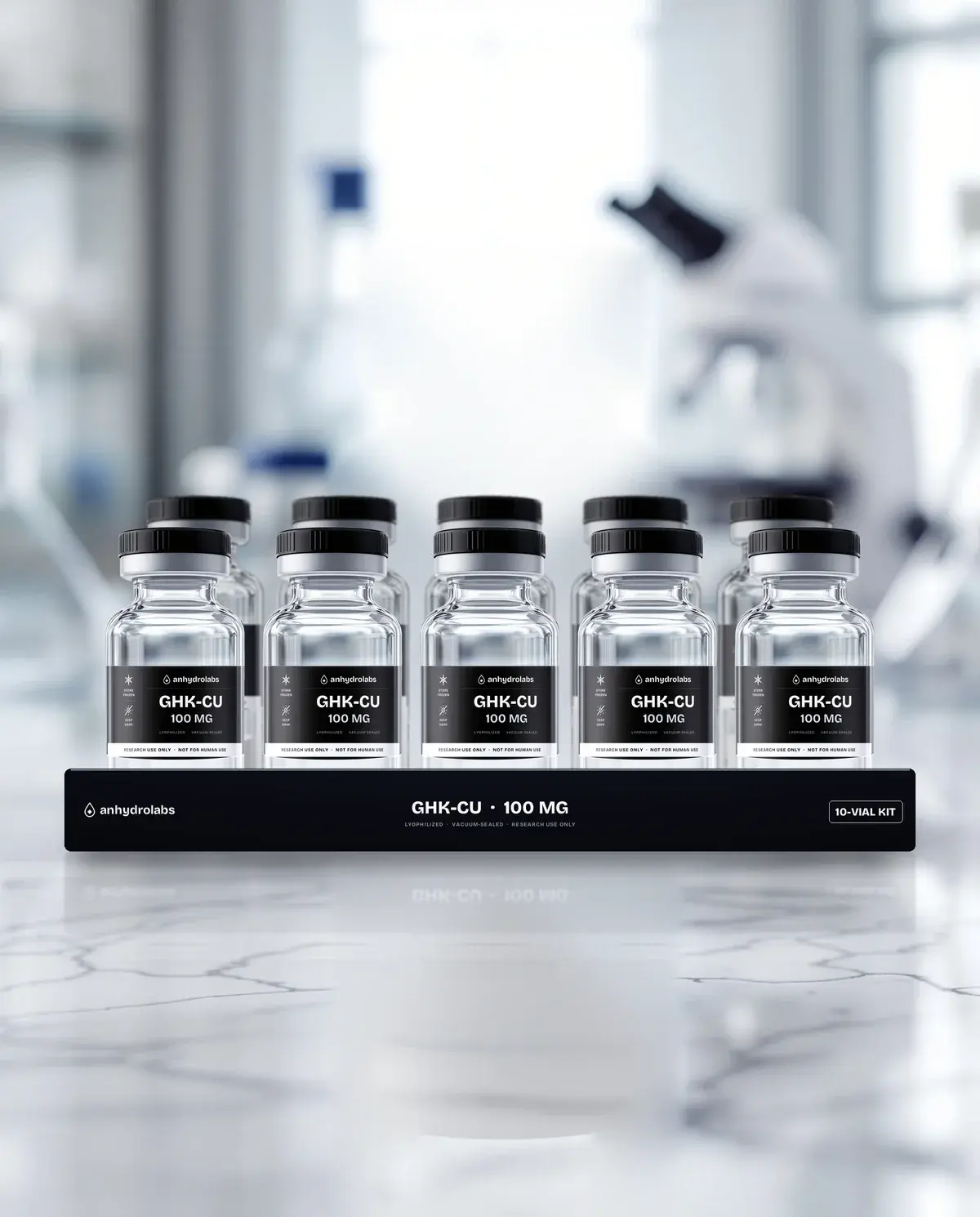
Yes. GHK-Cu comes in a 10-vial kit: 50 mg for $117.00 ($11.70 per vial); 100 mg for $166.50 ($16.65 per vial), presale prices. A kit is ten sealed vials of the same size, priced below ten single vials.
When do GHK-Cu presale kits ship?
By Dec 12, 2026. Presale kits are 10% off. If we cannot ship by Dec 12, 2026, we tell you before that date and you can cancel for a full refund.
What is the CAS number of GHK-Cu?
The CAS registry number of GHK-Cu is 89030-95-5.
How should GHK-Cu be stored?
Frozen at −4 °F and protected from light, from the day it arrives. Let the vial reach room temperature before breaking the seal; once reconstituted, stability holds for about four weeks refrigerated at 39 °F.
How fast does GHK-Cu ship?
Presale kits ship from the United States by Dec 12, 2026, to US addresses. Sizes marked in stock ship within 1 business day of payment.
Is GHK-Cu for human use?
No. It is supplied as a reference reagent for laboratory research use. Not for human or veterinary use, and not for diagnostic or therapeutic application.
How does GHK bind copper?
In solution the complex is monomeric, and copper(II) is held by three nitrogen atoms: the N-terminal amine of glycine, a deprotonated amide nitrogen and a nitrogen of the histidine imidazole ring. The fourth equatorial position is labile and can be taken by another ligand. The conditional dissociation constant measured by calorimetry at pH 7.4 is 7.0 x 10^-14 M.
Who discovered GHK?
Loren Pickart discovered the tripeptide in human serum in 1973, in work described in his doctoral thesis at the University of California, San Francisco. In 1980 Pickart and Thaler reported that the peptide is complexed with copper and iron in plasma.
Is GHK-Cu approved by the FDA?
No. GHK-Cu is not the active ingredient of an FDA-approved drug. The FDA lists GHK-Cu for injectable routes among bulk drug substances whose compounding nominations were withdrawn, with a note on possible immunogenicity and limited human data.
$32.95
GHK-Cu · 50 mg