Epithalon
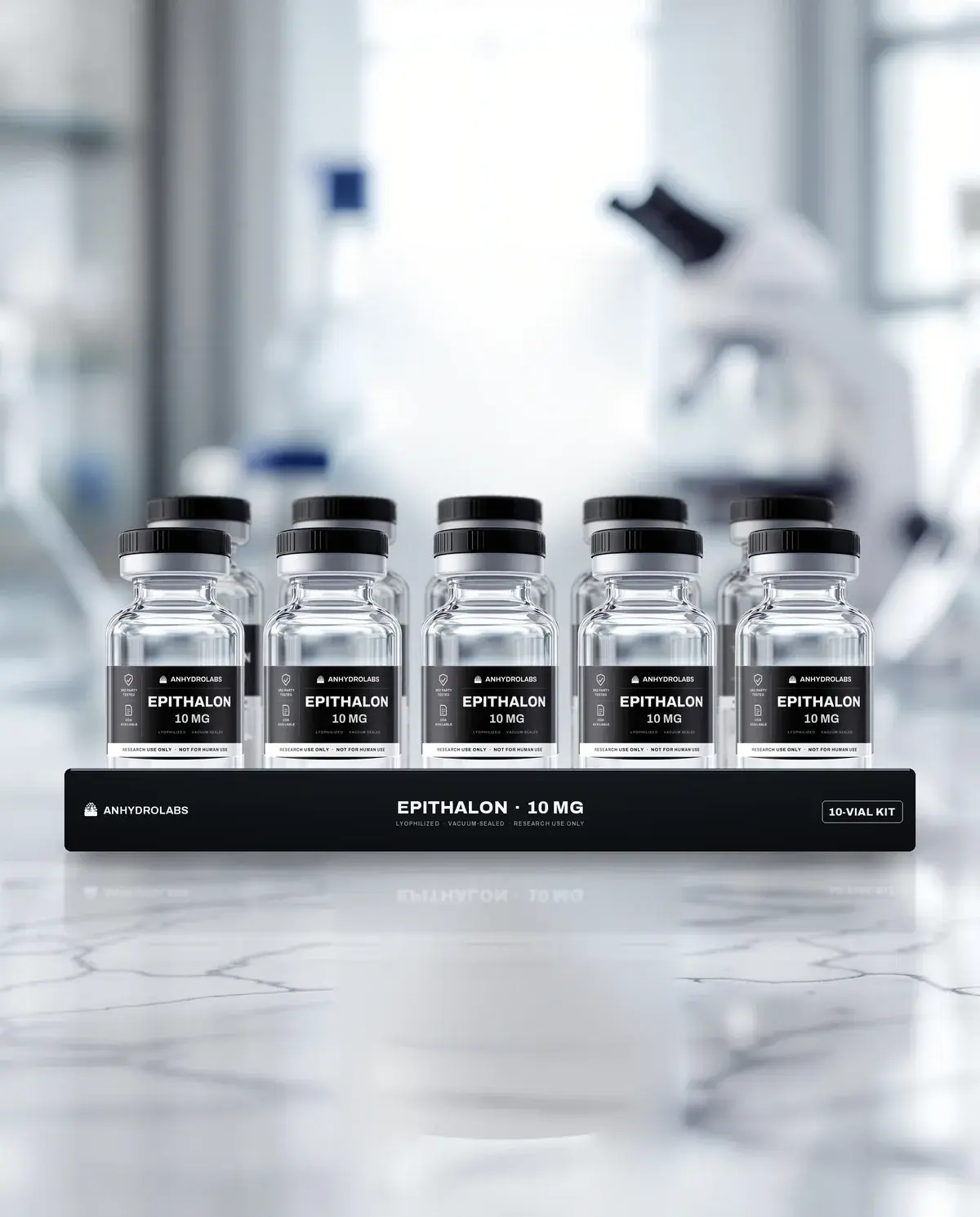
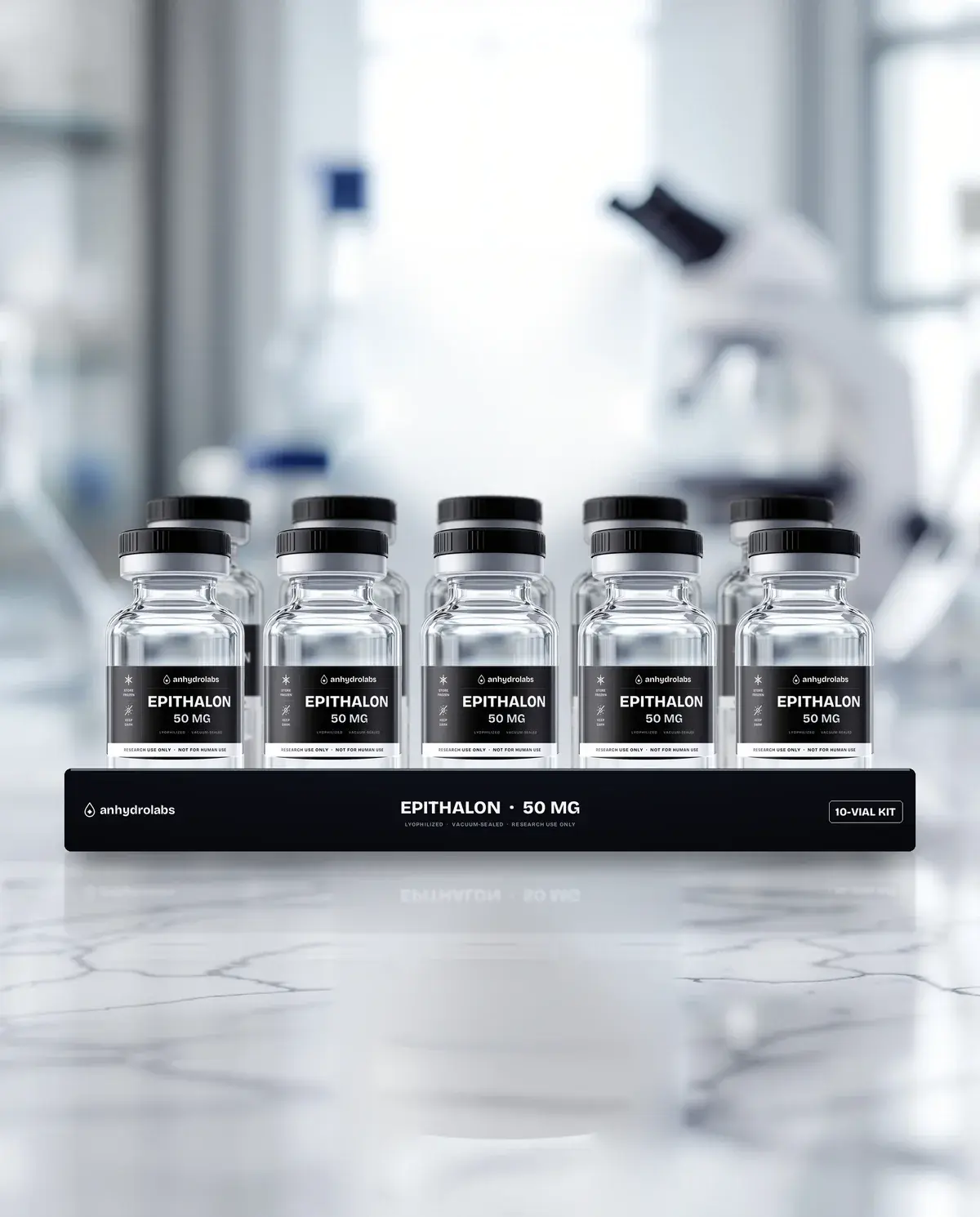
Also known as Epitalon. Lyophilized, vacuum-sealed, 10-vial kit.
- CAS
- 307297-39-8
- Form
- Lyophilized powder
- Storage
- Frozen, in the dark
- Ships
- Kits by Dec 12, 2026
- Presale
- Ships within the US
- Pay by card or crypto
- All sales final
Epithalon is the synthetic tetrapeptide Ala-Glu-Asp-Gly, also spelled Epitalon and written AEDG. It was developed by V. Kh. Khavinson and colleagues in St. Petersburg on the basis of the amino acid composition of epithalamin, a polypeptide extract of cattle pineal gland. It is known mainly for cell-culture studies of telomerase and telomere length, and it is not an approved drug.
Supplied for laboratory research use only. Not for human or veterinary use, and not for diagnostic or therapeutic application.
Epithalon: compound data
- Molecular formula
- C14H22N4O9
- Molecular weight
- 390.35 g/mol
- CAS number
- 307297-39-8
- PubChem
- CID 219042
- Form supplied
- Lyophilized powder, vacuum-sealed
- Concentration
- mg/mL and molarity calculator
Reference values from PubChem, the chemistry database of the US National Library of Medicine, for the compound as registered there.
About Epithalon
Structure of Epithalon
PubChem lists the compound as Epitalon, with Epithalon, Epithalone and Ala-Glu-Asp-Gly among its synonyms, along with the descriptive name alanyl-glutamyl-aspartyl-glycine. It is a linear tetrapeptide with a free amino terminus on alanine and a free acid on glycine. Glutamic acid and aspartic acid give it two side-chain carboxyl groups in addition to the C-terminus. It is a defined single molecule, unlike epithalamin, which is a tissue extract. A 2025 review notes that the material is commonly sold as a salt with acetate or trifluoroacetate counterions, which matters when a formula weight is compared with a label.
Where Epithalon comes from
Epithalamin, a pineal polypeptide extract from cattle, was studied mainly by V. Kh. Khavinson and V. N. Anisimov, according to a 2025 review in the International Journal of Molecular Sciences. Epitalon was then developed on the basis of the amino acid composition of that extract; the review marks June 2025 as 25 years since its synthesis was patented. For years the tetrapeptide was a designed molecule not known to occur in tissue, until 2017, when it was reported for the first time in a pineal gland polypeptide complex by LC-MS. Some authors avoid the trade name and write only the sequence, AEDG.
What Epithalon binds
No receptor has been established. The best-known proposal concerns telomerase: a 2003 report from the originating group described expression of the catalytic subunit, telomerase enzymatic activity and telomere elongation in telomerase-negative human fetal fibroblast cultures. A 2025 study from Brunel University London cites earlier findings that the peptide binds preferentially to methylated cytosine in DNA and interacts with the linker histones H1.3 and H1.6. The 2025 review lists further proposals, including an influence on melatonin synthesis, changes in interleukin-2 mRNA and binding to specific DNA sequences. These are proposals from a limited set of studies, not a settled mechanism.
Epithalon in the research literature
The Brunel study used four human cell lines, the breast cancer lines 21NT and BT474 and the normal lines IBR.3 fibroblasts and HMEC epithelial cells, and measured telomere length and hTERT expression by qPCR, telomerase activity by TRAP assay, and alternative lengthening of telomeres by C-circle assay and PML body immunofluorescence. The authors note that the work was done in two-dimensional culture. The 2025 review covers other systems, including Drosophila, several mouse strains, rats and rhesus monkeys, along with a few small human studies. No study of Epitalon was found on ClinicalTrials.gov.
Regulatory status of Epithalon
Epithalon is not approved by the FDA. The 2025 review treats approval as a future question, stating that additional studies of short- and long-term toxicity, genotoxic activity and carcinogenic potential would be essential first. On the FDA page listing bulk drug substances that may present significant safety risks in compounding, current as of April 22, 2026, epitalon appears among substances whose nominations were withdrawn by the nominators, with a note on possible immunogenicity and the absence of identified safety information. Epithalon is supplied here as a reference reagent for in-vitro laboratory research only.
Handling Epithalon in the laboratory
It is a lyophilized powder in a vacuum-sealed vial. Keep it frozen at -4 °F and protected from light, and let the vial reach room temperature before breaking the seal so that moisture does not condense on the cold solid. In solution, plan on about four weeks at 39 °F, and divide a stock into single-use aliquots instead of freezing and thawing one tube. The sequence has no cysteine, methionine or tryptophan, and three carboxyl groups make the peptide acidic and polar. Because a counterion is a noticeable share of the mass of so small a molecule, the salt form stated for a lot should be taken into account when converting a weighed amount into a molar concentration.
Sources
- PubChem CID 219042: Epitalon
- Araj SK et al. Overview of Epitalon: Highly Bioactive Pineal Tetrapeptide with Promising Properties (Int J Mol Sci, 2025)
- Khavinson VKh, Bondarev IE, Butyugov AA. Epithalon peptide induces telomerase activity and telomere elongation in human somatic cells (Bull Exp Biol Med, 2003)
- Al-Dulaimi S et al. Epitalon increases telomere length in human cell lines through telomerase upregulation or ALT activity (Biogerontology, 2025)
- Certain Bulk Drug Substances for Use in Compounding that May Present Significant Safety Risks (FDA, content current as of April 22, 2026)
- ClinicalTrials.gov: search for studies with Epitalon as an intervention
Research notes on Epithalon
- Epithalon (Epitalon): The Tetrapeptide ExplainedEpitalon (Epithalon) explained: the Ala-Glu-Asp-Gly sequence, its origin in pineal extract research, the telomerase studies, regulatory status and lab handling.
Epithalon: common questions
Is Epitalon the same as Epithalon?
Yes. Epitalon is another name for Epithalon (CAS 307297-39-8). It is the same compound, supplied here as a lyophilized powder for in-vitro laboratory research use only.
What is Epithalon supplied as?
Epithalon is supplied as a lyophilized (freeze-dried) powder in a vacuum-sealed vial, in 10 mg and 50 mg, for in-vitro laboratory research use only.
Is Epithalon available as a 10-vial kit?
Yes. Epithalon comes in a 10-vial kit: 10 mg for $139.50 ($13.95 per vial); 50 mg for $589.50 ($58.95 per vial), presale prices. A kit is ten sealed vials of the same size, priced below ten single vials.
When do Epithalon presale kits ship?
By Dec 12, 2026. Presale kits are 10% off. If we cannot ship by Dec 12, 2026, we tell you before that date and you can cancel for a full refund.
What is the CAS number of Epithalon?
The CAS registry number of Epithalon is 307297-39-8.
How should Epithalon be stored?
Frozen at −4 °F and protected from light, from the day it arrives. Let the vial reach room temperature before breaking the seal; once reconstituted, stability holds for about four weeks refrigerated at 39 °F.
How fast does Epithalon ship?
Presale kits ship from the United States by Dec 12, 2026, to US addresses. Sizes marked in stock ship within 1 business day of payment.
Is Epithalon for human use?
No. It is supplied as a reference reagent for laboratory research use. Not for human or veterinary use, and not for diagnostic or therapeutic application.
What is the sequence of Epithalon?
Epithalon is the tetrapeptide Ala-Glu-Asp-Gly, written AEDG in one-letter code. PubChem records it as Epitalon, a linear peptide of four residues with a free amino terminus and a free C-terminal acid, and lists Epithalon and Epithalone as other spellings.
How is Epithalon different from epithalamin?
Epithalamin is a polypeptide extract of cattle pineal gland, a mixture. Epithalon is a single synthetic tetrapeptide that was developed on the basis of the amino acid composition of that extract. A 2025 review notes that the tetrapeptide was first detected in a pineal gland polypeptide complex only in 2017.
What did the telomerase studies of Epithalon measure?
A 2003 report measured expression of the telomerase catalytic subunit, telomerase enzymatic activity and telomere length in human fetal fibroblast cultures. A 2025 study in four human cell lines measured telomere length and hTERT expression by qPCR, telomerase activity by TRAP assay, and markers of alternative lengthening of telomeres. Both are cell-culture studies.
$139.50
Epithalon · 10 mg · 10-vial kit