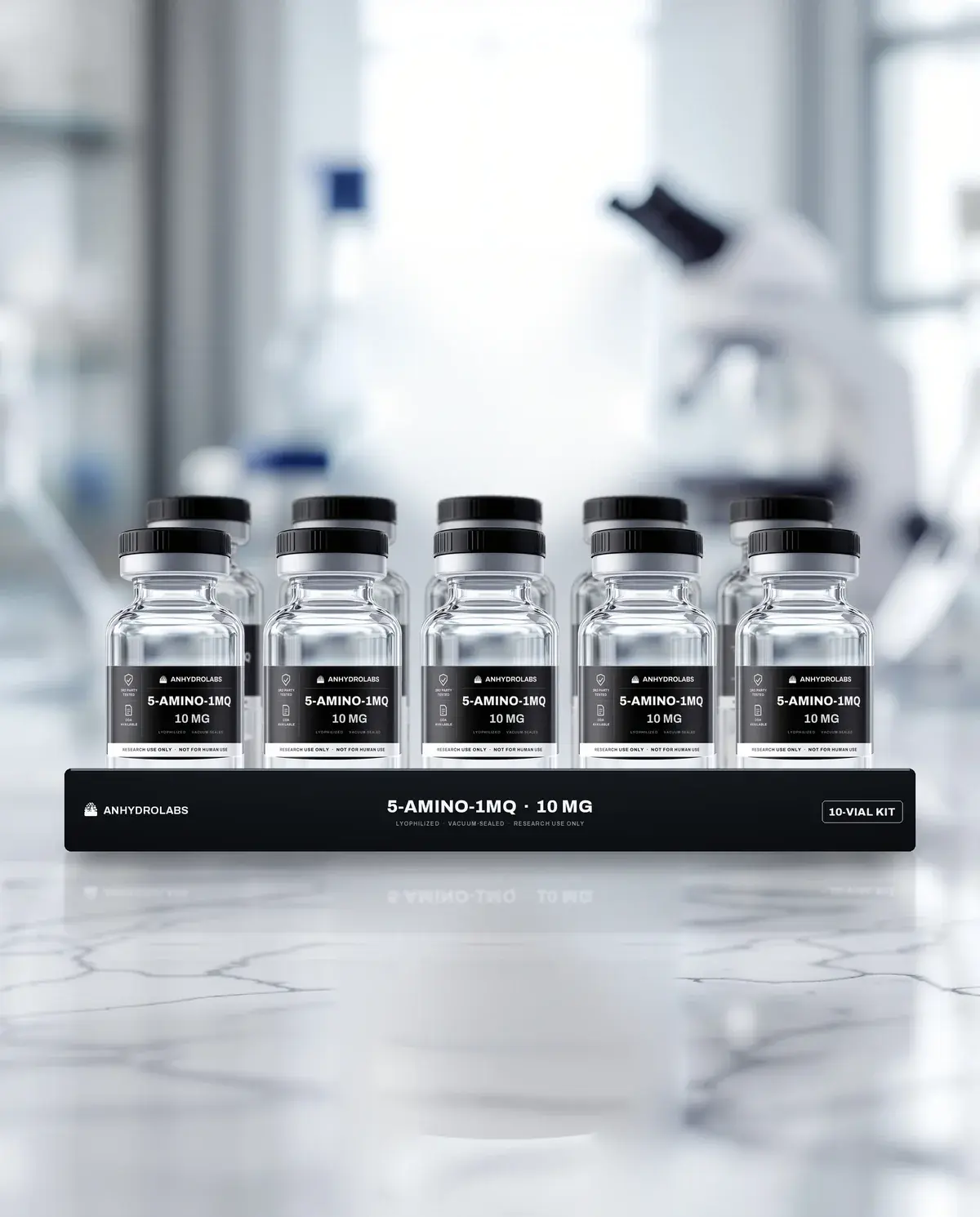
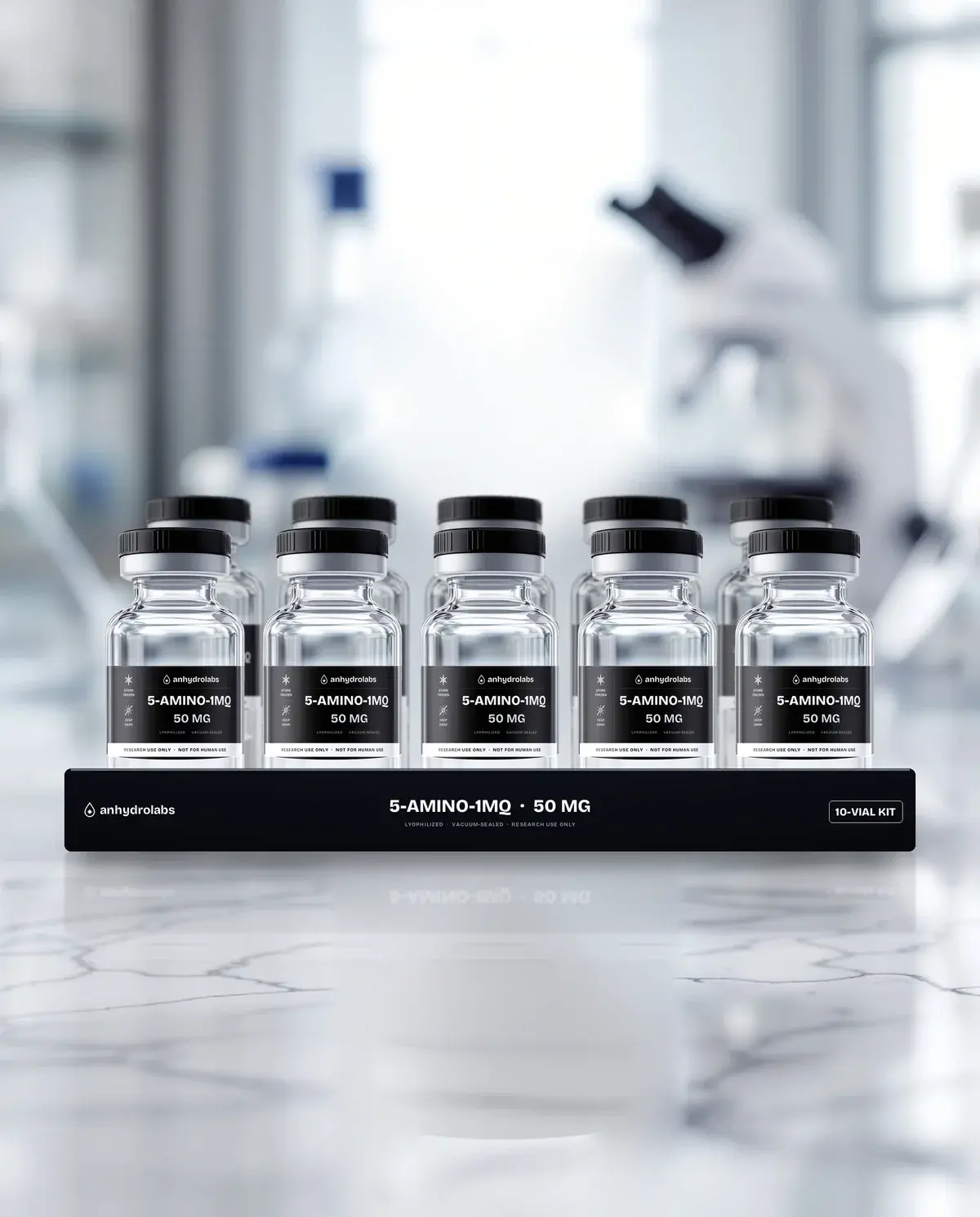
5-Amino-1MQ
Also known as 5-amino-1-methylquinolinium. Lyophilized, vacuum-sealed, 10-vial kit.
- Form
- Lyophilized powder
- Storage
- Frozen, in the dark
- Ships
- Kits by Dec 12, 2026
- Presale
- Ships within the US
- Pay by card or crypto
- All sales final
5-Amino-1MQ is a small molecule, not a peptide: the 5-amino-1-methylquinolinium cation, a methylated quinoline ring carrying one amine group. It is known in the literature as a membrane-permeable inhibitor of nicotinamide N-methyltransferase (NNMT), the cytoplasmic enzyme that methylates nicotinamide. It was described by a University of Texas group in 2017 and 2018, and the published record consists of enzyme, cell and mouse studies.
Supplied for laboratory research use only. Not for human or veterinary use, and not for diagnostic or therapeutic application.
About 5-Amino-1MQ
Structure of 5-Amino-1MQ
PubChem names the cation 1-methylquinolin-1-ium-5-amine. A quinoline ring system carries a methyl group on its ring nitrogen, which gives that nitrogen a fixed positive charge, and a primary amine at position 5. There are no amino acids and no peptide bonds. Because the cation is permanently charged it is always paired with a counterion; PubChem holds a separate record for the iodide salt, which it also lists as NNMTi. The cation is C10H11N2+ at 159.21 g/mol and the iodide salt is C10H11IN2 at 286.11 g/mol, so any molar calculation depends on which form is in the vial.
Where 5-Amino-1MQ comes from
The compound comes from a structure-activity study published in the Journal of Medicinal Chemistry in 2017 by Neelakantan, Watowich and colleagues at the University of Texas Medical Branch in Galveston, working with chemists at the University of Texas at San Antonio. They screened N-methylated quinolinium, isoquinolinium, pyridinium, benzimidazolium and benzothiazolium analogues against NNMT and identified the quinoliniums as the most promising scaffold, with inhibition near 1 micromolar. A 2018 paper in Biochemical Pharmacology from the same group characterized the series further and used 5-amino-1MQ as its lead inhibitor. Interest in NNMT as a target followed a 2014 Nature paper by Kraus and colleagues on Nnmt knockdown in mouse adipose tissue and liver.
What 5-Amino-1MQ binds
NNMT (UniProt P40261, EC 2.1.1.1) is a 264-residue cytoplasmic enzyme that transfers a methyl group from S-adenosyl-L-methionine (SAM) to nicotinamide, giving 1-methylnicotinamide and S-adenosyl-L-homocysteine. Docking in the 2017 study placed the quinolinium analogues in the nicotinamide substrate-binding site. In the 2018 study the series did not inhibit the related methyltransferases COMT, DNMT1 and PRMT3, or the NAD+ salvage pathway enzymes NAMPT and SIRT1. In cultured adipocytes the inhibitors lowered intracellular 1-methylnicotinamide and raised intracellular NAD+ and SAM, the pattern expected when the enzyme is blocked inside a cell. The binding orientation rests on computer docking in these sources, not on a crystal structure.
5-Amino-1MQ in the research literature
Published work is preclinical. The 2018 paper used enzyme assays for potency and selectivity, parallel artificial membrane and Caco-2 monolayer assays for permeability, and 3T3-L1 cells differentiated into adipocytes for metabolite and lipogenesis measurements. Its in-vivo arm used male C57Bl/6 mice kept on a high-fat diet. The earlier Kraus study used antisense knockdown of Nnmt in mouse white adipose tissue and liver and did not involve this compound. A search of ClinicalTrials.gov in October 2026 under 5-amino-1MQ and 5-amino-1-methylquinolinium returned no registered human studies. PubMed indexes only a few papers that name the compound, so the literature is thin.
Regulatory status of 5-Amino-1MQ
5-Amino-1MQ is not approved as a drug by the FDA, and no approval by any other regulator appears in the sources cited here. No human trial of it is registered on ClinicalTrials.gov, so its record is that of a laboratory enzyme inhibitor described in academic papers, not of a drug candidate that has entered human studies. It is supplied here as a reference reagent for in-vitro laboratory research only.
Handling 5-Amino-1MQ in the laboratory
5-Amino-1MQ is supplied lyophilized in a vacuum-sealed vial. Keep the sealed vial frozen at -4 °F and protected from light, and let it reach room temperature before breaking the seal so that moisture does not condense on the powder. Once in solution, material keeps for about four weeks at 39 °F; divide it into single-use aliquots instead of freezing and thawing one tube repeatedly. Because the cation and its iodide salt differ in formula weight by a factor of about 1.8, confirm which form is in the vial before calculating a molar concentration.
Sources
- PubChem compound summary: 5-Amino-1-methylquinolinium, CID 950107
- PubChem compound summary: 5-amino-1-methylquinolinium iodide (NNMTi), CID 66522933
- Neelakantan H, et al. Biochemical Pharmacology, 2018. PubMed Central PMC5826726
- Structure-Activity Relationship for Small Molecule Inhibitors of Nicotinamide N-Methyltransferase (Neelakantan H, et al. Journal of Medicinal Chemistry, 2017)
- Kraus D, et al. Nature, 2014. PubMed 24717514
- UniProt P40261: Nicotinamide N-methyltransferase (human)
Research notes on 5-Amino-1MQ
- 5-Amino-1MQ: The NNMT Inhibitor Explained5-Amino-1MQ explained: a small molecule, not a peptide, its formula and salt form, the NNMT enzyme it inhibits, the models studied and lab handling.
5-Amino-1MQ: common questions
Is 5-amino-1-methylquinolinium the same as 5-Amino-1MQ?
Yes. 5-amino-1-methylquinolinium is another name for 5-Amino-1MQ. It is the same compound, supplied here as a lyophilized powder for in-vitro laboratory research use only.
What is 5-Amino-1MQ supplied as?
5-Amino-1MQ is supplied as a lyophilized (freeze-dried) powder in a vacuum-sealed vial, in 10 mg and 50 mg, for in-vitro laboratory research use only.
Is 5-Amino-1MQ available as a 10-vial kit?
Yes. 5-Amino-1MQ comes in a 10-vial kit: 10 mg for $166.50 ($16.65 per vial); 50 mg for $315.00 ($31.50 per vial), presale prices. A kit is ten sealed vials of the same size, priced below ten single vials.
When do 5-Amino-1MQ presale kits ship?
By Dec 12, 2026. Presale kits are 10% off. If we cannot ship by Dec 12, 2026, we tell you before that date and you can cancel for a full refund.
How should 5-Amino-1MQ be stored?
Frozen at −4 °F and protected from light, from the day it arrives. Let the vial reach room temperature before breaking the seal; once reconstituted, stability holds for about four weeks refrigerated at 39 °F.
How fast does 5-Amino-1MQ ship?
Presale kits ship from the United States by Dec 12, 2026, to US addresses. Sizes marked in stock ship within 1 business day of payment.
Is 5-Amino-1MQ for human use?
No. It is supplied as a reference reagent for laboratory research use. Not for human or veterinary use, and not for diagnostic or therapeutic application.
Is 5-Amino-1MQ a peptide?
No. 5-Amino-1MQ is a small molecule, the 5-amino-1-methylquinolinium cation, made of a single quinoline ring system with a methyl group on the ring nitrogen and an amine at position 5. It contains no amino acids and no peptide bonds, and it is usually handled as a salt such as the iodide.
What enzyme does 5-Amino-1MQ inhibit?
It inhibits nicotinamide N-methyltransferase (NNMT), a cytoplasmic enzyme that moves a methyl group from S-adenosyl-L-methionine to nicotinamide to form 1-methylnicotinamide. In the 2018 characterization the series did not inhibit COMT, DNMT1, PRMT3, NAMPT or SIRT1, and in cultured adipocytes it lowered 1-methylnicotinamide while raising NAD+ and SAM.
Who first described 5-Amino-1MQ?
Neelakantan, Watowich and colleagues at the University of Texas Medical Branch in Galveston, with chemists at the University of Texas at San Antonio. Their 2017 structure-activity study identified N-methylated quinoliniums as NNMT inhibitors, and a 2018 paper in Biochemical Pharmacology used 5-amino-1MQ as the lead member of the series.
$166.50
5-Amino-1MQ · 10 mg · 10-vial kit