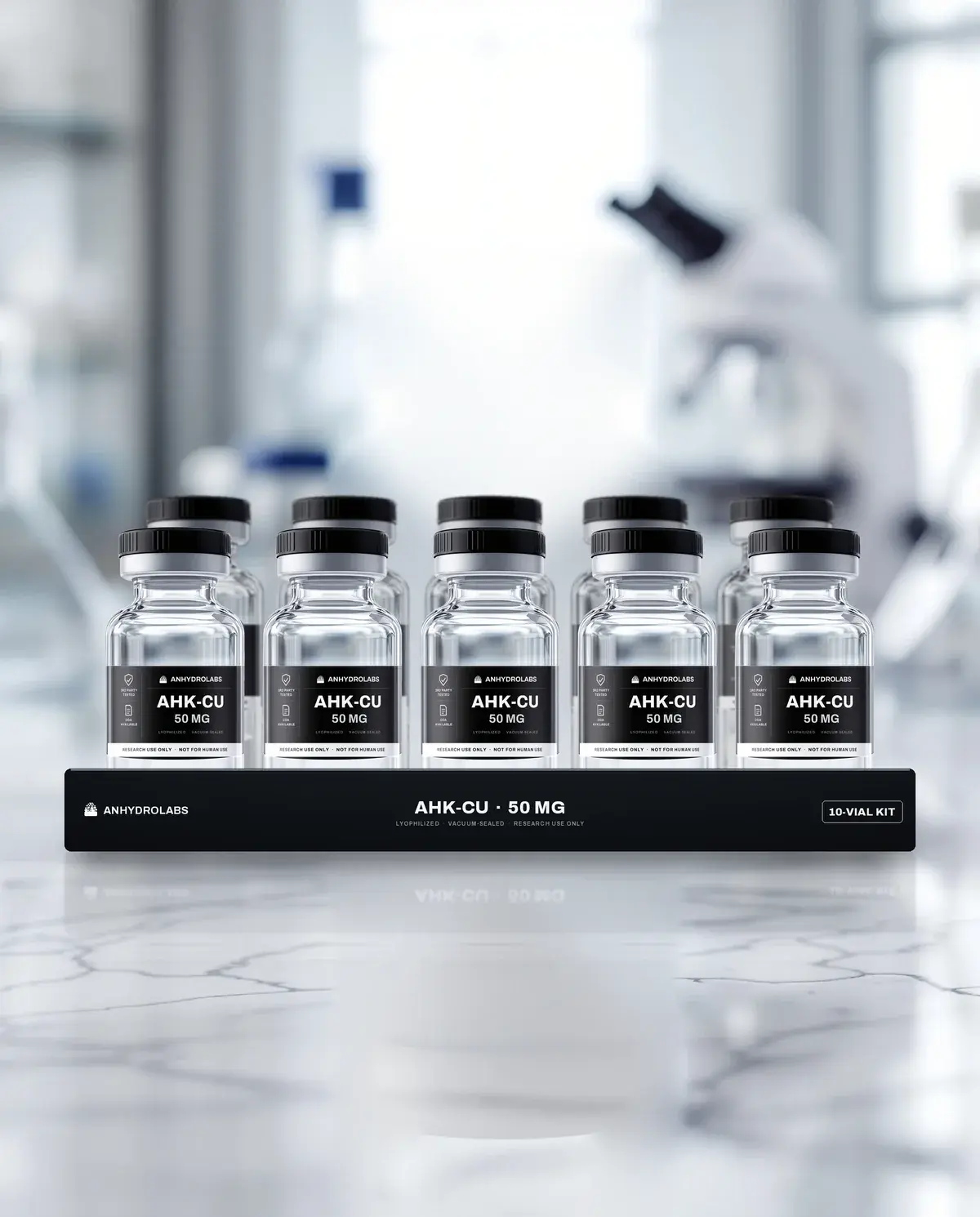
 ×10 · 10-vial kit
AHK-Cu
Lyophilized, vacuum-sealed, 10-vial kit.
- Form
- Lyophilized powder
- Storage
- Frozen, in the dark
- Ships
- Kits by Dec 12, 2026
- Presale
- Ships within the US
- Pay by card or crypto
- All sales final
AHK-Cu is the copper(II) complex of the tripeptide L-alanyl-L-histidyl-L-lysine (Ala-His-Lys). It is a close analog of GHK-Cu, the copper complex of the plasma tripeptide Gly-His-Lys, and differs from it only in the first residue. Its published record is small: it is known chiefly from a 2007 study in cultured human dermal papilla cells and isolated hair follicles.
Supplied for laboratory research use only. Not for human or veterinary use, and not for diagnostic or therapeutic application.
About AHK-Cu
Structure of AHK-Cu
The peptide part is three L-amino acids, alanine, histidine and lysine, with a free amine at the N-terminus and a free acid at the C-terminus. PubChem lists it as L-alanyl-L-histidyl-L-lysine, formula C15H26N6O4, 354.41 g/mol, and records AHK and H-Ala-His-Lys-OH among its synonyms. In AHK-Cu a copper(II) ion is bound to that peptide. Compared with GHK, the first residue carries a methyl side chain where glycine has none. The PubChem record cited here covers the free peptide, not the copper complex, so the formula weight of a given lot depends on its copper content and salt form.
Where AHK-Cu comes from
AHK is an analog of an older peptide. Its parent, Gly-His-Lys, is described by Hureau and colleagues as a naturally occurring high-affinity copper(II) chelator found in blood plasma; replacing the glycine with alanine gives AHK. The copper complex entered the indexed literature through a 2007 paper in Archives of Pharmacal Research by Pyo and colleagues in Seoul, who wrote it as L-alanyl-L-histidyl-L-lysine-Cu2+ and abbreviated it AHK-Cu. A PubMed search for the term AHK-Cu in October 2026 returned that paper alone, so the compound has no documented history in the primary literature beyond it.
What AHK-Cu binds
No receptor or binding protein has been identified for AHK-Cu. What can be said at the molecular level concerns the metal site, and it comes from work on the parent peptide: in solution the copper(II) complex of GHK is a monomer in which three nitrogen atoms hold the metal, the N-terminal amine, an amide nitrogen and a histidine imidazole nitrogen, with a labile fourth position. AHK keeps the same N-terminal amine, first amide bond and histidine, so the same coordination is expected, but no structure of AHK-Cu itself appears in the sources cited here. In cells, the 2007 study measured the Bcl-2 to Bax ratio and the cleaved forms of caspase-3 and PARP.
AHK-Cu in the research literature
The one indexed study used two systems: human hair follicles kept in ex-vivo culture, and cultured human dermal papilla cells, a specialized fibroblast population. AHK-Cu was applied at picomolar to nanomolar concentrations. The readouts were follicle elongation, cell proliferation, apoptosis by annexin V and propidium iodide labeling with flow cytometry, and the apoptosis-related proteins Bcl-2, Bax, caspase-3 and PARP. A search of ClinicalTrials.gov in October 2026 returned no registered human studies of AHK-Cu. Statements about AHK-Cu that go beyond this single paper are generally extrapolated from GHK-Cu and should be read that way.
Regulatory status of AHK-Cu
AHK-Cu is not approved as a drug by the FDA, no approval by any other regulator appears in the sources cited here, and it has not entered a registered human trial. FDA's page on bulk drug substances that may present significant safety risks in compounding, current as of April 22, 2026, has no entry for AHK; the related GHK-Cu does appear there, among nominations that were withdrawn. That absence is not a finding about safety. It is supplied here as a reference reagent for in-vitro laboratory research only.
Handling AHK-Cu in the laboratory
AHK-Cu is supplied lyophilized in a vacuum-sealed vial. Keep the sealed vial frozen at -4 °F and protected from light, and let it reach room temperature before breaking the seal so that moisture does not condense on the powder. Once in solution, material keeps for about four weeks at 39 °F; divide it into single-use aliquots instead of freezing and thawing one tube repeatedly. Work on the parent complex showed that free glycine or histidine can occupy the fourth coordination position of the copper, and that reduction of the copper(II) center releases the metal ion, so buffer composition matters for copper peptides of this type.
Sources
- PubChem compound summary: L-Alanyl-L-histidyl-L-lysine, CID 7408502
- Pyo HK, et al. Archives of Pharmacal Research, 2007. PubMed 17703734
- X-ray and solution structures of Cu(II) GHK and Cu(II) DAHK complexes: influence on their redox properties (Hureau C, et al. Chemistry: A European Journal, 2011)
- Certain Bulk Drug Substances for Use in Compounding that May Present Significant Safety Risks
Research notes on AHK-Cu
- GHK-Cu Copper Peptide: Structure and ResearchCopper peptides explained through GHK-Cu: the Gly-His-Lys sequence, how it binds copper(II), its discovery in human plasma, identifiers and lab handling.
AHK-Cu: common questions
What is AHK-Cu supplied as?
AHK-Cu is supplied as a lyophilized (freeze-dried) powder in a vacuum-sealed vial, in 50 mg, for in-vitro laboratory research use only.
Is AHK-Cu available as a 10-vial kit?
Yes. AHK-Cu comes in a 10-vial kit: 50 mg for $153.00 ($15.30 per vial), presale prices. A kit is ten sealed vials of the same size, priced below ten single vials.
When do AHK-Cu presale kits ship?
By Dec 12, 2026. Presale kits are 10% off. If we cannot ship by Dec 12, 2026, we tell you before that date and you can cancel for a full refund.
How should AHK-Cu be stored?
Frozen at −4 °F and protected from light, from the day it arrives. Let the vial reach room temperature before breaking the seal; once reconstituted, stability holds for about four weeks refrigerated at 39 °F.
How fast does AHK-Cu ship?
Presale kits ship from the United States by Dec 12, 2026, to US addresses. Sizes marked in stock ship within 1 business day of payment.
Is AHK-Cu for human use?
No. It is supplied as a reference reagent for laboratory research use. Not for human or veterinary use, and not for diagnostic or therapeutic application.
What is the sequence of AHK-Cu?
The peptide is Ala-His-Lys, three L-amino acids with a free N-terminal amine and a free C-terminal acid, bound to one copper(II) ion. PubChem lists the free peptide as L-alanyl-L-histidyl-L-lysine with the formula C15H26N6O4 and a molecular weight of 354.41 g/mol.
How is AHK-Cu different from GHK-Cu?
The two peptides differ at the first residue: alanine in AHK, glycine in GHK. Histidine and lysine are shared, so the same copper-binding atoms are present. GHK is a natural plasma peptide whose copper complex has published X-ray and solution structures, while AHK-Cu is known mainly from one 2007 cell and hair follicle culture study.
Is AHK-Cu approved by the FDA?
No. AHK-Cu is not an approved drug, and no registered human trial of it was found on ClinicalTrials.gov in October 2026. It also has no entry on the FDA page listing bulk drug substances nominated for compounding that raise safety concerns, where the related GHK-Cu appears among withdrawn nominations.
$153.00
AHK-Cu · 50 mg · 10-vial kit