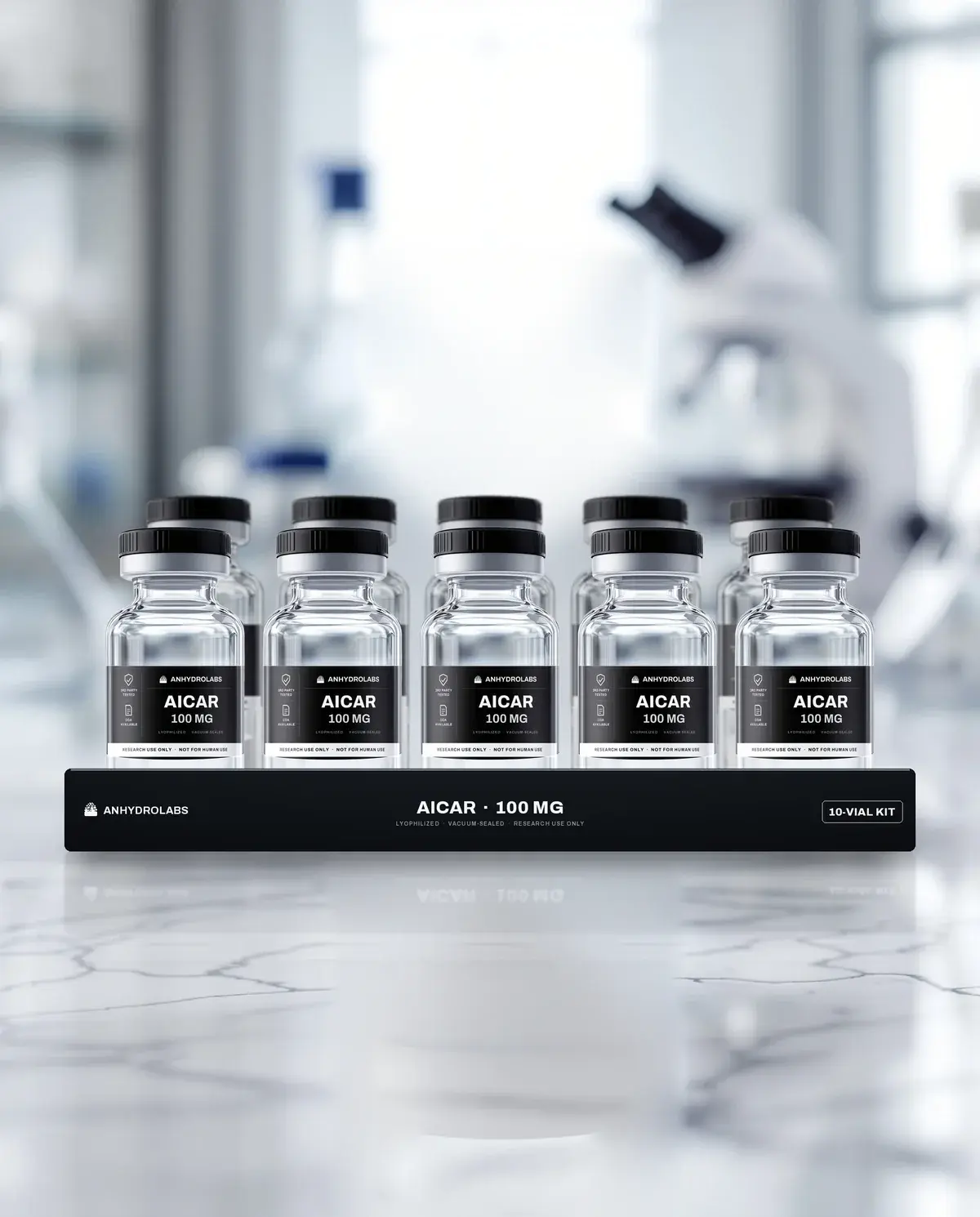
 ×10 · 10-vial kit
AICAR
Also known as acadesine. Lyophilized, vacuum-sealed, 10-vial kit.
- CAS
- 2627-69-2
- Form
- Lyophilized powder
- Storage
- Frozen, in the dark
- Ships
- Kits by Dec 12, 2026
- Presale
- Ships within the US
- Pay by card or crypto
- All sales final
AICAR is a nucleoside, not a peptide: 5-aminoimidazole-4-carboxamide ribonucleoside, also called acadesine. Inside cells it is phosphorylated to the monophosphate ZMP, which mimics AMP and activates AMP-activated protein kinase (AMPK). Since a 1995 paper from the Hardie laboratory in Dundee it has been one of the most widely used laboratory activators of AMPK, though later work documents AMPK-independent effects as well.
Supplied for laboratory research use only. Not for human or veterinary use, and not for diagnostic or therapeutic application.
AICAR: compound data
- Molecular formula
- C9H14N4O5
- Molecular weight
- 258.23 g/mol
- CAS number
- 2627-69-2
- PubChem
- CID 17513
- Form supplied
- Lyophilized powder, vacuum-sealed
- Concentration
- mg/mL and molarity calculator
Reference values from PubChem, the chemistry database of the US National Library of Medicine, for the compound as registered there.
About AICAR
Structure of AICAR
AICAR is a ribose sugar joined to an aminoimidazole carboxamide base. PubChem titles its record Acadesine and lists AICA riboside among the synonyms; its computed XLogP of -2.2 marks the molecule as strongly hydrophilic. The abbreviation is used for two different molecules. One is the nucleoside, which is the reagent in the vial. The other is its monophosphate, also written ZMP, which forms inside cells and is a normal intermediate of de novo purine synthesis. The 2021 review by Višnjić and colleagues writes AICAr for the nucleoside and AICAR for the phosphorylated form to keep the two apart.
Where AICAR comes from
Because its monophosphate is a normal intermediate of purine synthesis, the molecule belongs to purine biochemistry as well as to signaling research. According to the Višnjić review, animal studies in the 1980s examined acadesine in the ischemic heart, and human studies followed in the 1990s. Its present role dates from 1995, when Corton, Gillespie, Hawley and Hardie at the University of Dundee reported in the European Journal of Biochemistry that it activated AMPK in intact cells. PubChem lists acadesine, AICA riboside, Arasine, Protara and the code GP-1-110 among its names.
What AICAR binds
AICAR enters cells through adenosine transporters and is phosphorylated by adenosine kinase to ZMP. ZMP binds the gamma subunit of AMPK, activates the enzyme allosterically and promotes its phosphorylation at threonine 172; the Višnjić review puts it at 40 to 50 times less potent than AMP. Corton and colleagues found that in rat hepatocytes ZMP reproduced both activating effects of AMP without changing cellular ATP, ADP or AMP content, and that 3-hydroxy-3-methylglutaryl coenzyme A reductase, a known AMPK target, became phosphorylated and inactivated. ZMP is also a substrate of the purine pathway enzyme AICAR transformylase, one reason some effects of AICAR do not depend on AMPK.
AICAR in the research literature
AICAR has been used in isolated rat hepatocytes and adipocytes, in skeletal muscle, in cultured lines including glioma and leukemia cells, and in rodent models. The 2021 systematic review catalogs AMPK-dependent and AMPK-independent findings across metabolism, hypoxia, exercise, nucleotide synthesis and cancer, and advises caution in reading studies that rely on AICAR alone. In people, acadesine has been studied in Phase 1 through Phase 3 trials around coronary artery bypass surgery and in a Phase 1/2 study in chronic lymphocytic leukemia. The largest, the Phase 3 RED-CABG trial (NCT00872001), enrolled 3,080 participants and was stopped early after a prespecified futility analysis.
Regulatory status of AICAR
Acadesine is not approved as a drug by the FDA, and no approval by another regulator appears in the sources cited here. Its history is that of an investigational compound: ClinicalTrials.gov lists three studies under the name, a completed Phase 1/2 study, a terminated Phase 1/2 study, and the terminated Phase 3 RED-CABG trial sponsored by Merck Sharp and Dohme, which was published in JAMA in 2012. It is supplied here as a reference reagent for in-vitro laboratory research only.
Handling AICAR in the laboratory
AICAR is supplied lyophilized in a vacuum-sealed vial. Keep the sealed vial frozen at -4 °F and protected from light, and let it reach room temperature before breaking the seal so that moisture does not condense on the powder. Once in solution, material keeps for about four weeks at 39 °F; divide it into single-use aliquots instead of freezing and thawing one tube repeatedly. PubChem's computed XLogP of -2.2 marks the nucleoside as strongly hydrophilic, which is consistent with preparing stock solutions in water or an aqueous buffer.
Sources
- PubChem compound summary: Acadesine (AICAR), CID 17513
- 5-aminoimidazole-4-carboxamide ribonucleoside. A specific method for activating AMP-activated protein kinase in intact cells? (Corton JM, et al. European Journal of Biochemistry, 1995)
- AICAr, a Widely Used AMPK Activator with Important AMPK-Independent Effects: A Systematic Review (Višnjić D, et al. Cells, 2021)
- Effect of adenosine-regulating agent acadesine on morbidity and mortality associated with coronary artery bypass grafting: the RED-CABG randomized controlled trial (Newman MF, et al. JAMA, 2012)
- ClinicalTrials.gov NCT00872001: The Effect Of Acadesine On Reducing Cardiovascular and Cerebrovascular Adverse Events In Coronary Artery Bypass Graft (CABG) Surgery
AICAR: common questions
Is acadesine the same as AICAR?
Yes. acadesine is another name for AICAR (CAS 2627-69-2). It is the same compound, supplied here as a lyophilized powder for in-vitro laboratory research use only.
What is AICAR supplied as?
AICAR is supplied as a lyophilized (freeze-dried) powder in a vacuum-sealed vial, in 100 mg, for in-vitro laboratory research use only.
Is AICAR available as a 10-vial kit?
Yes. AICAR comes in a 10-vial kit: 100 mg for $256.50 ($25.65 per vial), presale prices. A kit is ten sealed vials of the same size, priced below ten single vials.
When do AICAR presale kits ship?
By Dec 12, 2026. Presale kits are 10% off. If we cannot ship by Dec 12, 2026, we tell you before that date and you can cancel for a full refund.
What is the CAS number of AICAR?
The CAS registry number of AICAR is 2627-69-2.
How should AICAR be stored?
Frozen at −4 °F and protected from light, from the day it arrives. Let the vial reach room temperature before breaking the seal; once reconstituted, stability holds for about four weeks refrigerated at 39 °F.
How fast does AICAR ship?
Presale kits ship from the United States by Dec 12, 2026, to US addresses. Sizes marked in stock ship within 1 business day of payment.
Is AICAR for human use?
No. It is supplied as a reference reagent for laboratory research use. Not for human or veterinary use, and not for diagnostic or therapeutic application.
Is AICAR a peptide?
No. AICAR is a nucleoside, a ribose sugar joined to an aminoimidazole carboxamide base, with no amino acids and no peptide bonds. It is also called acadesine, and inside cells it is converted to the monophosphate ZMP.
How does AICAR activate AMPK?
Cells take AICAR up through adenosine transporters and adenosine kinase phosphorylates it to ZMP. ZMP binds the gamma subunit of AMPK and mimics AMP, activating the enzyme allosterically and promoting its phosphorylation. Corton and colleagues reported in 1995 that this happens without a change in cellular ATP, ADP or AMP content.
Are all effects of AICAR due to AMPK?
No. A 2021 systematic review in the journal Cells found that numerous effects once attributed to AMPK activation are AMPK-independent, in areas including metabolism, hypoxia, nucleotide synthesis and cancer models. ZMP is itself an intermediate of purine synthesis, and the review advises caution in interpreting studies that rely on AICAR alone.
$256.50
AICAR · 100 mg · 10-vial kit