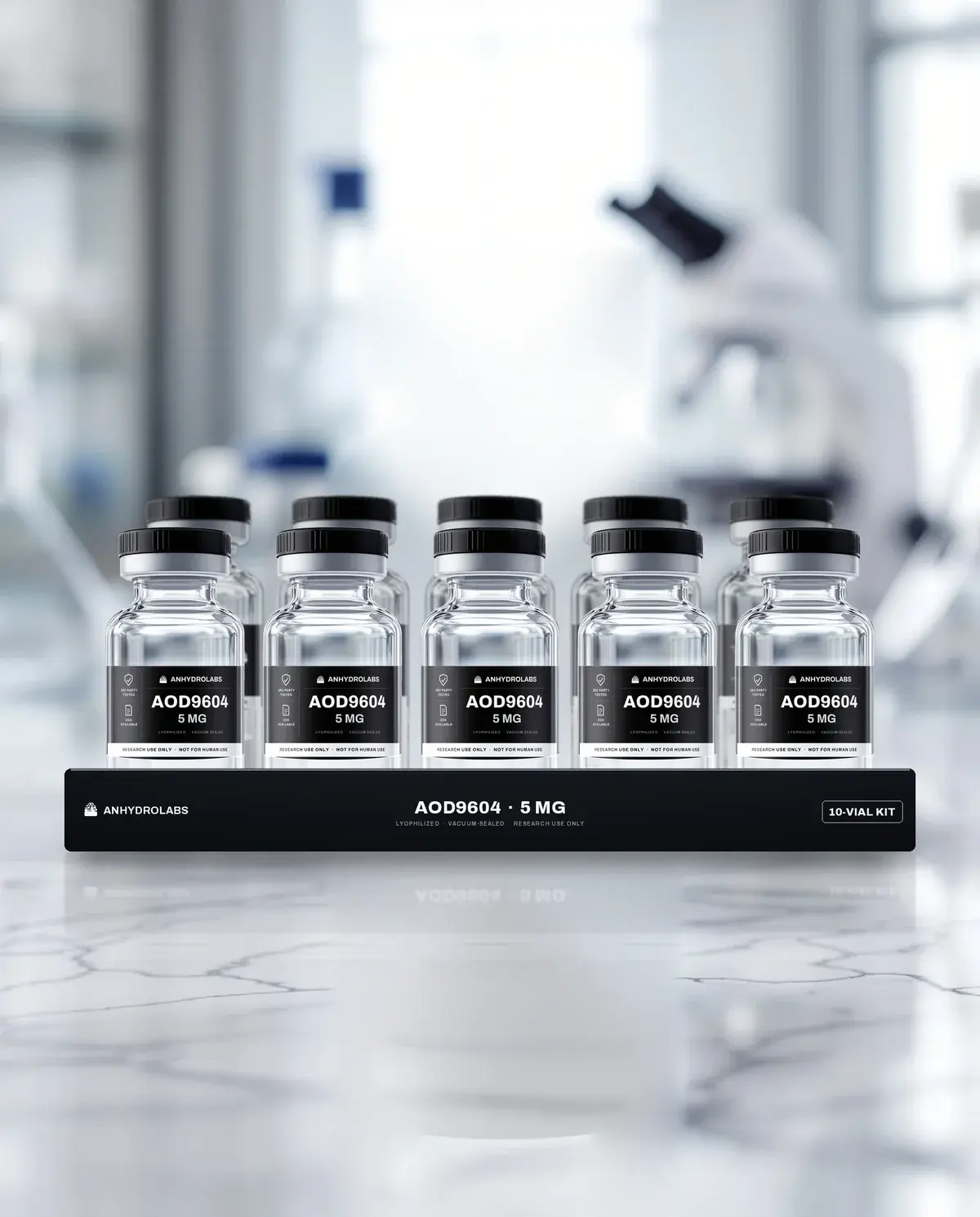
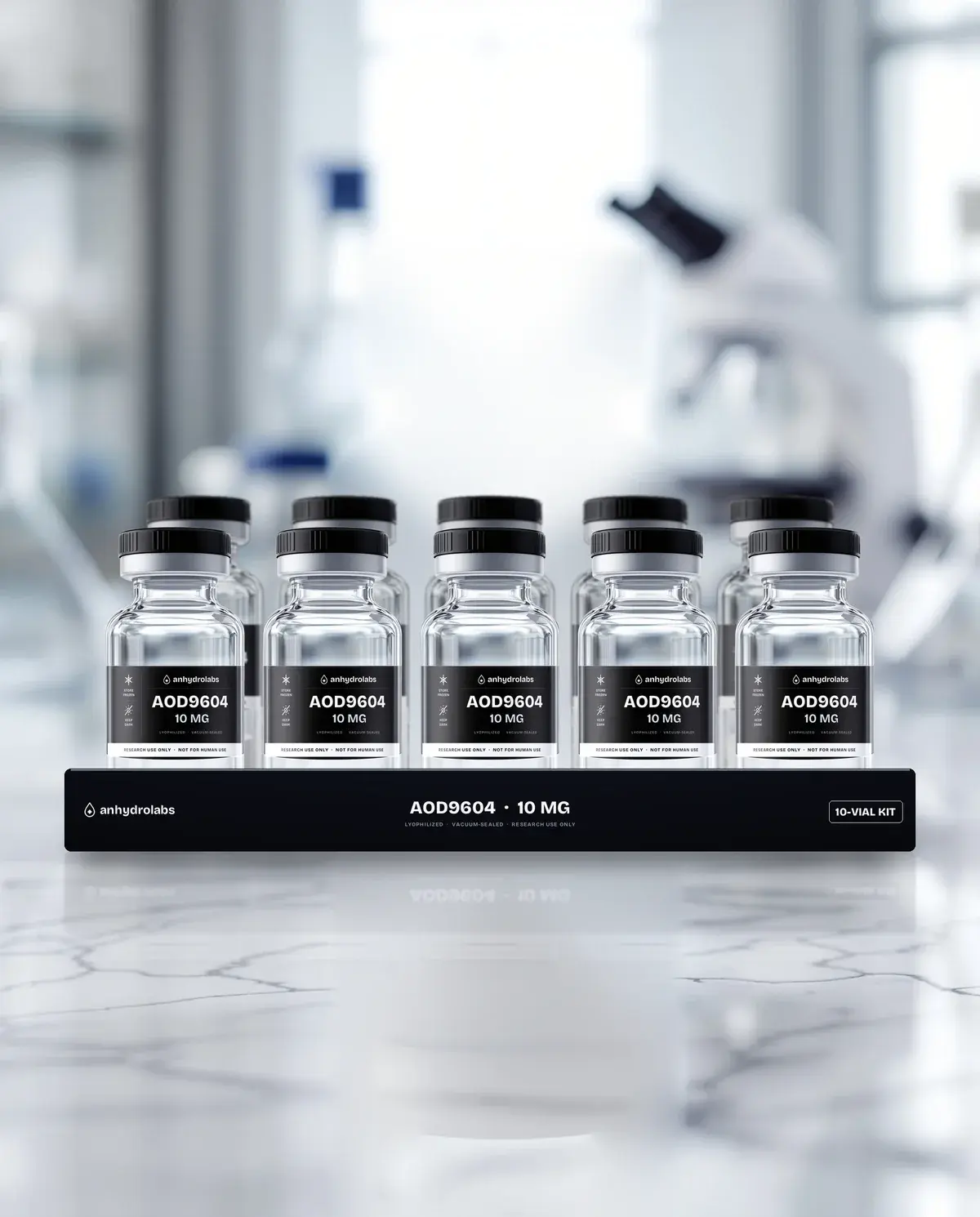
AOD9604
Lyophilized, vacuum-sealed, 10-vial kit.
- CAS
- 221231-10-3
- Form
- Lyophilized powder
- Storage
- Frozen, in the dark
- Ships
- Kits by Dec 12, 2026
- Presale
- Ships within the US
- Pay by card or crypto
- All sales final
AOD9604 is a synthetic 16-residue peptide with one disulfide bond, modeled on the C-terminal end of human growth hormone (hGH). Its sequence is residues 177 to 191 of the hormone with a tyrosine added at the N-terminus. It was described by a Monash University group around 2000 as an analog of the hormone's lipolytic domain, and it is not approved as a drug.
Supplied for laboratory research use only. Not for human or veterinary use, and not for diagnostic or therapeutic application.
AOD9604: compound data
- Molecular formula
- C78H123N23O23S2
- Molecular weight
- 1,815.1 g/mol
- CAS number
- 221231-10-3
- PubChem
- CID 71300630
- Form supplied
- Lyophilized powder, vacuum-sealed
- Concentration
- mg/mL and molarity calculator
Reference values from PubChem, the chemistry database of the US National Library of Medicine, for the compound as registered there.
About AOD9604
Structure of AOD9604
The sequence is Tyr-Leu-Arg-Ile-Val-Gln-Cys-Arg-Ser-Val-Glu-Gly-Ser-Cys-Gly-Phe, or YLRIVQCRSVEGSCGF. The two cysteines, at positions 7 and 14, are joined by a disulfide bond that closes a ring; they correspond to the C-terminal disulfide of growth hormone, which UniProt annotates at positions 208 and 215 of the 217-residue precursor, or 182 and 189 of the mature 191-residue chain. The native C-terminal fragment, hGH 176-191, begins with phenylalanine where AOD9604 has tyrosine, so the two peptides differ by a single hydroxyl group at residue 1. PubChem lists an acetate salt among the synonyms.
Where AOD9604 comes from
AOD9604 came from the Department of Biochemistry and Molecular Biology at Monash University in Australia, where the group of F. M. Ng studied the C-terminal region of hGH as the part of the hormone responsible for its lipolytic action. Their 2000 paper in Hormone Research calls it a synthetic analogue of the lipolytic domain of human growth hormone, and a 2001 paper in Endocrinology calls it a lipolytic fragment synthesized from the C-terminus. PubChem lists the spellings AOD 9604, AOD9604 and AOD-9604, along with a descriptive synonym that gives the residue range as 177-191 with an added tyrosine.
What AOD9604 binds
No receptor for AOD9604 has been identified in the sources cited here. Heffernan and colleagues examined the beta-3 adrenergic receptor, which they describe as the main receptor driving lipolysis in adipocytes. Both hGH and AOD9604 raised beta-3 receptor RNA in mice, and the long-term changes seen in wild-type mice were absent in mice lacking the receptor. In a short-term experiment, however, the knockout animals still showed a response to the fragment. The authors concluded that the lipolytic action is not mediated directly through the beta-3 receptor, although both compounds raise its expression. What the peptide binds first remains unknown.
AOD9604 in the research literature
The primary literature cited here is rodent work from one program. Ng and colleagues used Zucker rats, measuring lipolytic activity in adipose tissue taken from the animals and insulin sensitivity by the euglycemic clamp technique. Heffernan and colleagues used mice, including beta-3 adrenergic receptor knockout mice, with wild-type controls, measuring receptor RNA levels and lipolysis. A search of ClinicalTrials.gov in October 2026 under AOD9604 and AOD-9604 returned no registered studies. FDA states that it has identified no, or only limited, safety-related information for the substance.
Regulatory status of AOD9604
AOD9604 is not an FDA-approved drug. FDA's page on bulk drug substances that may present significant safety risks in compounding, current as of April 22, 2026, lists AOD-9604 among substances whose nominations were withdrawn. The agency's stated concerns are a possible risk of immunogenicity, complexities in peptide-related impurities and in characterizing the active ingredient, and a lack of safety-related information; it also notes serious adverse events that may be associated with the substance, with causality unclear. It is supplied here as a reference reagent for in-vitro laboratory research only.
Handling AOD9604 in the laboratory
AOD9604 is supplied lyophilized in a vacuum-sealed vial. Keep the sealed vial frozen at -4 °F and protected from light, and let it reach room temperature before breaking the seal so that moisture does not condense on the powder. Once in solution, material keeps for about four weeks at 39 °F; divide it into single-use aliquots instead of freezing and thawing one tube repeatedly. The sequence contains one disulfide bond between its two cysteines, and PubChem's computed XLogP of -4.8 marks the peptide as hydrophilic.
Sources
- PubChem compound summary: AOD-9604, CID 71300630
- Metabolic studies of a synthetic lipolytic domain (AOD9604) of human growth hormone (Ng FM, et al. Hormone Research, 2000)
- Heffernan M, et al. Endocrinology, 2001. PubMed 11713213
- UniProt P01241: Somatotropin (human growth hormone)
- Certain Bulk Drug Substances for Use in Compounding that May Present Significant Safety Risks
Research notes on AOD9604
- AOD9604: The hGH Fragment 176-191 AnalogThe AOD 9604 peptide explained: a synthetic 16-residue fragment of human growth hormone (hGH), its disulfide ring, the fat metabolism studies and status.
AOD9604: common questions
What is AOD9604 supplied as?
AOD9604 is supplied as a lyophilized (freeze-dried) powder in a vacuum-sealed vial, in 5 mg and 10 mg, for in-vitro laboratory research use only.
Is AOD9604 available as a 10-vial kit?
Yes. AOD9604 comes in a 10-vial kit: 5 mg for $202.50 ($20.25 per vial); 10 mg for $351.00 ($35.10 per vial), presale prices. A kit is ten sealed vials of the same size, priced below ten single vials.
When do AOD9604 presale kits ship?
By Dec 12, 2026. Presale kits are 10% off. If we cannot ship by Dec 12, 2026, we tell you before that date and you can cancel for a full refund.
What is the CAS number of AOD9604?
The CAS registry number of AOD9604 is 221231-10-3.
How should AOD9604 be stored?
Frozen at −4 °F and protected from light, from the day it arrives. Let the vial reach room temperature before breaking the seal; once reconstituted, stability holds for about four weeks refrigerated at 39 °F.
How fast does AOD9604 ship?
Presale kits ship from the United States by Dec 12, 2026, to US addresses. Sizes marked in stock ship within 1 business day of payment.
Is AOD9604 for human use?
No. It is supplied as a reference reagent for laboratory research use. Not for human or veterinary use, and not for diagnostic or therapeutic application.
What is the sequence of AOD9604?
AOD9604 is Tyr-Leu-Arg-Ile-Val-Gln-Cys-Arg-Ser-Val-Glu-Gly-Ser-Cys-Gly-Phe, written YLRIVQCRSVEGSCGF in one-letter code. It has 16 residues, and a disulfide bond between the cysteines at positions 7 and 14 closes a ring within the chain.
How is AOD9604 different from hGH fragment 176-191?
They differ at the first residue. The native fragment of human growth hormone begins with phenylalanine at position 176, giving FLRIVQCRSVEGSCGF, while AOD9604 begins with tyrosine, giving YLRIVQCRSVEGSCGF. The remaining fifteen residues and the disulfide bond are identical.
What receptor does AOD9604 bind?
None has been identified in the sources cited here. A 2001 study in mice lacking the beta-3 adrenergic receptor concluded that the lipolytic action of hGH and of AOD9604 is not mediated directly through that receptor, although both raised its RNA levels. The first binding event remains unknown.
$202.50
AOD9604 · 5 mg · 10-vial kit