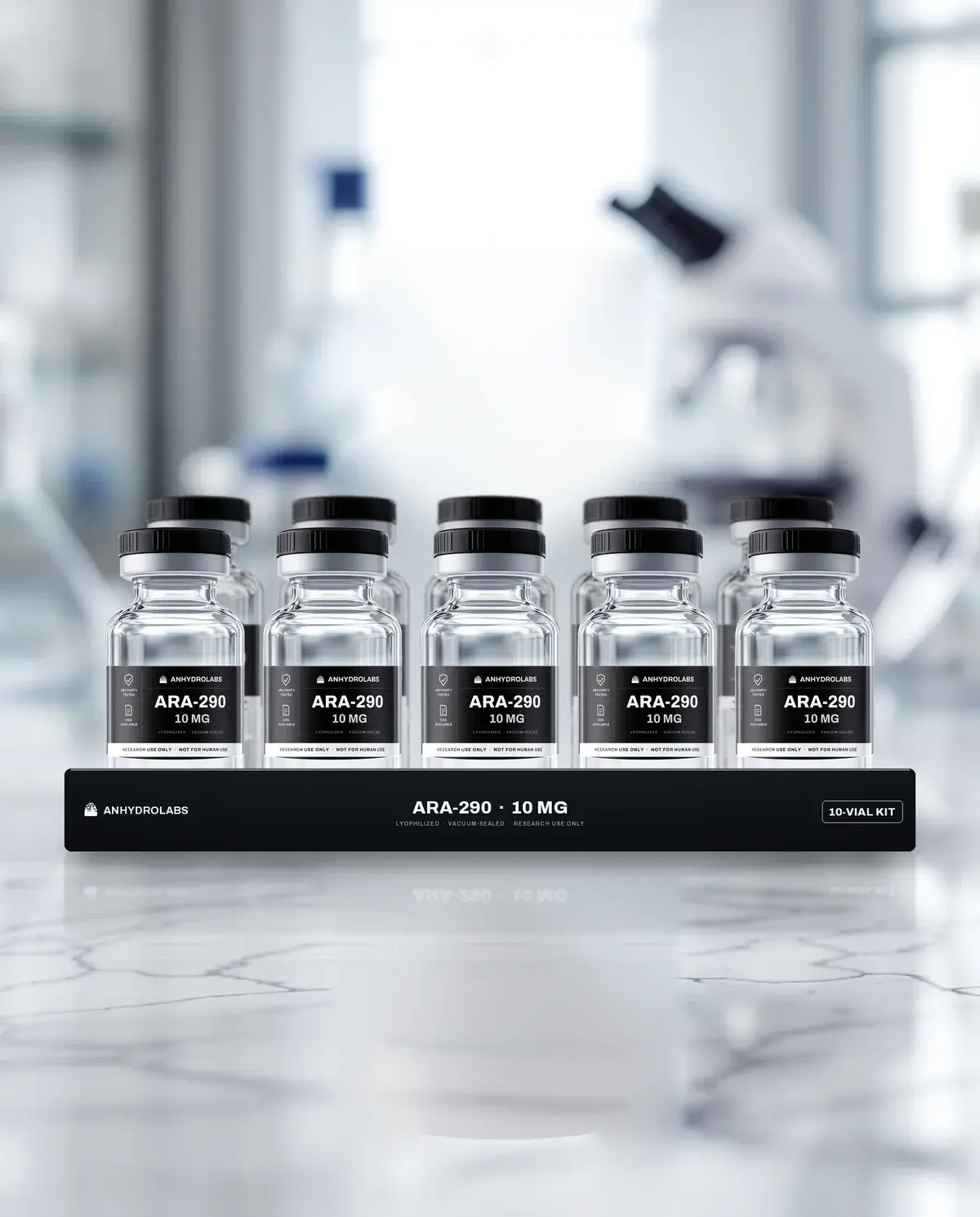
 ×10 · 10-vial kit
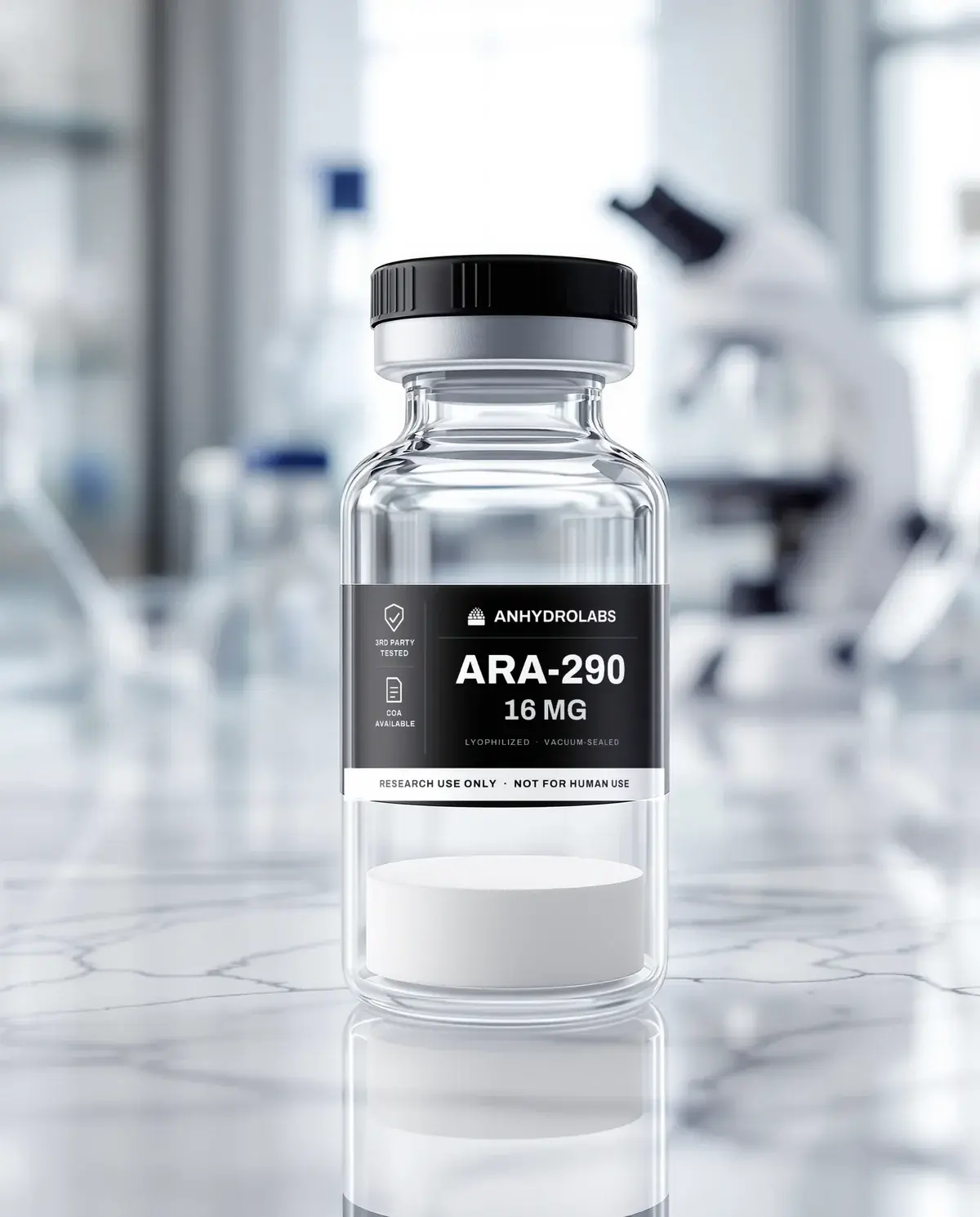
ARA-290
Also known as cibinetide. Lyophilized, vacuum-sealed, 10-vial kit.
- CAS
- 1208243-50-8
- Form
- Lyophilized powder
- Storage
- Frozen, in the dark
- Ships
- Kits by Dec 12, 2026
- Presale
- Ships within the US
- Pay by card or crypto
- All sales final
ARA-290 is a synthetic 11-residue peptide, also called cibinetide, designed to copy the water-facing surface of helix B of erythropoietin (EPO). It was described in 2008 by Brines, Cerami and colleagues as a peptide that keeps the tissue-protective signaling attributed to EPO in laboratory models without stimulating red cell production. It is investigational: human studies reached Phase 2, and no regulator has approved it.
Supplied for laboratory research use only. Not for human or veterinary use, and not for diagnostic or therapeutic application.
ARA-290: compound data
- Molecular formula
- C51H84N16O21
- Molecular weight
- 1,257.3 g/mol
- CAS number
- 1208243-50-8
- PubChem
- CID 91810664
- Form supplied
- Lyophilized powder, vacuum-sealed
- Concentration
- mg/mL and molarity calculator
Reference values from PubChem, the chemistry database of the US National Library of Medicine, for the compound as registered there.
About ARA-290
Structure of ARA-290
The sequence is pGlu-Glu-Gln-Leu-Glu-Arg-Ala-Leu-Asn-Ser-Ser, where pGlu is pyroglutamate formed by cyclization of an N-terminal glutamine; in one-letter code the uncyclized form is QEQLERALNSS. The peptide is linear, has a free C-terminal acid and contains no cysteine. Its residues are not a contiguous stretch of EPO: eight come from the aqueous face of helix B and three from the adjacent BC loop, so they are neighbors in the folded protein but not along the chain. Mature EPO, by contrast, is a 166-residue hormone with two disulfide bonds, which makes ARA-290 a small surface mimic and not a cleavage fragment.
Where ARA-290 comes from
The design was published in PNAS in 2008 by Brines, Cerami and colleagues, with collaborators in Milan, London, Turkey and Lisbon. Working from the crystal structure of EPO bound to its receptor, they identified helix B, residues 58 to 82, as facing the surrounding water, and built an 11-residue helix B surface peptide, HBSP, from it. Because the N-terminal glutamine of that peptide cyclized spontaneously, they synthesized the pure pyroglutamate form and called it pHBSP. PubChem lists cibinetide, ARA 290, ARA-290 and pHBSP as names for the same molecule. Later human studies were sponsored by Araim and by academic centers.
What ARA-290 binds
Brines and colleagues describe two receptors for EPO: the EPO receptor homodimer, which mediates red cell production, and a heterocomplex of the EPO receptor with CD131, the beta common receptor, which they link to tissue protection. UniProt describes CD131 as the subunit that pairs with the interleukin-3, interleukin-5 and GM-CSF receptor alpha chains. ARA-290 was designed to engage the heterocomplex and not the homodimer. In the 2008 assays neither helix B nor the 11-residue peptide was erythropoietic, in UT-7 EPO cells or in the rat. No structure of the peptide bound to the receptor complex is given in the sources cited here.
ARA-290 in the research literature
The 2008 paper used a rat motoneuron excitotoxicity assay in vitro and several rodent models of tissue injury, among them sciatic nerve crush and renal ischemia-reperfusion, and reported a plasma half-life of about 2 minutes in the rat and rabbit. ClinicalTrials.gov lists four interventional studies: a completed Phase 2 study with 64 participants (NCT02039687), a second Phase 2 study, a completed Phase 1/2 study in volunteers, and a terminated Phase 2 study. The completed Phase 2 study, published in 2017, took change in corneal nerve fiber area, measured by microscopy, as its primary endpoint.
Regulatory status of ARA-290
ARA-290 is not approved by the FDA, and no approval by any other regulator appears in the sources cited here. It is an investigational peptide whose registered human studies are Phase 1/2 and Phase 2; no Phase 3 study was listed on ClinicalTrials.gov in October 2026. Cibinetide is the name used for it in PubChem and in the published Phase 2b report. It is supplied here as a reference reagent for in-vitro laboratory research only.
Handling ARA-290 in the laboratory
ARA-290 is supplied lyophilized in a vacuum-sealed vial. Keep the sealed vial frozen at -4 °F and protected from light, and let it reach room temperature before breaking the seal so that moisture does not condense on the powder. Once in solution, material keeps for about four weeks at 39 °F; divide it into single-use aliquots instead of freezing and thawing one tube repeatedly. Brines and colleagues note that an N-terminal glutamine cyclizes spontaneously and irreversibly to pyroglutamate, particularly at room temperature under acidic conditions; in ARA-290 that position is already cyclized.
Sources
- PubChem compound summary: Cibinetide, CID 91810664
- Nonerythropoietic, tissue-protective peptides derived from the tertiary structure of erythropoietin (Brines M, et al. PNAS, 2008)
- Culver DA, et al. Investigative Ophthalmology and Visual Science, 2017. PubMed 28475703
- ClinicalTrials.gov NCT02039687
- UniProt P01588: Erythropoietin (human)
- UniProt P32927: Cytokine receptor common subunit beta (CD131)
Research notes on ARA-290
- ARA-290 (Cibinetide): An EPO-Derived PeptideARA-290 (cibinetide) explained: the 11-residue helix B surface peptide from erythropoietin, the EPOR/CD131 heteroreceptor, research models and status.
ARA-290: common questions
Is cibinetide the same as ARA-290?
Yes. cibinetide is another name for ARA-290 (CAS 1208243-50-8). It is the same compound, supplied here as a lyophilized powder for in-vitro laboratory research use only.
What is ARA-290 supplied as?
ARA-290 is supplied as a lyophilized (freeze-dried) powder in a vacuum-sealed vial, in 10 mg and 16 mg, for in-vitro laboratory research use only.
Is ARA-290 available as a 10-vial kit?
Yes. ARA-290 comes in a 10-vial kit: 10 mg for $288.00 ($28.80 per vial), presale prices. A kit is ten sealed vials of the same size, priced below ten single vials.
When do ARA-290 presale kits ship?
By Dec 12, 2026. Presale kits are 10% off. If we cannot ship by Dec 12, 2026, we tell you before that date and you can cancel for a full refund.
What is the CAS number of ARA-290?
The CAS registry number of ARA-290 is 1208243-50-8.
How should ARA-290 be stored?
Frozen at −4 °F and protected from light, from the day it arrives. Let the vial reach room temperature before breaking the seal; once reconstituted, stability holds for about four weeks refrigerated at 39 °F.
How fast does ARA-290 ship?
Presale kits ship from the United States by Dec 12, 2026, to US addresses. Sizes marked in stock ship within 1 business day of payment.
Is ARA-290 for human use?
No. It is supplied as a reference reagent for laboratory research use. Not for human or veterinary use, and not for diagnostic or therapeutic application.
What is the sequence of ARA-290?
ARA-290 is pGlu-Glu-Gln-Leu-Glu-Arg-Ala-Leu-Asn-Ser-Ser, an 11-residue linear peptide with pyroglutamate at the N-terminus and a free acid at the C-terminus. Before cyclization of the first residue the sequence reads QEQLERALNSS in one-letter code.
What receptor does ARA-290 bind?
It was designed to engage a heterocomplex of the EPO receptor and CD131, the beta common receptor, which its developers associate with tissue protection. The EPO receptor homodimer mediates red cell production, and in the 2008 characterization the peptide was not erythropoietic in UT-7 EPO cells or in the rat.
Is ARA-290 a fragment of erythropoietin?
Not in the literal sense. Its residues were chosen from the water-facing side of helix B and from the adjacent BC loop, and the developers describe them as spatially but not linearly adjacent. The peptide therefore imitates a surface of the folded hormone and does not match a continuous stretch of the EPO chain.
$288.00
ARA-290 · 10 mg · 10-vial kit