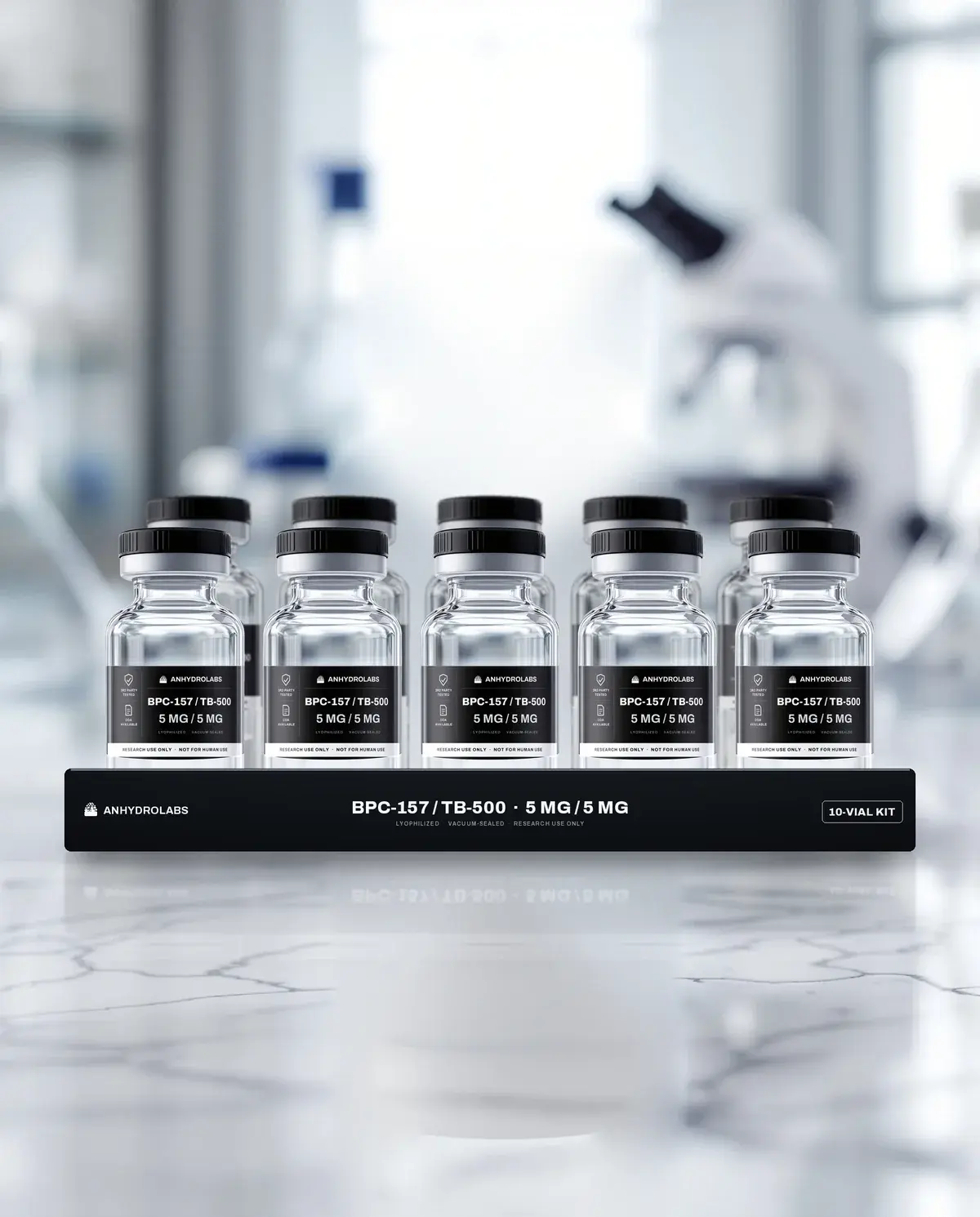
 ×10 · 10-vial kit
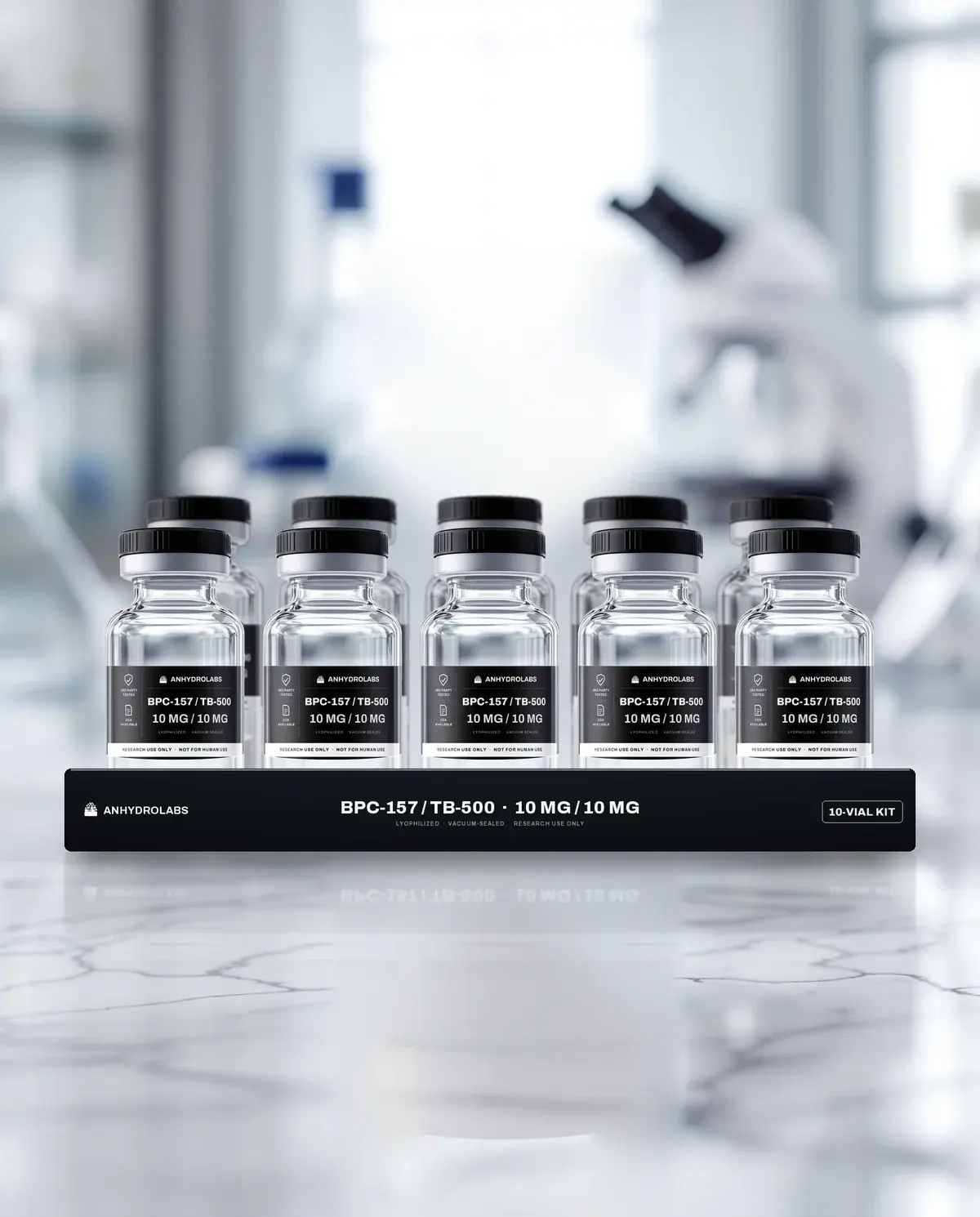
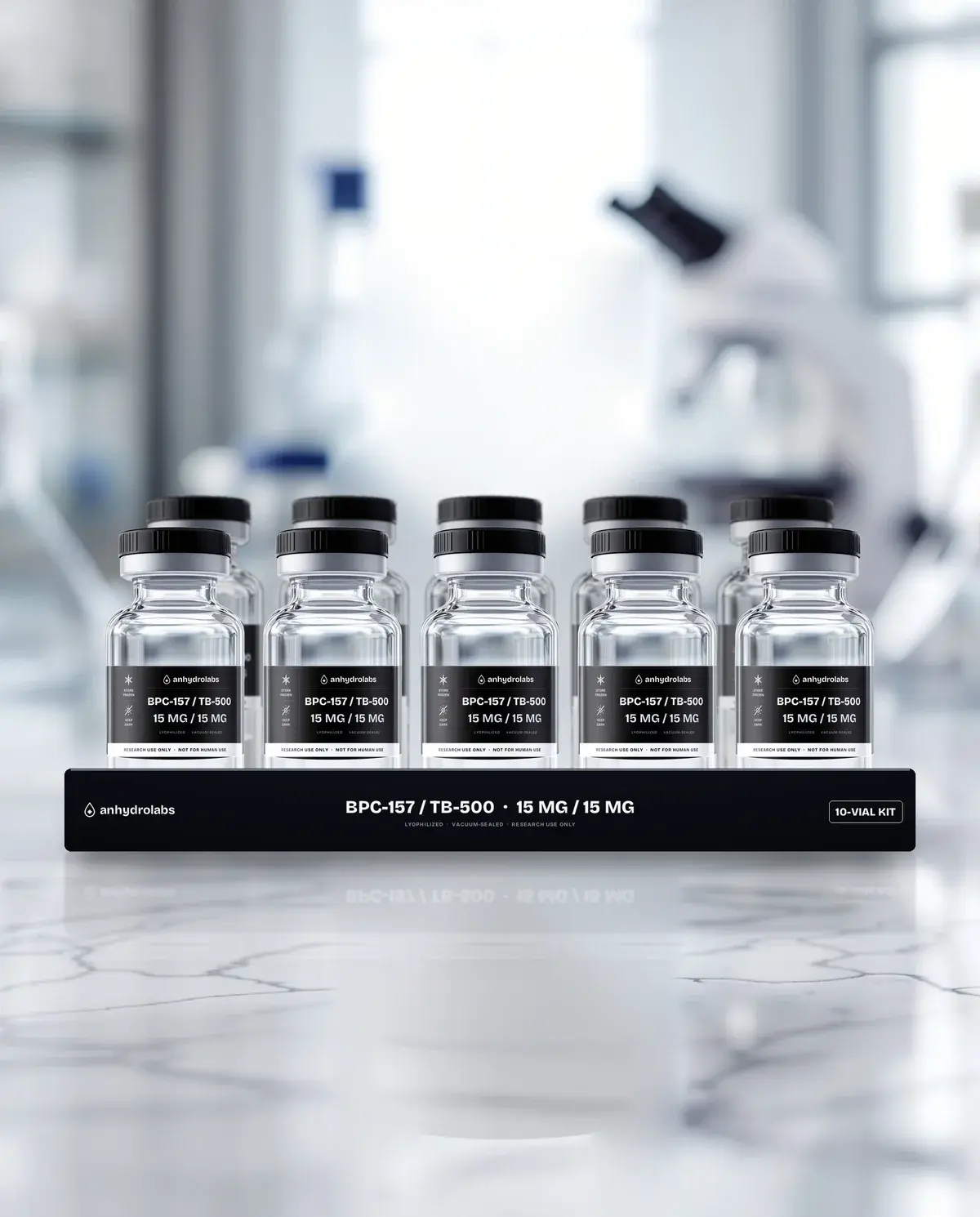
BPC-157 / TB-500
Lyophilized, vacuum-sealed, 10-vial kit.
- Form
- Lyophilized powder
- Storage
- Frozen, in the dark
- Ships
- Kits by Dec 12, 2026
- Presale
- Ships within the US
- Pay by card or crypto
- All sales final
BPC-157 / TB-500 is a blend of two unrelated peptides lyophilized together in one vial: BPC-157, a 15-residue peptide first described from human gastric juice, and TB-500, the N-acetylated seven-residue fragment Ac-LKKTETQ of thymosin beta-4. Each component has its own literature. The combination has almost none: a single 2026 rat study with a combined arm was found, and nothing else on the blend as such.
Supplied for laboratory research use only. Not for human or veterinary use, and not for diagnostic or therapeutic application.
About BPC-157 / TB-500
Structure of BPC-157 / TB-500
BPC-157 is Gly-Glu-Pro-Pro-Pro-Gly-Lys-Pro-Ala-Asp-Asp-Ala-Gly-Leu-Val, a linear pentadecapeptide with free termini, listed by PubChem at C62H98N16O22 and 1419.5 g/mol. TB-500 is Ac-Leu-Lys-Lys-Thr-Glu-Thr-Gln-OH, a heptapeptide with an acetylated N-terminus, listed at C38H68N10O14 and 889.0 g/mol. The two share no sequence, and neither contains cysteine, so no disulfide bonds can form within or between them. Because TB-500 is the lighter molecule, equal masses are not equal molar amounts: a vial holding the same mass of each contains about 1.6 molecules of TB-500 for every molecule of BPC-157.
Where BPC-157 / TB-500 comes from
The two components have separate histories. BPC-157 is described in the literature as a pentadecapeptide isolated from human gastric juice and named body protection compound; a 2025 review notes that its sequence shows no homology with known intestinal peptides. TB-500 takes its sequence from thymosin beta-4, a 43-residue peptide regarded as the main G-actin sequestering peptide of mammalian cells: it is the N-acetylated form of that protein's seven-residue actin-binding motif, and FDA names it thymosin beta-4, fragment (LKKTETQ). No paper describing the origin of the combination was found.
What BPC-157 / TB-500 binds
The two peptides have different proposed mechanisms, and neither has a confirmed receptor. For BPC-157, a 2025 review lists the nitric oxide system, increased expression of the VEGFR-2 receptor, EGR-1 gene expression and dopamine and serotonin systems as proposed targets. For TB-500 the rationale is structural: its sequence is the actin-binding motif of thymosin beta-4. In the endothelial assays of Philp and colleagues that seven-residue motif showed near-identical activity to the full-length protein at about 50 nM, and peptides lacking any part of the motif were inactive. No published work in the sources cited here examines how the two interact at the molecular level.
BPC-157 / TB-500 in the research literature
Each component has mostly been studied on its own. BPC-157 work catalogued in the Józwiak review spans Sprague-Dawley and Wistar rats, mice, beagle dogs, Caco-2 cells and endothelial cell cultures. For the thymosin beta-4 motif, Philp and colleagues used migration assays with human umbilical vein endothelial cells and vessel sprouting from chick aortic arches. For the pair, a PubMed search in October 2026 found one primary study: an exploratory 2026 experiment in 32 Sprague-Dawley rats with an Achilles tendon transection model, which compared each peptide alone, the two together and a control group by histology and mechanical loading. No cell study and no human study of the blend was found.
Regulatory status of BPC-157 / TB-500
Neither component is an FDA-approved drug, and the blend is not an approved product. FDA's page on bulk drug substances that may present significant safety risks in compounding, current as of April 22, 2026, lists both BPC-157 and thymosin beta-4 fragment (LKKTETQ) among nominations that were withdrawn. For BPC-157 it records concerns about immunogenicity, peptide-related impurities and characterization; for the thymosin fragment it cites possible aggregation and impurities and says no human exposure data had been identified. The blend is supplied here as a reference reagent for in-vitro laboratory research only.
Handling BPC-157 / TB-500 in the laboratory
The BPC-157 / TB-500 blend is supplied lyophilized in a vacuum-sealed vial. Keep the sealed vial frozen at -4 °F and protected from light, and let it reach room temperature before breaking the seal so that moisture does not condense on the powder. Once in solution, material keeps for about four weeks at 39 °F; divide it into single-use aliquots instead of freezing and thawing one tube repeatedly. Both components are strongly hydrophilic by PubChem's computed XLogP, about -9 and -8.6, and their masses differ enough, 1419.5 against 889.0, for mass spectrometry to tell them apart in one sample.
Sources
- PubChem compound summary: BPC-157, CID 9941957
- PubChem compound summary: TB-500 (Ac-Leu-Lys-Lys-Thr-Glu-Thr-Gln-OH), CID 62707662
- Józwiak et al., 2025. PubMed Central PMC11859134
- The actin binding site on thymosin beta4 promotes angiogenesis (Philp D, et al. FASEB Journal, 2003)
- Biçer O, et al. Joint Diseases and Related Surgery, 2026. PubMed 42542926
- Certain Bulk Drug Substances for Use in Compounding that May Present Significant Safety Risks
Research notes on BPC-157 / TB-500
- BPC-157 vs TB-500: How the Two Peptides DifferBPC 157 vs TB 500 compared side by side: sequences, origins, molecular weights, proposed mechanisms, research models, regulatory status and lab handling.
- What Is BPC-157? Sequence, Structure and ResearchWhat is BPC-157? A 15-residue synthetic peptide from gastric juice studies: its sequence, formula, CAS number, proposed mechanisms and regulatory status.
- What Is TB-500? Thymosin Beta-4 Fragment ExplainedWhat is TB-500? The acetylated seven-residue fragment Ac-LKKTETQ from thymosin beta-4's actin-binding region: identity, origin, research and status.
BPC-157 / TB-500: common questions
What is BPC-157 / TB-500 supplied as?
BPC-157 / TB-500 is supplied as a lyophilized (freeze-dried) powder in a vacuum-sealed vial, in 5 mg / 5 mg, 10 mg / 10 mg and 15 mg / 15 mg, for in-vitro laboratory research use only.
Is BPC-157 / TB-500 available as a 10-vial kit?
Yes. BPC-157 / TB-500 comes in a 10-vial kit: 5 mg / 5 mg for $202.50 ($20.25 per vial); 10 mg / 10 mg for $405.00 ($40.50 per vial); 15 mg / 15 mg for $549.00 ($54.90 per vial), presale prices. A kit is ten sealed vials of the same size, priced below ten single vials.
When do BPC-157 / TB-500 presale kits ship?
By Dec 12, 2026. Presale kits are 10% off. If we cannot ship by Dec 12, 2026, we tell you before that date and you can cancel for a full refund.
How should BPC-157 / TB-500 be stored?
Frozen at −4 °F and protected from light, from the day it arrives. Let the vial reach room temperature before breaking the seal; once reconstituted, stability holds for about four weeks refrigerated at 39 °F.
How fast does BPC-157 / TB-500 ship?
Presale kits ship from the United States by Dec 12, 2026, to US addresses. Sizes marked in stock ship within 1 business day of payment.
Is BPC-157 / TB-500 for human use?
No. It is supplied as a reference reagent for laboratory research use. Not for human or veterinary use, and not for diagnostic or therapeutic application.
What is in the BPC-157 / TB-500 blend?
Two separate peptides in one vial. BPC-157 is the 15-residue chain GEPPPGKPADDAGLV, and TB-500 is the acetylated seven-residue peptide Ac-LKKTETQ taken from the actin-binding motif of thymosin beta-4. They are not chemically linked to each other and share no sequence.
Has the BPC-157 / TB-500 blend been studied as a combination?
Barely. A PubMed search in October 2026 found one primary study with a combined arm, an exploratory 2026 experiment in rats using an Achilles tendon model. Everything else in the literature concerns one peptide or the other alone, so findings for either component cannot be assumed to describe the blend.
Are BPC-157 and TB-500 related peptides?
No. BPC-157 was described from a human gastric juice protein and shows no homology with known intestinal peptides, while TB-500 comes from thymosin beta-4, a 43-residue actin-sequestering peptide. They differ in length, sequence and mass, 1419.5 against 889.0 g/mol, and in the mechanisms proposed for them.
$202.50
BPC-157 / TB-500 · 5 mg / 5 mg · 10-vial kit