Cagrilintide
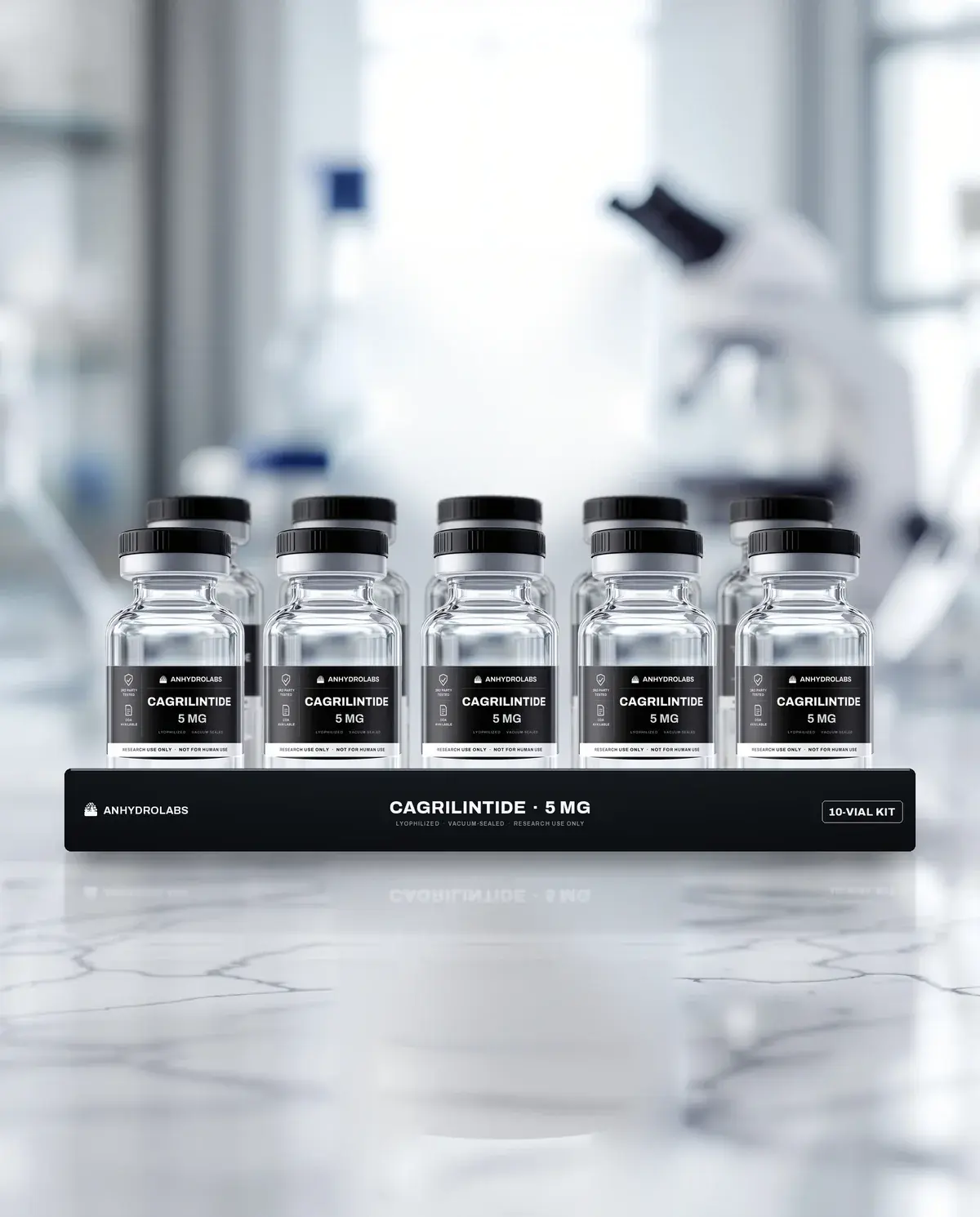
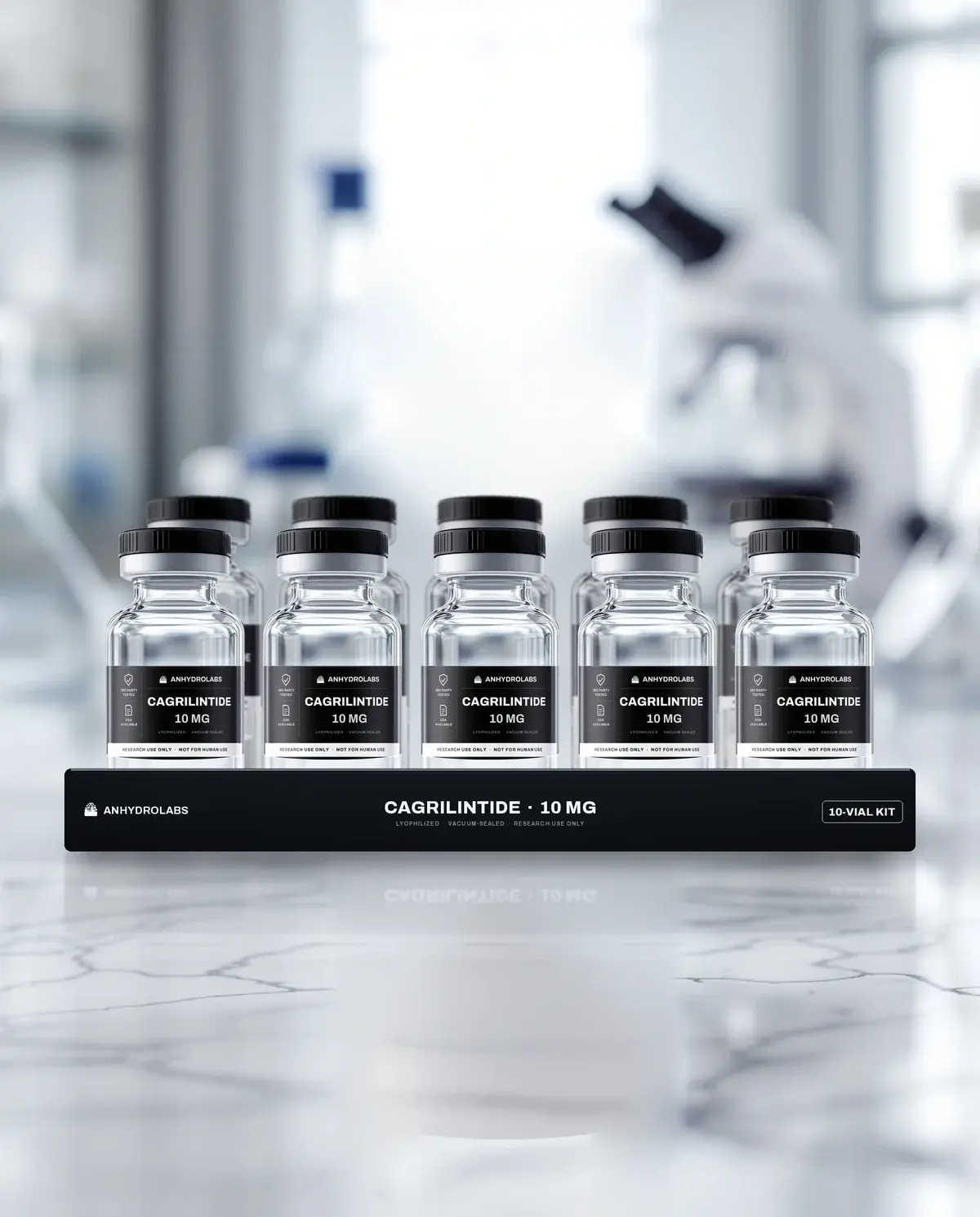
Also known as Cagri. Lyophilized, vacuum-sealed, 10-vial kit.
- CAS
- 1415456-99-3
- Form
- Lyophilized powder
- Storage
- Frozen, in the dark
- Ships
- Kits by Dec 12, 2026
- Presale
- Ships within the US
- Pay by card or crypto
- All sales final
Cagrilintide is a long-acting, lipidated analog of the pancreatic hormone amylin, developed by Novo Nordisk and often shortened to Cagri. Its 37-residue chain carries a 20-carbon fatty diacid at the N-terminus, and the literature describes it as a non-selective agonist of the amylin receptors and the calcitonin receptor. It is investigational and has been studied alone and together with semaglutide in registered human trials.
Supplied for laboratory research use only. Not for human or veterinary use, and not for diagnostic or therapeutic application.
Cagrilintide: compound data
- Molecular formula
- C194H312N54O59S2
- Molecular weight
- 4,409 g/mol
- CAS number
- 1415456-99-3
- PubChem
- CID 171397054
- Form supplied
- Lyophilized powder, vacuum-sealed
- Concentration
- mg/mL and molarity calculator
Reference values from PubChem, the chemistry database of the US National Library of Medicine, for the compound as registered there.
About Cagrilintide
Structure of Cagrilintide
The systematic name recorded in PubChem spells out the structure: a 19-carboxynonadecanoyl group, which is a 20-carbon diacid, joined through gamma-glutamic acid to the N-terminal lysine of a 37-residue chain that ends in prolinamide, with a disulfide between the cysteines at positions 2 and 7. Set against mature human amylin in UniProt P10997, the chain differs at six positions: glutamic acid at 14, arginine at 17, proline at 25, 28 and 29, and proline in place of the C-terminal tyrosine. Native amylin carries no lipid. PubChem also lists the developer code NN0174-0833.
Where Cagrilintide comes from
The compound was described in 2021 in the Journal of Medicinal Chemistry by Kruse and colleagues, where it is analogue 23 of a structure-activity series. The paper frames the design problem as the high propensity of amylin to form amyloid fibrils, and notes that pramlintide, the earlier marketed amylin analog, has a short half-life. Cagrilintide was the stable, lipidated, long-acting analog selected from that work for human studies. Its parent hormone, amylin or islet amyloid polypeptide, is a 37-residue peptide with a tyrosine amide at the C-terminus and one disulfide, cut from an 89-residue precursor.
What Cagrilintide binds
Amylin has no receptor gene of its own. UniProt describes its function as mediated by complexes of the calcitonin receptor with receptor activity-modifying proteins, and notes that amylin can also bind the calcitonin receptor in the absence of those partners. In a 2025 study from Eli Lilly that used cagrilintide as a comparator, it activated amylin 1, amylin 3 and calcitonin receptors with comparable relative potency in cyclic AMP accumulation assays, in both human and rat receptor sets, and the authors call it a non-selective amylin receptor agonist. Human serum albumin lowered the measured potency of the lipidated peptides in that study.
Cagrilintide in the research literature
Published work runs from receptor assays in engineered cells through rodent studies to human trials. The 2025 comparison used UMUC3 cells stably expressing calcitonin, amylin 1 or amylin 3 receptors for radioligand binding and cyclic AMP measurements, and cites a half-life of 159 to 195 hours for cagrilintide in people. A Phase 2 trial at 57 sites in ten countries, is registered as NCT03856047 and ran for 26 weeks. A Phase 3 study of cagrilintide combined with semaglutide in about 3,400 participants is registered by Novo Nordisk as NCT05567796.
Regulatory status of Cagrilintide
Cagrilintide is investigational. The published trials describe it as under investigation, and it is not approved by the FDA; no approved product containing it was listed in the Drugs@FDA data when this profile was written in October 2026. Pramlintide, the earlier amylin analog, is a different molecule and is an approved drug in the United States. Phase 3 studies of cagrilintide given together with semaglutide are registered on ClinicalTrials.gov, and an approval in any jurisdiction after the date of this profile would not be reflected here. Cagrilintide is supplied here as a reference reagent for in-vitro laboratory research only.
Handling Cagrilintide in the laboratory
It is a lyophilized powder in a vacuum-sealed vial. Keep it frozen at -4 °F and protected from light, and let the vial reach room temperature before breaking the seal so that moisture does not condense on the cold solid. In solution, plan on about four weeks at 39 °F, and divide a stock into single-use aliquots instead of freezing and thawing one tube. Albumin in an assay buffer lowered the measured potency of lipidated amylin analogs in the 2025 receptor study, so the albumin content of a buffer belongs in any record of potency values. Amylin itself is described as highly prone to forming amyloid fibrils, the problem this analog was designed around.
Sources
- PubChem CID 171397054: Cagrilintide
- Kruse T et al. Development of Cagrilintide, a Long-Acting Amylin Analogue (J Med Chem, 2021)
- UniProt P10997: Islet amyloid polypeptide (IAPP), human
- Briere DA et al. Molecular Metabolism, 2025. PubMed Central PMC12640043
- Lau DCW et al. Lancet, 2021. PubMed 34798060
- ClinicalTrials.gov NCT05567796
Research notes on Cagrilintide
- Cagrilintide: The Long-Acting Amylin AnalogCagrilintide is a lipidated 37-residue amylin analog from Novo Nordisk. Learn its sequence, receptor targets, half-life, trial status and lab handling.
Cagrilintide: common questions
Is Cagri the same as Cagrilintide?
Yes. Cagri is another name for Cagrilintide (CAS 1415456-99-3). It is the same compound, supplied here as a lyophilized powder for in-vitro laboratory research use only.
What is Cagrilintide supplied as?
Cagrilintide is supplied as a lyophilized (freeze-dried) powder in a vacuum-sealed vial, in 5 mg and 10 mg, for in-vitro laboratory research use only.
Is Cagrilintide available as a 10-vial kit?
Yes. Cagrilintide comes in a 10-vial kit: 5 mg for $265.50 ($26.55 per vial); 10 mg for $450.00 ($45.00 per vial), presale prices. A kit is ten sealed vials of the same size, priced below ten single vials.
When do Cagrilintide presale kits ship?
By Dec 12, 2026. Presale kits are 10% off. If we cannot ship by Dec 12, 2026, we tell you before that date and you can cancel for a full refund.
What is the CAS number of Cagrilintide?
The CAS registry number of Cagrilintide is 1415456-99-3.
How should Cagrilintide be stored?
Frozen at −4 °F and protected from light, from the day it arrives. Let the vial reach room temperature before breaking the seal; once reconstituted, stability holds for about four weeks refrigerated at 39 °F.
How fast does Cagrilintide ship?
Presale kits ship from the United States by Dec 12, 2026, to US addresses. Sizes marked in stock ship within 1 business day of payment.
Is Cagrilintide for human use?
No. It is supplied as a reference reagent for laboratory research use. Not for human or veterinary use, and not for diagnostic or therapeutic application.
How is cagrilintide different from human amylin?
Both are 37-residue peptides with a disulfide between cysteines 2 and 7. Cagrilintide differs from the human sequence at six positions, with glutamic acid at 14, arginine at 17, prolines at 25, 28 and 29, and a C-terminal prolinamide in place of tyrosine amide. It also carries a 20-carbon fatty diacid on its N-terminus through gamma-glutamic acid, which native amylin lacks.
What receptors does cagrilintide activate?
Amylin receptors are complexes of the calcitonin receptor with receptor activity-modifying proteins. In a 2025 comparison, cagrilintide activated amylin 1, amylin 3 and calcitonin receptors with comparable relative potency in cyclic AMP assays, and the authors describe it as a non-selective amylin receptor agonist.
Is cagrilintide approved by the FDA?
No. Cagrilintide is investigational, and no product containing it appeared in the Drugs@FDA data when this profile was written in October 2026. Phase 3 studies of cagrilintide combined with semaglutide are registered on ClinicalTrials.gov by Novo Nordisk.
$265.50
Cagrilintide · 5 mg · 10-vial kit