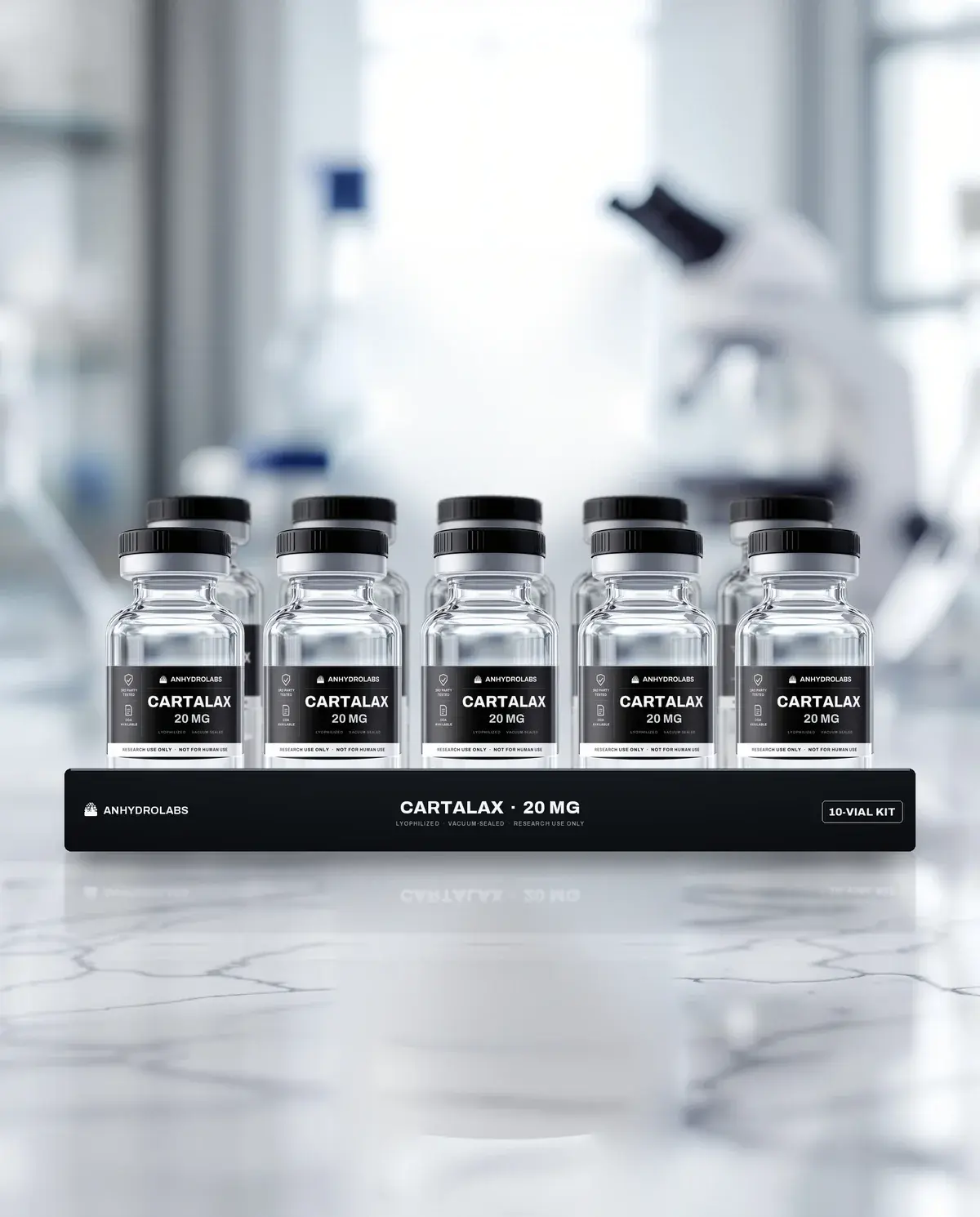
 ×10 · 10-vial kit
Cartalax
Lyophilized, vacuum-sealed, 10-vial kit.
- CAS
- 85806-95-7
- Form
- Lyophilized powder
- Storage
- Frozen, in the dark
- Ships
- Kits by Dec 12, 2026
- Presale
- Ships within the US
- Pay by card or crypto
- All sales final
Cartalax is the trade name of the synthetic tripeptide Ala-Glu-Asp, written AED in the research literature and also catalogued as T-31 peptide. It belongs to the family of short peptides studied by V. Kh. Khavinson and colleagues at the St. Petersburg Institute of Bioregulation and Gerontology. The published record is small, comes almost entirely from that one group, and consists mainly of cell-culture experiments.
Supplied for laboratory research use only. Not for human or veterinary use, and not for diagnostic or therapeutic application.
Cartalax: compound data
- Molecular formula
- C12H19N3O8
- Molecular weight
- 333.29 g/mol
- CAS number
- 85806-95-7
- PubChem
- CID 87815447
- Form supplied
- Lyophilized powder, vacuum-sealed
- Concentration
- mg/mL and molarity calculator
Reference values from PubChem, the chemistry database of the US National Library of Medicine, for the compound as registered there.
About Cartalax
Structure of Cartalax
PubChem lists the compound as alanyl-glutamyl-aspartic acid, with L-alanyl-L-glutamyl-L-aspartic acid, Ala-Glu-Asp, Cartalax and T-31 peptide among its synonyms. It is a linear tripeptide of three L-amino acids with a free amino terminus and a free C-terminal acid, no ring and no modified residue. Two of the three side chains are carboxylic acids, so together with the C-terminus the molecule has three carboxyl groups against a single amine. It shares its sequence with the first three residues of Epitalon, Ala-Glu-Asp-Gly, a tetrapeptide from the same group. One PubChem synonym, H-Asp-Glu-Asp-OH, does not match the structure drawn in the record.
Where Cartalax comes from
No single discovery paper for Cartalax was found. The name appears in a 2021 review in Molecules by Khavinson and colleagues, where a table of short peptides lists AED, Cartalax, and gives its reported activity as regulation of cartilage and skin fibroblast functions and neuronal cell differentiation. Earlier papers from the St. Petersburg institute refer to the peptide by the code T-31 or simply as AED. Two papers from the institute in 2023 study AED side by side with a cartilage polypeptide complex, which is the setting the trade name points to. The sources read for this profile do not say how the sequence was first chosen.
What Cartalax binds
No receptor for AED has been identified. The general model of the originating group, set out in the 2021 review, is that peptides of two to seven residues can enter the nucleus and nucleolus of a cell and interact with the nucleosome, histone proteins and single- and double-stranded DNA, changing gene expression. For AED specifically, a 2014 paper reported molecular models in which the peptide formed its most energetically favorable complexes with alternating adenine-thymine sequences in the minor groove of DNA. That is computational modelling set beside expression changes in cultured cells, not a direct binding measurement, and independent confirmation was not found.
Cartalax in the research literature
The work found is almost all in cultured cells. In human skin fibroblasts during replicative aging, a 2020 study compared AED with the dipeptide KE and measured sirtuin-1, sirtuin-6, collagen I, IL-1, TGF-beta and NF-kB by immunocytochemistry and confocal microscopy. In a human bone marrow mesenchymal stem cell line, FetMSC, another 2020 paper measured expression of the IGF1, FOXO1, TERT, TNKS2 and NFkB genes. A 2014 study in aging renal cell cultures measured p16, p21, p53 and SIRT-6, and a 2023 study in mesenchymal stem cells measured SOX9, aggrecan, type II collagen and COMP. No human trial of the tripeptide was found on ClinicalTrials.gov.
Regulatory status of Cartalax
Cartalax is not an approved drug in the United States. A search of ClinicalTrials.gov for the name Cartalax returned no registered study. The papers that describe it come from the institute that developed it and its collaborators, and they report laboratory experiments, not a regulatory assessment. Readers should treat the literature as early and narrow: a handful of cell-culture studies, most without independent replication. Cartalax is supplied here as a reference reagent for in-vitro laboratory research only.
Handling Cartalax in the laboratory
It is a lyophilized powder in a vacuum-sealed vial. Keep it frozen at -4 °F and protected from light, and let the vial reach room temperature before breaking the seal so that moisture does not condense on the cold solid. In solution, plan on about four weeks at 39 °F, and divide a stock into single-use aliquots instead of freezing and thawing one tube. The sequence gives the peptide three carboxyl groups and no cysteine, methionine or tryptophan, so it is a small, strongly polar, acidic molecule with no thiol or thioether to oxidize. No solubility or stability study specific to Ala-Glu-Asp was found.
Sources
- PubChem CID 87815447: Alanyl-glutamyl-aspartic acid
- Khavinson VK et al. Peptide Regulation of Gene Expression: A Systematic Review (Molecules, 2021)
- Fridman NV et al. Bull Exp Biol Med, 2020. PubMed 33231794
- Ashapkin V et al. Mol Biol Rep, 2020. PubMed 32399807
- Adv Gerontol, 2014. PubMed 25946838
- Myakisheva SN et al. Adv Gerontol, 2023. PubMed 37782646
Cartalax: common questions
What is Cartalax supplied as?
Cartalax is supplied as a lyophilized (freeze-dried) powder in a vacuum-sealed vial, in 20 mg, for in-vitro laboratory research use only.
Is Cartalax available as a 10-vial kit?
Yes. Cartalax comes in a 10-vial kit: 20 mg for $225.00 ($22.50 per vial), presale prices. A kit is ten sealed vials of the same size, priced below ten single vials.
When do Cartalax presale kits ship?
By Dec 12, 2026. Presale kits are 10% off. If we cannot ship by Dec 12, 2026, we tell you before that date and you can cancel for a full refund.
What is the CAS number of Cartalax?
The CAS registry number of Cartalax is 85806-95-7.
How should Cartalax be stored?
Frozen at −4 °F and protected from light, from the day it arrives. Let the vial reach room temperature before breaking the seal; once reconstituted, stability holds for about four weeks refrigerated at 39 °F.
How fast does Cartalax ship?
Presale kits ship from the United States by Dec 12, 2026, to US addresses. Sizes marked in stock ship within 1 business day of payment.
Is Cartalax for human use?
No. It is supplied as a reference reagent for laboratory research use. Not for human or veterinary use, and not for diagnostic or therapeutic application.
What is the sequence of Cartalax?
Cartalax is the tripeptide Ala-Glu-Asp, written AED in one-letter code. PubChem records it as L-alanyl-L-glutamyl-L-aspartic acid, a linear peptide with a free amino terminus and a free C-terminal acid, and lists T-31 peptide as another name.
How is Cartalax different from Epitalon?
Epitalon is the tetrapeptide Ala-Glu-Asp-Gly, and Cartalax is the tripeptide Ala-Glu-Asp, the same sequence without the final glycine. Both come from the short-peptide work of Khavinson and colleagues in St. Petersburg and appear in the same 2021 review, but they are separate compounds with separate, and in the case of Cartalax much smaller, bodies of published work.
What has Cartalax been studied in?
Published studies used cultured cells: human skin fibroblasts, a human bone marrow mesenchymal stem cell line, renal cell cultures and mesenchymal stem cells undergoing chondrogenic differentiation. They measured markers such as sirtuins, collagen I, p16, p21, p53, SOX9 and aggrecan. Nearly all of this work comes from one research group, and no registered human trial was found.
$225.00
Cartalax · 20 mg · 10-vial kit