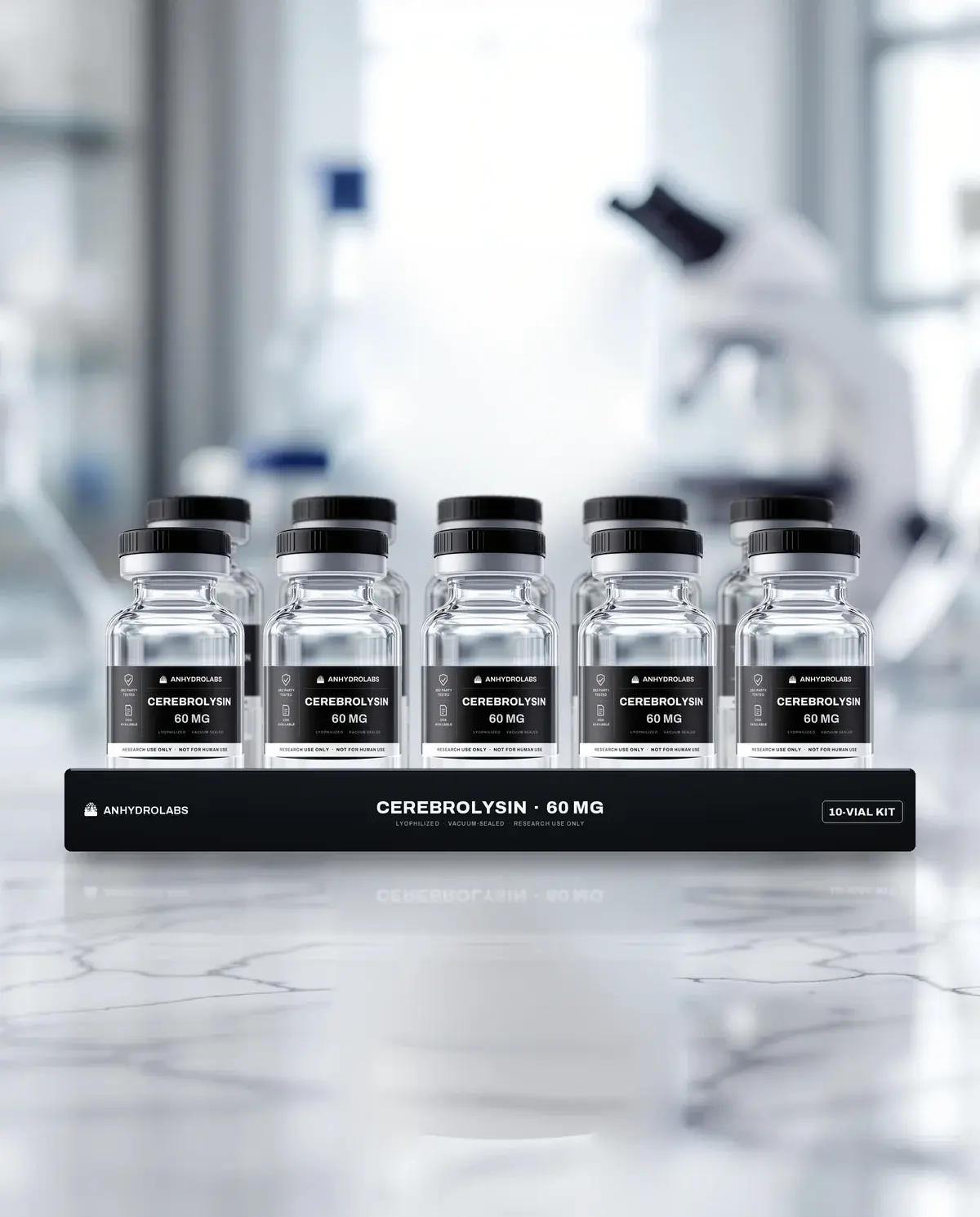
 ×10 · 10-vial kit
Cerebrolysin
Lyophilized, vacuum-sealed, 10-vial kit.
- Form
- Lyophilized powder
- Storage
- Frozen, in the dark
- Ships
- Kits by Dec 12, 2026
- Presale
- Ships within the US
- Pay by card or crypto
- All sales final
Cerebrolysin is not a single compound. It is the trade name of a preparation made from porcine brain: a mixture of low-molecular-weight peptides and free amino acids, described in a 2023 Cochrane review as about 80 percent peptides and 20 percent amino acids. It has no single sequence, formula or molecular weight, and what is known about it comes from studies of the original manufacturer's product.
Supplied for laboratory research use only. Not for human or veterinary use, and not for diagnostic or therapeutic application.
About Cerebrolysin
Structure of Cerebrolysin
Because it is a mixture, the usual identifiers of a peptide do not exist for Cerebrolysin: there is no one sequence, molecular formula, molecular weight or PubChem compound record to quote. A 2019 mass spectrometry study of its light peptide fraction, using orbital ion traps and de novo sequencing, reported amino acid sequences for 14,635 peptides corresponding to 1,643 porcine neuronal proteins. Identity is therefore a matter of pattern, not of one mass. A 2024 study compared preparations by reversed-phase HPLC peptide fingerprint, and found that eleven other brain-derived products did not share the composition of the original.
Where Cerebrolysin comes from
Cerebrolysin is a manufactured biological preparation, not a molecule that was discovered or designed. The Cochrane review describes it as derived from porcine brain, and the 2024 comparison from Paracelsus Medical University in Salzburg calls it the originator product among a group of similar preparations, several of which are labeled as cerebroprotein hydrolysates. The same paper obtained its reference material and the matching amino acid control from a single manufacturer. Cortexin, which the Cochrane review treats as a Cerebrolysin-like agent, is a separate Russian-made product from a different source, and the two are not interchangeable.
What Cerebrolysin binds
No single active component or receptor has been established. The Cochrane review states that the preparation has proposed neuroprotective and neurotrophic properties similar to those of naturally occurring growth factors such as nerve growth factor and brain-derived neurotrophic factor. The evidence on what carries that activity is mixed: the 2019 peptide analysis reported Leu- and Met-enkephalin and fragments of orexin, neuropeptide VF, galanin and nerve growth factor among the sequences, while the Cochrane authors cite another study that identified 638 unique peptides, none of which appeared related to a known trophic factor or its precursor. The mechanism should be regarded as unresolved.
Cerebrolysin in the research literature
In cell work, the Salzburg study used rat pheochromocytoma PC12 cells carrying a reporter in which green fluorescent protein tracks neurofilament-L expression, read by flow cytometry, with an amino acid solution matching the amino acid component of Cerebrolysin as a control. Human research is extensive: one 2023 Cochrane review alone included seven randomized trials with 1,773 participants. Several dozen interventional studies are registered on ClinicalTrials.gov, from Phase 1 to Phase 4. This profile does not summarize what those trials found; the review itself is the place to read that.
Regulatory status of Cerebrolysin
Cerebrolysin is not approved by the FDA, and no evaluation of it by that agency was found. A 2023 Cochrane review reports that it is in wide use in Russia, Eastern Europe, China and other Asian and post-Soviet countries; authorization is national, so a country's own medicines register is the source for its status there. The literature describes the original manufacturer's preparation, and its findings cannot be assumed to hold for material from any other source, as the published comparison of similar products shows. It is supplied here as a reference reagent for in-vitro laboratory research only.
Handling Cerebrolysin in the laboratory
It is a lyophilized powder in a vacuum-sealed vial. Keep it frozen at -4 °F and protected from light, and let the vial reach room temperature before breaking the seal so that moisture does not condense on the cold solid. In solution, plan on about four weeks at 39 °F, and divide a stock into single-use aliquots instead of freezing and thawing one tube. A mixture has no single molecular weight, so solutions are described by mass concentration, not molarity. Because free amino acids are part of the material, the Salzburg study ran a matching amino acid solution as a control in its cell assay. Comparing lots means comparing chromatographic fingerprints.
Sources
- Ziganshina LE et al. Cochrane Database Syst Rev, 2023. PubMed Central PMC10565895
- Seidl LF, Aigner L. Comparing the biological activity and composition of Cerebrolysin with other peptide preparations (J Med Life, 2024)
- Gromova OA et al. An analysis of the peptide composition of a 'light' peptide fraction of cerebrolysin (Zh Nevrol Psikhiatr Im S S Korsakova, 2019)
- ClinicalTrials.gov: registered studies with Cerebrolysin as an intervention
Research notes on Cerebrolysin
- Cerebrolysin: A Peptide Mixture ExplainedWhat Cerebrolysin is: a porcine brain peptide mixture, how it is analyzed, how the acute ischemic stroke meta-analysis literature is built, and its status.
Cerebrolysin: common questions
What is Cerebrolysin supplied as?
Cerebrolysin is supplied as a lyophilized (freeze-dried) powder in a vacuum-sealed vial, in 60 mg, for in-vitro laboratory research use only.
Is Cerebrolysin available as a 10-vial kit?
Yes. Cerebrolysin comes in a 10-vial kit: 60 mg for $180.00 ($18.00 per vial), presale prices. A kit is ten sealed vials of the same size, priced below ten single vials.
When do Cerebrolysin presale kits ship?
By Dec 12, 2026. Presale kits are 10% off. If we cannot ship by Dec 12, 2026, we tell you before that date and you can cancel for a full refund.
How should Cerebrolysin be stored?
Frozen at −4 °F and protected from light, from the day it arrives. Let the vial reach room temperature before breaking the seal; once reconstituted, stability holds for about four weeks refrigerated at 39 °F.
How fast does Cerebrolysin ship?
Presale kits ship from the United States by Dec 12, 2026, to US addresses. Sizes marked in stock ship within 1 business day of payment.
Is Cerebrolysin for human use?
No. It is supplied as a reference reagent for laboratory research use. Not for human or veterinary use, and not for diagnostic or therapeutic application.
Is Cerebrolysin a single peptide?
No. Cerebrolysin is a mixture of low-molecular-weight peptides and free amino acids derived from porcine brain. It has no single sequence, molecular formula or molecular weight, and one mass spectrometry study reported 14,635 peptide sequences in its light peptide fraction.
Is Cerebrolysin approved by the FDA?
No. Cerebrolysin is not an FDA-approved product. A 2023 Cochrane review describes it as in wide use in Russia, Eastern Europe, China and other Asian and post-Soviet countries, where authorization is decided nationally.
Are other brain peptide preparations equivalent to Cerebrolysin?
Not on the published evidence. A 2024 study from Paracelsus Medical University compared Cerebrolysin with eleven other preparations by reversed-phase HPLC fingerprint and a PC12 cell reporter assay. The authors reported that the peptide composition of the other products was not comparable, even among those sharing cerebroprotein hydrolysate as the stated ingredient.
$180.00
Cerebrolysin · 60 mg · 10-vial kit