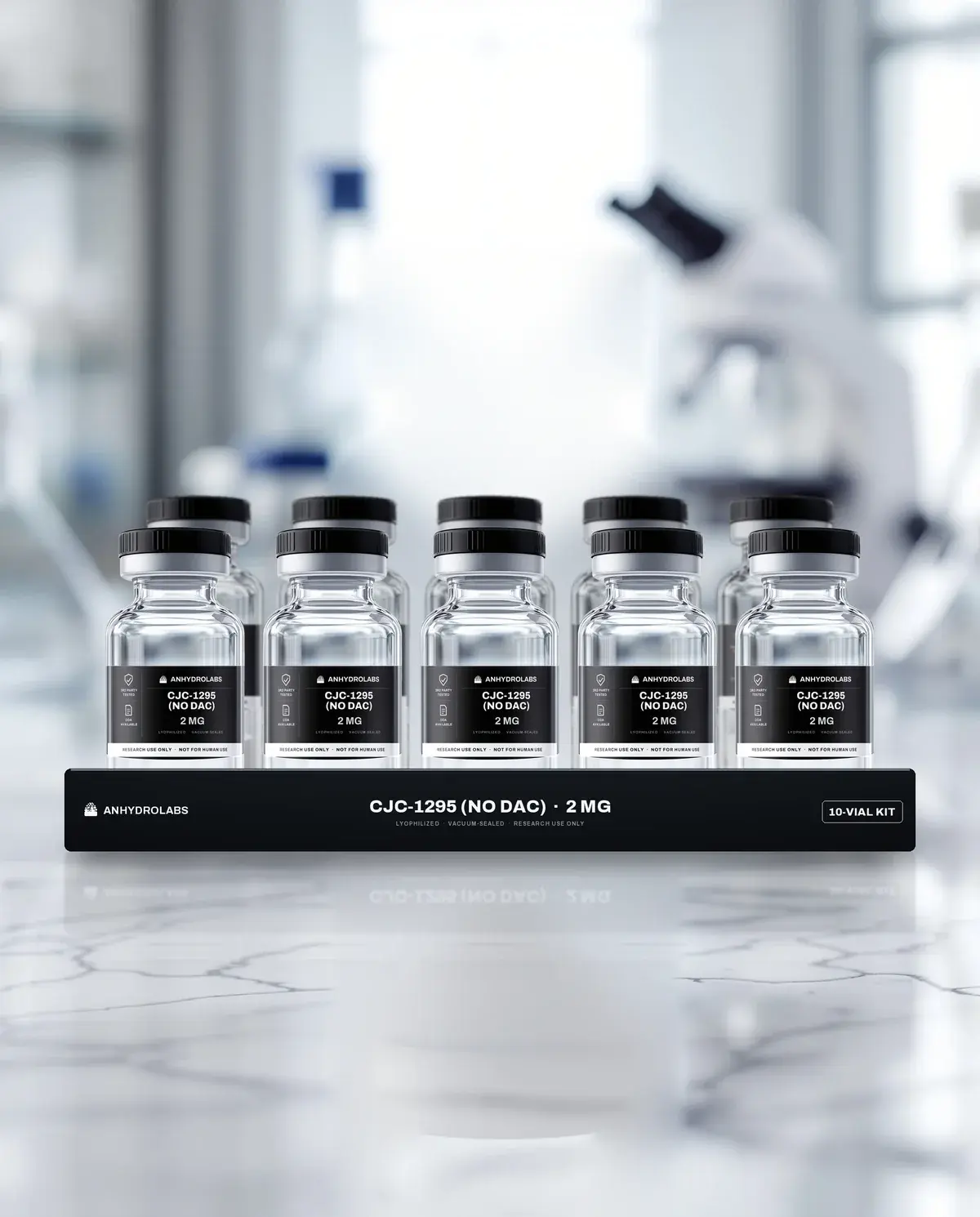
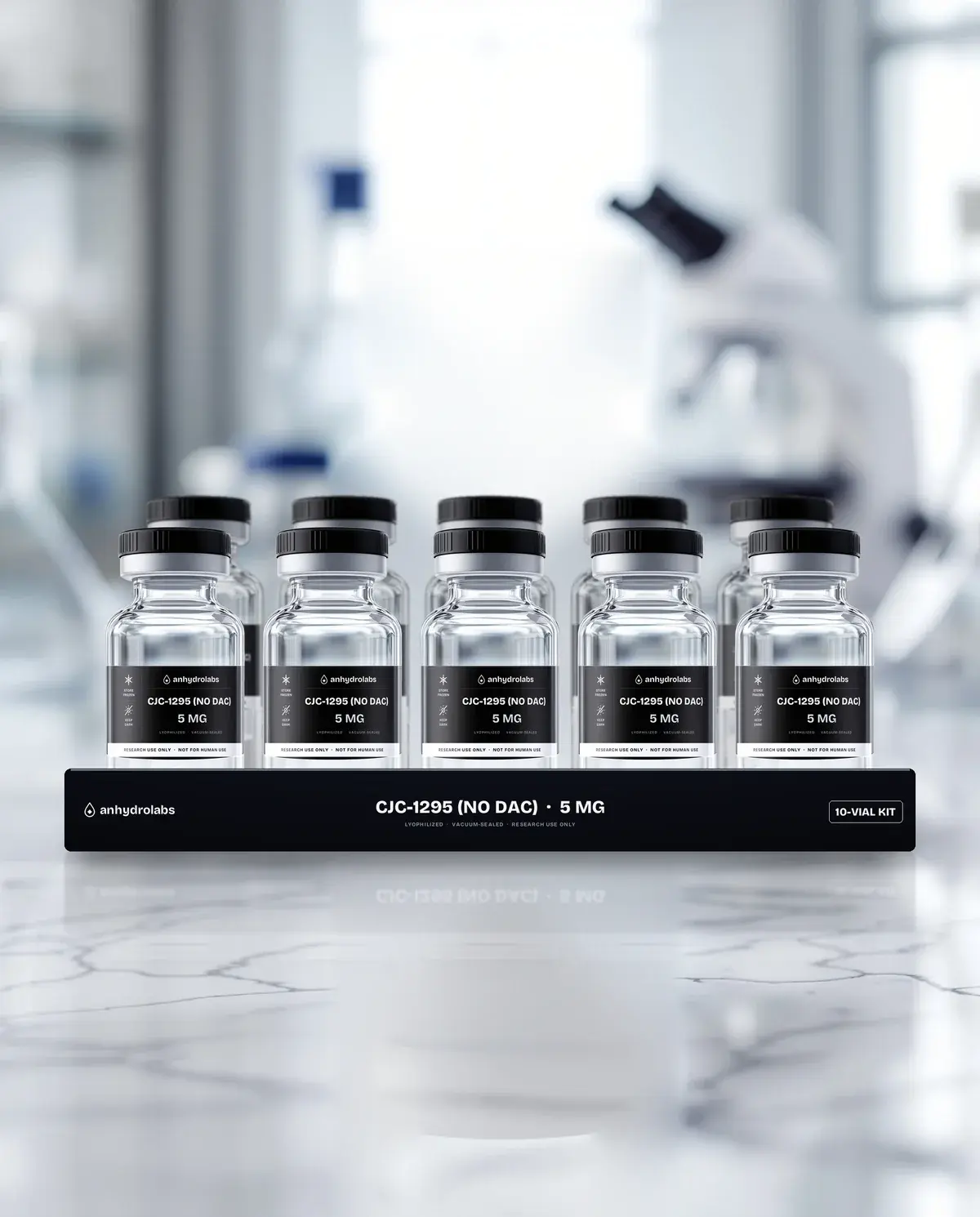
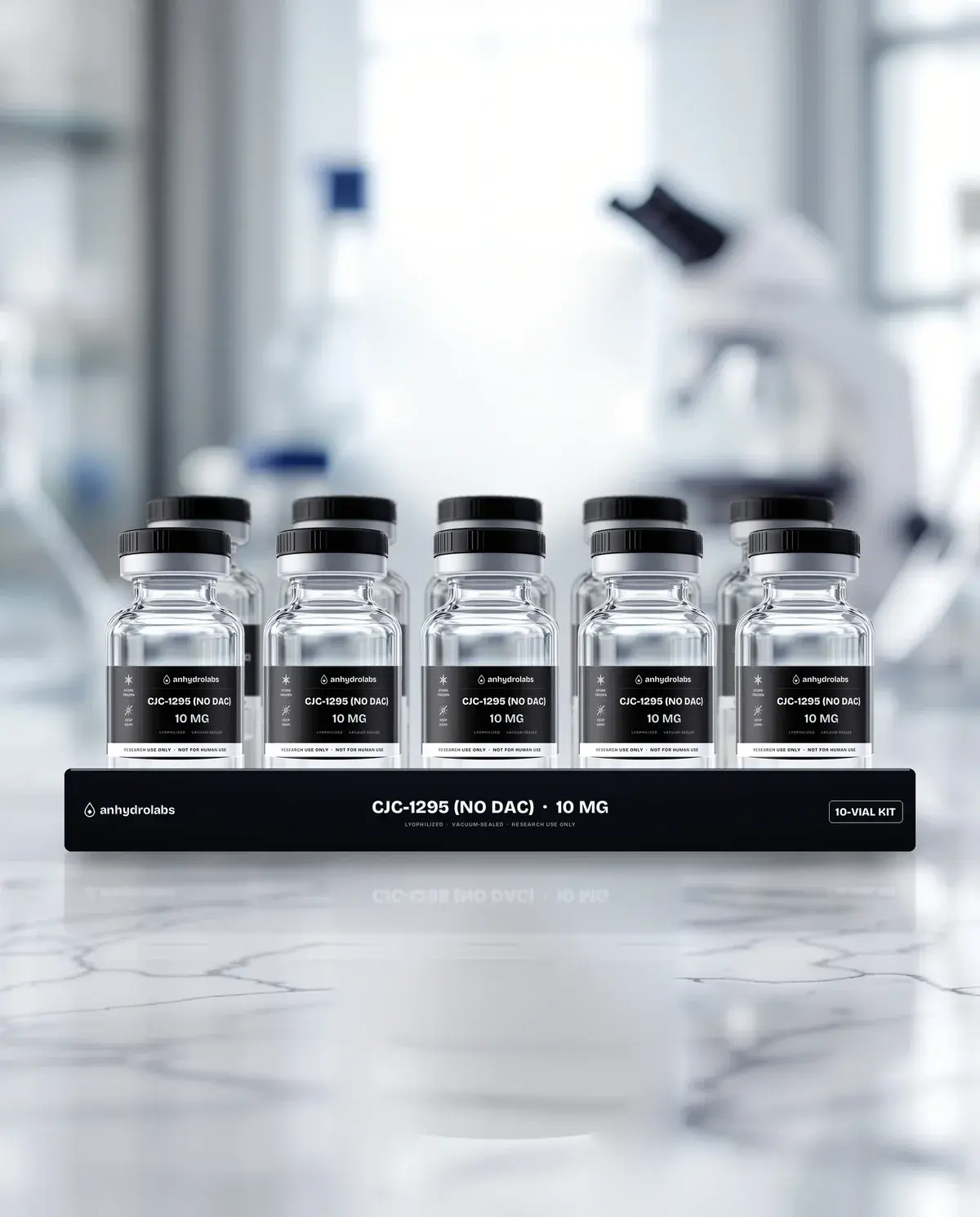
CJC-1295 (no DAC)
Also known as CJC 1295 and Mod GRF 1-29. Lyophilized, vacuum-sealed, 10-vial kit.
- CAS
- 863288-34-0
- Form
- Lyophilized powder
- Storage
- Frozen, in the dark
- Ships
- Kits by Dec 12, 2026
- Presale
- Ships within the US
- Pay by card or crypto
- All sales final
CJC-1295 (no DAC) is a synthetic 29-residue analog of growth hormone-releasing hormone, also sold as CJC 1295 or Mod GRF 1-29. It carries the four amino acid substitutions of the ConjuChem compound CJC-1295 but lacks the added lysine and maleimide group that let the original molecule bond covalently to serum albumin. The published literature describes the albumin-binding form; the no-DAC peptide has almost none of its own.
Supplied for laboratory research use only. Not for human or veterinary use, and not for diagnostic or therapeutic application.
CJC-1295 (no DAC): compound data
- Molecular formula
- C152H252N44O42
- Molecular weight
- 3,367.9 g/mol
- CAS number
- 863288-34-0
- PubChem
- CID 56841945
- Form supplied
- Lyophilized powder, vacuum-sealed
- Concentration
- mg/mL and molarity calculator
Reference values from PubChem, the chemistry database of the US National Library of Medicine, for the compound as registered there.
About CJC-1295 (no DAC)
Structure of CJC-1295 (no DAC)
The chain is the first 29 residues of human growth hormone-releasing hormone with a C-terminal amide and four changes: D-alanine at position 2, glutamine at 8, alanine at 15 and leucine at 27, in place of the L-alanine, asparagine, glycine and methionine of sermorelin, the unmodified 1-29 amide. The PubChem record for CJC-1295 (CID 91971820) shows that substituted chain followed by an extra lysine whose side chain carries a 3-maleimidopropionyl group. The no-DAC form ends at arginine 29, so it has no thiol-reactive group and no sulfur. PubChem holds no separate compound record for it under its trade names.
Where CJC-1295 (no DAC) comes from
CJC-1295 was introduced in 2005 by Jetté and colleagues at ConjuChem in Montreal. They synthesized three maleimido derivatives of human growth hormone-releasing factor 1-29, joined them to human serum albumin, and selected one as CJC-1295: a tetrasubstituted form of the 1-29 peptide with a maleimidopropionamide derivative of lysine added at the C-terminus. The aim was bioconjugation in the body to the free thiol on cysteine 34 of albumin. The names modified GRF 1-29 and Mod GRF 1-29 are supplier names for the substituted chain without that lysine. No peer-reviewed paper introducing the no-DAC peptide under those names was found.
What CJC-1295 (no DAC) binds
The target is the growth hormone-releasing hormone receptor on pituitary somatotrophs. UniProt (Q02643) describes it as a receptor coupled to G proteins that activate adenylyl cyclase, stimulating somatotroph cell growth, growth hormone gene transcription and growth hormone secretion. In the 2005 paper, the albumin conjugates of the maleimido peptides were active in a growth hormone secretion assay in cultured rat anterior pituitary cells and were more stable against dipeptidyl peptidase IV in vitro than the parent peptide. Receptor binding or signaling data measured on the no-DAC peptide itself were not found in the sources read for this profile.
CJC-1295 (no DAC) in the research literature
Nearly all published work concerns the DAC form. Jetté and colleagues used cultured rat anterior pituitary cells, then measured plasma growth hormone in Sprague Dawley rats and followed the compound in plasma, where a Western blot showed an immunoreactive species on the band corresponding to serum albumin. In 2006 Teichman and colleagues reported two randomized, placebo-controlled studies in adults that measured growth hormone, IGF-I and the pharmacokinetics of CJC-1295, with an estimated half-life of 5.8 to 8.1 days. That figure belongs to the albumin-binding molecule. It cannot be carried over to the no-DAC peptide, for which no equivalent published study was found.
Regulatory status of CJC-1295 (no DAC)
No form of CJC-1295 is an approved drug in the United States. On the FDA page listing bulk drug substances that may present significant safety risks in compounding, current as of April 22, 2026, CJC-1295 appears among substances whose nominations were withdrawn by the nominators. The agency's note cites possible immunogenicity, difficulty characterizing peptide-related impurities, and limited human data, and it does not distinguish the DAC and no-DAC forms. The peptide is supplied here as a reference reagent for in-vitro laboratory research only.
Handling CJC-1295 (no DAC) in the laboratory
It is a lyophilized powder in a vacuum-sealed vial. Keep it frozen at -4 °F and protected from light, and let the vial reach room temperature before breaking the seal so that moisture does not condense on the cold solid. In solution, plan on about four weeks at 39 °F, and divide a stock into single-use aliquots instead of freezing and thawing one tube. The no-DAC peptide has no maleimide, so the reactivity toward free thiols that defines the original CJC-1295 does not apply to it. Going by the substituted sequence, it contains no cysteine and no methionine. No solubility or solution-stability study specific to this peptide was found.
Sources
- Jetté L et al. Human growth hormone-releasing factor (hGRF)1-29-albumin bioconjugates activate the GRF receptor on the anterior pituitary in rats: identification of CJC-1295 as a long-lasting GRF analog (Endocrinology, 2005)
- Teichman SL et al. Prolonged stimulation of growth hormone (GH) and insulin-like growth factor I secretion by CJC-1295, a long-acting analog of GH-releasing hormone, in healthy adults (J Clin Endocrinol Metab, 2006)
- PubChem CID 91971820: CJC-1295
- PubChem CID 16132413: Sermorelin
- UniProt Q02643: Growth hormone-releasing hormone receptor (GHRHR), human
- Certain Bulk Drug Substances for Use in Compounding that May Present Significant Safety Risks (FDA, content current as of April 22, 2026)
Research notes on CJC-1295 (no DAC)
- CJC-1295 vs Ipamorelin, and DAC vs No DACCJC-1295 vs ipamorelin compared: GHRH vs ghrelin receptor, the four substitutions in mod GRF(1-29), and what the Drug Affinity Complex adds.
CJC-1295 (no DAC): common questions
Is CJC 1295 the same as CJC-1295 (no DAC)?
Yes. CJC 1295 is another name for CJC-1295 (no DAC), which is also written Mod GRF 1-29 (CAS 863288-34-0). It is the same compound, supplied here as a lyophilized powder for in-vitro laboratory research use only.
What is CJC-1295 (no DAC) supplied as?
CJC-1295 (no DAC) is supplied as a lyophilized (freeze-dried) powder in a vacuum-sealed vial, in 2 mg, 5 mg and 10 mg, for in-vitro laboratory research use only.
Is CJC-1295 (no DAC) available as a 10-vial kit?
Yes. CJC-1295 (no DAC) comes in a 10-vial kit: 2 mg for $85.50 ($8.55 per vial); 5 mg for $175.50 ($17.55 per vial); 10 mg for $279.00 ($27.90 per vial), presale prices. A kit is ten sealed vials of the same size, priced below ten single vials.
When do CJC-1295 (no DAC) presale kits ship?
By Dec 12, 2026. Presale kits are 10% off. If we cannot ship by Dec 12, 2026, we tell you before that date and you can cancel for a full refund.
What is the CAS number of CJC-1295 (no DAC)?
The CAS registry number of CJC-1295 (no DAC) is 863288-34-0.
How should CJC-1295 (no DAC) be stored?
Frozen at −4 °F and protected from light, from the day it arrives. Let the vial reach room temperature before breaking the seal; once reconstituted, stability holds for about four weeks refrigerated at 39 °F.
How fast does CJC-1295 (no DAC) ship?
Presale kits ship from the United States by Dec 12, 2026, to US addresses. Sizes marked in stock ship within 1 business day of payment.
Is CJC-1295 (no DAC) for human use?
No. It is supplied as a reference reagent for laboratory research use. Not for human or veterinary use, and not for diagnostic or therapeutic application.
What is the difference between CJC-1295 with DAC and CJC-1295 (no DAC)?
Both share one 29-residue chain: growth hormone-releasing hormone 1-29 amide with D-alanine at 2, glutamine at 8, alanine at 15 and leucine at 27. The form with DAC has an extra C-terminal lysine carrying a 3-maleimidopropionyl group, which was designed to bond to the free thiol on cysteine 34 of serum albumin. The no-DAC form lacks that lysine and maleimide.
What receptor does CJC-1295 (no DAC) act on?
It is an analog of growth hormone-releasing hormone, whose receptor UniProt describes as coupled to G proteins that activate adenylyl cyclase in pituitary somatotrophs. The 2005 paper that introduced CJC-1295 showed activity of the albumin-conjugated peptides in cultured rat anterior pituitary cells. Direct receptor data on the no-DAC peptide were not found in the literature read for this profile.
Is CJC-1295 (no DAC) approved by the FDA?
No. Neither form of CJC-1295 is an FDA-approved drug. The FDA lists CJC-1295 among bulk drug substances that were nominated for compounding and later withdrawn by the nominators, with a note on possible immunogenicity and limited human data.
$85.50
CJC-1295 (no DAC) · 2 mg · 10-vial kit