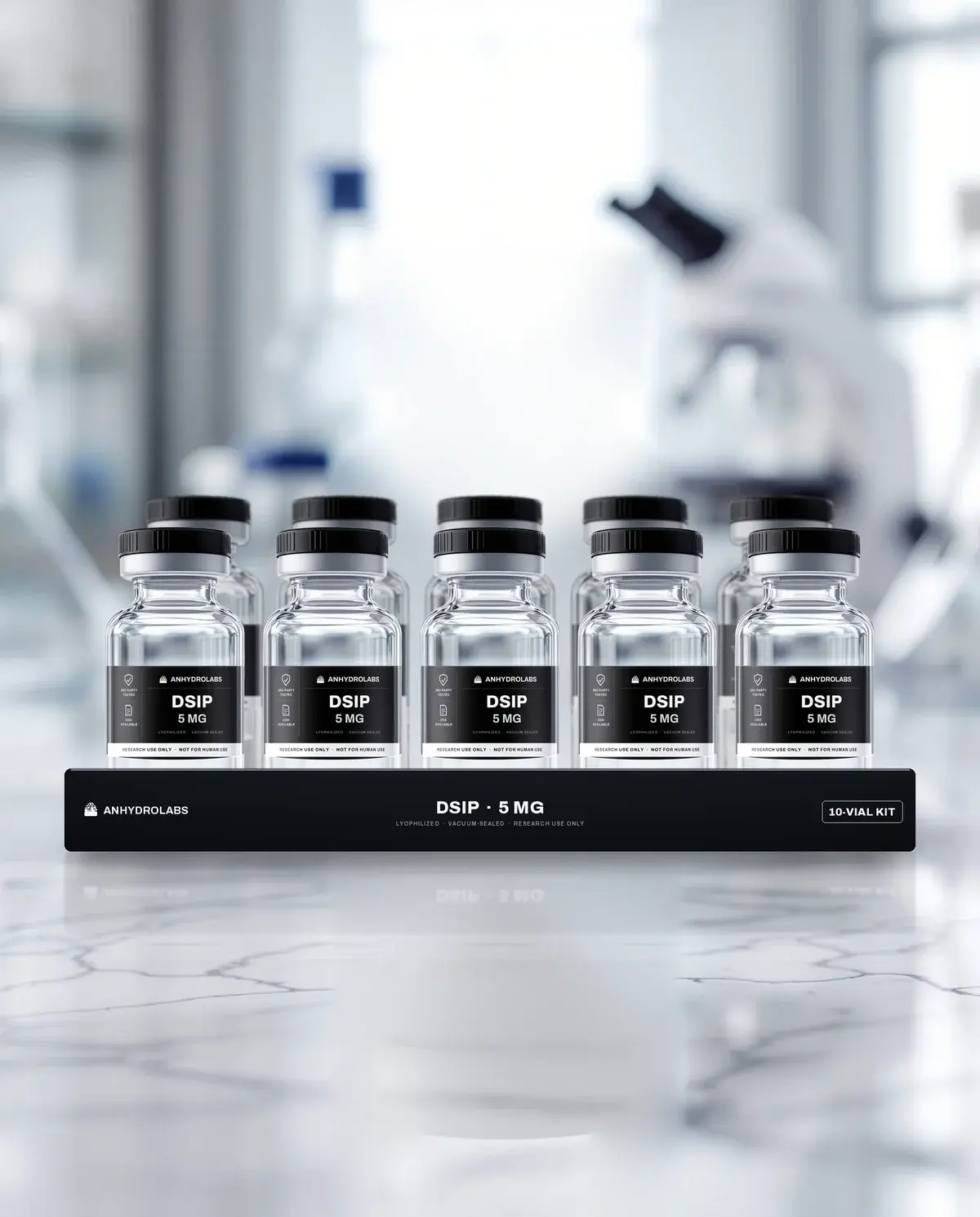
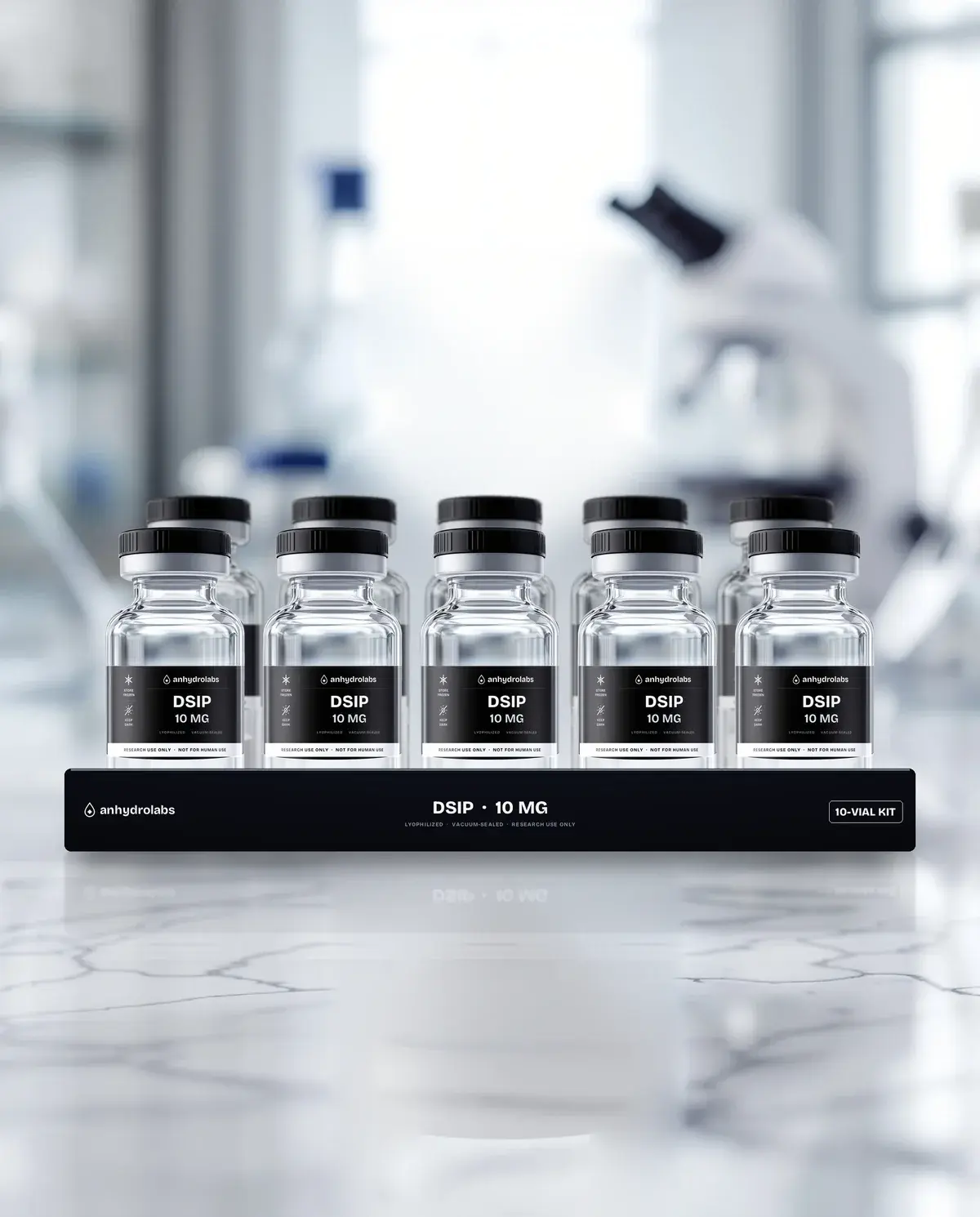
DSIP
Also known as delta sleep-inducing peptide. Lyophilized, vacuum-sealed, 10-vial kit.
- CAS
- 62568-57-4
- Form
- Lyophilized powder
- Storage
- Frozen, in the dark
- Ships
- Kits by Dec 12, 2026
- Presale
- Ships within the US
- Pay by card or crypto
- All sales final
DSIP is delta sleep-inducing peptide, a nine-residue peptide with the sequence Trp-Ala-Gly-Gly-Asp-Ala-Ser-Gly-Glu, isolated from rabbit cerebral venous blood by the Schoenenberger and Monnier group in Basel and characterized in 1977. It is named for the electroencephalogram pattern used to track it during isolation. No gene, precursor protein or receptor for it has been identified, and its biology remains unsettled.
Supplied for laboratory research use only. Not for human or veterinary use, and not for diagnostic or therapeutic application.
DSIP: compound data
- Molecular formula
- C35H48N10O15
- Molecular weight
- 848.8 g/mol
- CAS number
- 62568-57-4
- PubChem
- CID 68816
- Form supplied
- Lyophilized powder, vacuum-sealed
- Concentration
- mg/mL and molarity calculator
Reference values from PubChem, the chemistry database of the US National Library of Medicine, for the compound as registered there.
About DSIP
Structure of DSIP
DSIP is a linear nonapeptide, WAGGDASGE in one-letter code, with a free amino terminus on tryptophan and a free acid on the C-terminal glutamic acid. PubChem records it under the INN emideltide and also lists the name delta sleep-inducing peptide (rabbit). The sequence has one aromatic residue, three glycines, and two acidic residues, aspartic acid and glutamic acid; it has no lysine, arginine or histidine and no cysteine or methionine. A 2006 review notes that its structure differs from every other known peptide family, so there is no close natural relative to compare it with.
Where DSIP comes from
The peptide came from the Basel group of G. A. Schoenenberger and M. Monnier, in a series of papers on a delta-EEG enhancing factor in rabbits. The tenth paper of that series, in Pflügers Archiv in 1977, reported the final isolation and characterization of the nonapeptide. A report the same year in the Proceedings of the National Academy of Sciences gave the sequence and compared the synthetic nonapeptide with five fragments, two nonapeptide analogues and a related tripeptide in 58 rabbits, with cortical recordings analyzed by fast Fourier transformation. PubChem lists emideltide as its INN.
What DSIP binds
There is no established molecular mechanism. Kovalzon and Strekalova, reviewing the field in 2006, wrote that the link proposed in the 1970s was never characterized further, in part because the DSIP gene, protein and possible receptor were never isolated. They suggested that a different, still unidentified DSIP-like peptide accounts for at least part of the immunoreactivity and activity attributed to DSIP. Database searches add a trap: UniProt entry Q99576, TSC22 domain family protein 3, carries the alternative names DSIP-immunoreactive peptide and delta sleep-inducing peptide immunoreactor, but it is a 134-residue protein whose sequence does not contain WAGGDASGE.
DSIP in the research literature
The original assay was the rabbit electroencephalogram, scored after infusion of blood fractions or synthetic peptides; in the 1977 report only the full synthetic nonapeptide produced the delta and spindle pattern the authors were scoring. Later work summarized in the 2006 review falls into histochemical mapping of DSIP-like immunoreactivity in hypothalamic neurosecretory nuclei of several vertebrate species, biochemical and physiological studies in vitro, and electroencephalogram studies in rabbits and rats, where the reviewers found certain synthetic analogs, not DSIP itself, to be active.
Regulatory status of DSIP
DSIP is not an approved drug in the United States. Its INN, emideltide, is a naming decision and carries no marketing status. On the FDA page listing bulk drug substances that may present significant safety risks in compounding, current as of April 22, 2026, emideltide (DSIP) appears among substances whose nominations were withdrawn by the nominators; the agency's note cites possible immunogenicity and difficulty characterizing peptide-related impurities, and says the FDA lacks the information needed to judge harm in humans. DSIP is supplied here as a reference reagent for in-vitro laboratory research only.
Handling DSIP in the laboratory
It is a lyophilized powder in a vacuum-sealed vial. Keep it frozen at -4 °F and protected from light, and let the vial reach room temperature before breaking the seal so that moisture does not condense on the cold solid. In solution, plan on about four weeks at 39 °F, and divide a stock into single-use aliquots instead of freezing and thawing one tube. The single tryptophan at position 1 is the only strongly ultraviolet-absorbing residue in the sequence. With two acidic residues, no basic side chain and three glycines, the peptide is small and polar. No solubility or solution-stability study for DSIP was read for this profile.
Sources
- Schoenenberger GA, Monnier M. Proc Natl Acad Sci USA, 1977. PubMed Central PMC430668
- Schoenenberger GA et al. A naturally occurring delta-EEG enhancing nonapeptide in rabbits. X. Final isolation, characterization and activity test (Pflügers Arch, 1977)
- Kovalzon VM, Strekalova TV. J Neurochem, 2006. PubMed 16539679
- PubChem CID 68816
- UniProt Q99576: TSC22 domain family protein 3 (TSC22D3), human
- Certain Bulk Drug Substances for Use in Compounding that May Present Significant Safety Risks (FDA, content current as of April 22, 2026)
Research notes on DSIP
- DSIP: Delta Sleep-Inducing Peptide in ResearchWhat the DSIP peptide (delta sleep-inducing peptide) is: the WAGGDASGE nonapeptide's identity, its 1977 isolation, the missing receptor and lab handling.
DSIP: common questions
Is delta sleep-inducing peptide the same as DSIP?
Yes. delta sleep-inducing peptide is another name for DSIP (CAS 62568-57-4). It is the same compound, supplied here as a lyophilized powder for in-vitro laboratory research use only.
What is DSIP supplied as?
DSIP is supplied as a lyophilized (freeze-dried) powder in a vacuum-sealed vial, in 5 mg and 10 mg, for in-vitro laboratory research use only.
Is DSIP available as a 10-vial kit?
Yes. DSIP comes in a 10-vial kit: 5 mg for $139.50 ($13.95 per vial); 10 mg for $274.50 ($27.45 per vial), presale prices. A kit is ten sealed vials of the same size, priced below ten single vials.
When do DSIP presale kits ship?
By Dec 12, 2026. Presale kits are 10% off. If we cannot ship by Dec 12, 2026, we tell you before that date and you can cancel for a full refund.
What is the CAS number of DSIP?
The CAS registry number of DSIP is 62568-57-4.
How should DSIP be stored?
Frozen at −4 °F and protected from light, from the day it arrives. Let the vial reach room temperature before breaking the seal; once reconstituted, stability holds for about four weeks refrigerated at 39 °F.
How fast does DSIP ship?
Presale kits ship from the United States by Dec 12, 2026, to US addresses. Sizes marked in stock ship within 1 business day of payment.
Is DSIP for human use?
No. It is supplied as a reference reagent for laboratory research use. Not for human or veterinary use, and not for diagnostic or therapeutic application.
What is the sequence of DSIP?
DSIP is the nonapeptide Trp-Ala-Gly-Gly-Asp-Ala-Ser-Gly-Glu, written WAGGDASGE in one-letter code. It is linear, with a free amino terminus and a free C-terminal acid, and PubChem records it under the INN emideltide.
Does DSIP have a known receptor?
No. A 2006 review in the Journal of Neurochemistry states that the DSIP gene, protein and possible related receptor have not been isolated, and describes the original hypothesis about the peptide as poorly documented. The authors propose that an unidentified DSIP-like peptide explains part of the activity reported in the literature.
Who discovered DSIP?
The group of G. A. Schoenenberger and M. Monnier in Basel isolated it from the cerebral venous blood of rabbits. The final isolation and characterization appeared in Pflügers Archiv in 1977, and a paper in the Proceedings of the National Academy of Sciences that year reported the sequence and compared the synthetic nonapeptide with fragments and analogues.
$139.50
DSIP · 5 mg · 10-vial kit