Eloralintide
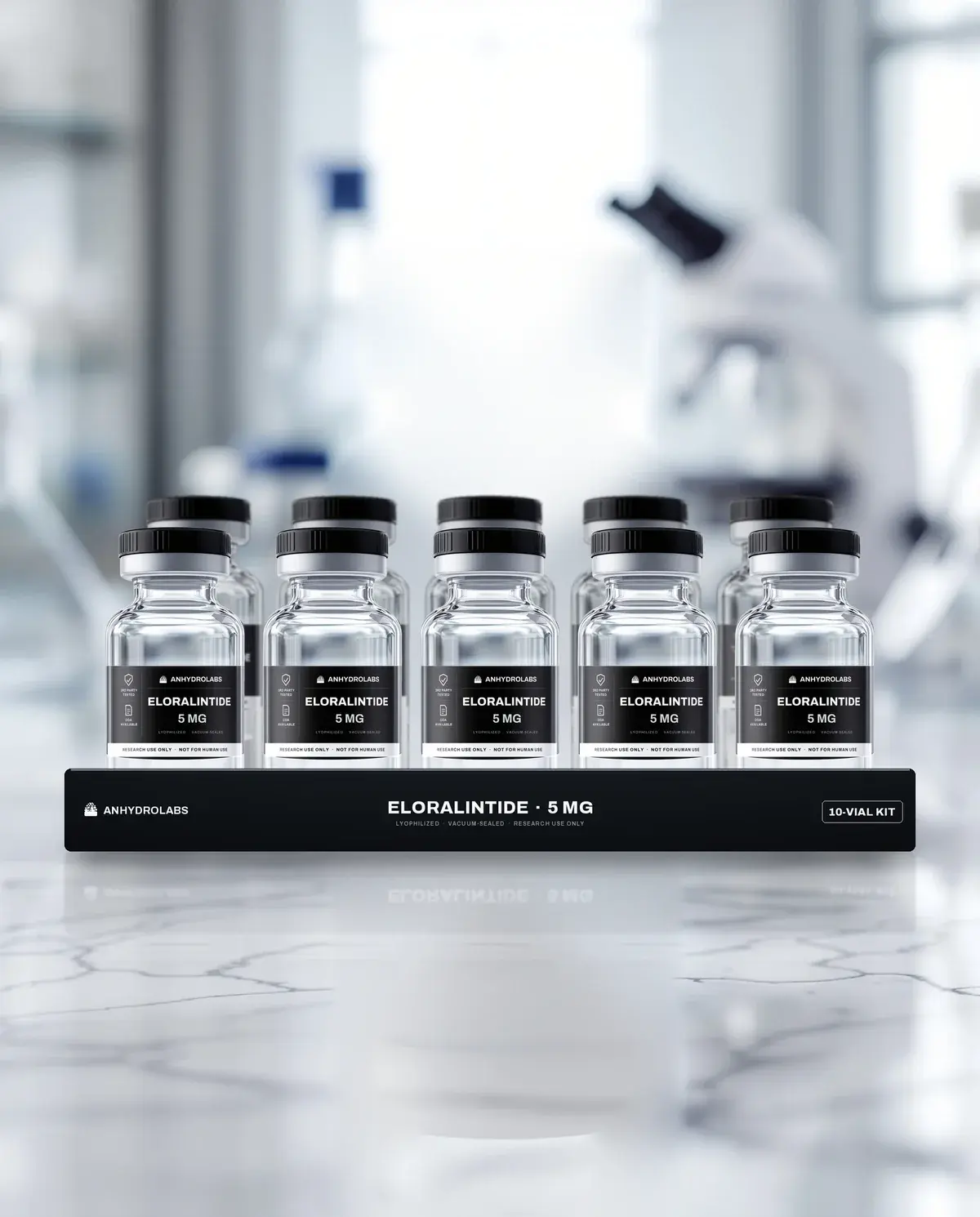
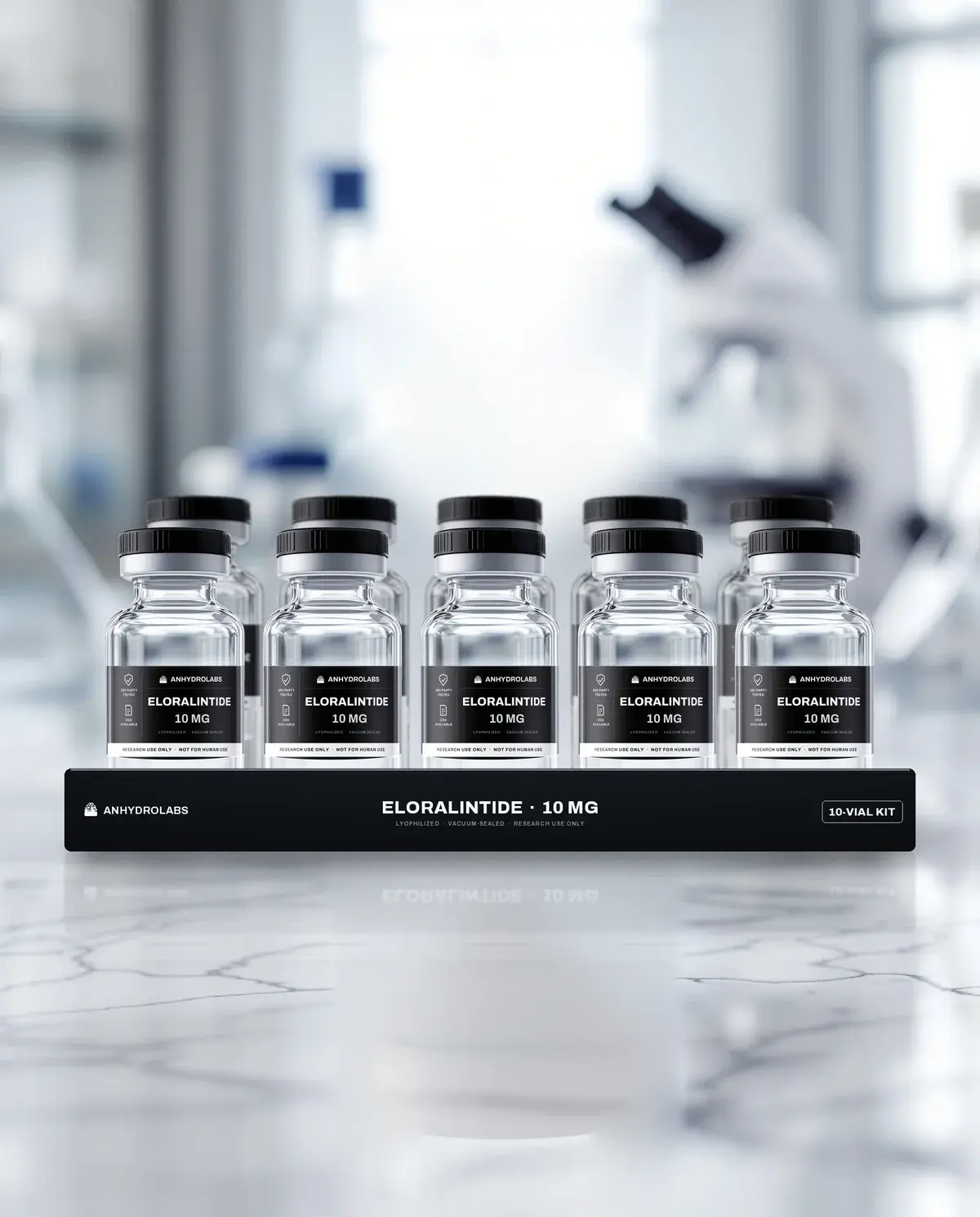
Lyophilized, vacuum-sealed, 10-vial kit.
- CAS
- 2883634-40-8
- Form
- Lyophilized powder
- Storage
- Frozen, in the dark
- Ships
- Kits by Dec 12, 2026
- Presale
- Ships within the US
- Pay by card or crypto
- All sales final
Eloralintide is a synthetic, lipidated analog of the pancreatic hormone amylin developed by Eli Lilly and Company under the code LY3841136. Its 37-residue chain has a methylene thioacetal bridge in place of the native disulfide and a 20-carbon fatty diacid on lysine 26. In cell assays it activates the human amylin 1 receptor more potently than the calcitonin receptor. It is investigational and in Phase 3 trials.
Supplied for laboratory research use only. Not for human or veterinary use, and not for diagnostic or therapeutic application.
Eloralintide: compound data
- Molecular formula
- C201H319N49O65S2
- Molecular weight
- 4,526 g/mol
- CAS number
- 2883634-40-8
- PubChem
- CID 175663130
- Form supplied
- Lyophilized powder, vacuum-sealed
- Concentration
- mg/mL and molarity calculator
Reference values from PubChem, the chemistry database of the US National Library of Medicine, for the compound as registered there.
About Eloralintide
Structure of Eloralintide
The discovery paper describes eloralintide as a C-terminally amidated linear peptide of 37 amino acids with three non-coded residues, at positions 11, 15 and 22. The disulfide of native amylin is replaced by a methylene thioacetal bridge; the systematic name in PubChem shows the two ring sulfur atoms joined through a single carbon. A 20-carbon fatty diacid is attached through a linker to the lysine at position 26, and the PubChem name shows two gamma-linked glutamic acid units in that linker. Cagrilintide, the earlier lipidated amylin analog, keeps the disulfide and carries its diacid at the N-terminus instead.
Where Eloralintide comes from
Eloralintide was reported in 2025 in Molecular Metabolism by Briere and colleagues at Eli Lilly and Company in Indianapolis, in a paper that sets out its structure, receptor data, animal studies and human pharmacokinetic data. Its parent hormone is amylin, or islet amyloid polypeptide, which UniProt records as a 37-residue peptide with a tyrosine amide at the C-terminus and one disulfide. The paper presents it as an amylin receptor agonist that is selective over the calcitonin receptor, in contrast to cagrilintide, which the same paper characterizes as non-selective. LY3841136 is the developer code used in trial registrations.
What Eloralintide binds
Amylin acts through complexes of the calcitonin receptor with receptor activity-modifying proteins, and UniProt notes that it can also bind the calcitonin receptor alone. In cyclic AMP accumulation assays, eloralintide was approximately 12-fold more potent at the human amylin 1 receptor than at the human calcitonin receptor and approximately 11-fold more potent than at the human amylin 3 receptor, behaving as a full agonist at each. The pattern differs by species: at rat receptors the margin over the calcitonin receptor was about 45-fold and over amylin 3 about 3-fold. Albumin binding lowered measured potency, but selectivity over the human calcitonin receptor was retained.
Eloralintide in the research literature
Receptor work used UMUC3 cells stably expressing rat or human calcitonin, amylin 1 or amylin 3 receptors, with cyclic AMP accumulation and radioligand binding to determine inhibition constants. Animal studies used lean and diet-induced obese male Sprague Dawley rats and cynomolgus monkeys, with plasma concentrations and behavioral and metabolic measures as readouts. The discovery paper reports a half-life in people of 310 to 366 hours. A 48-week Phase 2 trial in 263 participants at 46 centers in the United States, is registered as NCT06230523. Phase 3 studies are registered, among them NCT07321886.
Regulatory status of Eloralintide
Eloralintide is investigational and is not approved by the FDA or any other regulator named in the sources read for this profile. The Phase 2 trial was completed in August 2025 and published in the Lancet that December. A Phase 3 study sponsored by Eli Lilly and Company, NCT07321886, was listed as recruiting on ClinicalTrials.gov in October 2026, with a planned enrollment of 1,980 adults. The findings of these trials are not summarized here. Eloralintide is supplied here as a reference reagent for in-vitro laboratory research only.
Handling Eloralintide in the laboratory
It is a lyophilized powder in a vacuum-sealed vial. Keep it frozen at -4 °F and protected from light, and let the vial reach room temperature before breaking the seal so that moisture does not condense on the cold solid. In solution, plan on about four weeks at 39 °F, and divide a stock into single-use aliquots instead of freezing and thawing one tube. One point from the published assay data applies at the bench: albumin binding lowered the measured potency of the lipidated peptides in the discovery paper, so the albumin content of an assay buffer should be recorded alongside any potency value. Receptor balance also differed between human and rat receptors, which matters when choosing a cell system.
Sources
Research notes on Eloralintide
- Eloralintide: An Amylin Receptor AgonistEloralintide (LY3841136) is a selective amylin receptor agonist from Eli Lilly. Its structure, AMY1R selectivity, half-life, trial status and handling.
Eloralintide: common questions
What is Eloralintide supplied as?
Eloralintide is supplied as a lyophilized (freeze-dried) powder in a vacuum-sealed vial, in 5 mg and 10 mg, for in-vitro laboratory research use only.
Is Eloralintide available as a 10-vial kit?
Yes. Eloralintide comes in a 10-vial kit: 5 mg for $355.50 ($35.55 per vial); 10 mg for $643.50 ($64.35 per vial), presale prices. A kit is ten sealed vials of the same size, priced below ten single vials.
When do Eloralintide presale kits ship?
By Dec 12, 2026. Presale kits are 10% off. If we cannot ship by Dec 12, 2026, we tell you before that date and you can cancel for a full refund.
What is the CAS number of Eloralintide?
The CAS registry number of Eloralintide is 2883634-40-8.
How should Eloralintide be stored?
Frozen at −4 °F and protected from light, from the day it arrives. Let the vial reach room temperature before breaking the seal; once reconstituted, stability holds for about four weeks refrigerated at 39 °F.
How fast does Eloralintide ship?
Presale kits ship from the United States by Dec 12, 2026, to US addresses. Sizes marked in stock ship within 1 business day of payment.
Is Eloralintide for human use?
No. It is supplied as a reference reagent for laboratory research use. Not for human or veterinary use, and not for diagnostic or therapeutic application.
How is eloralintide different from cagrilintide?
Both are 37-residue lipidated amylin analogs carrying a 20-carbon fatty diacid. Eloralintide replaces the native disulfide with a methylene thioacetal bridge, attaches its diacid at lysine 26 and contains three non-coded residues. In the 2025 discovery paper it favored the human amylin 1 receptor over the calcitonin receptor, while cagrilintide activated amylin 1, amylin 3 and calcitonin receptors with comparable potency.
How selective is eloralintide for the amylin 1 receptor?
In cyclic AMP assays in UMUC3 cells, eloralintide was approximately 12-fold more potent at the human amylin 1 receptor than at the human calcitonin receptor and approximately 11-fold more potent than at the human amylin 3 receptor. At rat receptors the pattern was different, with about a 45-fold margin over the calcitonin receptor and about 3-fold over amylin 3.
Is eloralintide approved by the FDA?
No. Eloralintide is an investigational compound from Eli Lilly and Company. A Phase 2 trial was published in 2025, and Phase 3 studies, including NCT07321886, are registered on ClinicalTrials.gov.
$355.50
Eloralintide · 5 mg · 10-vial kit