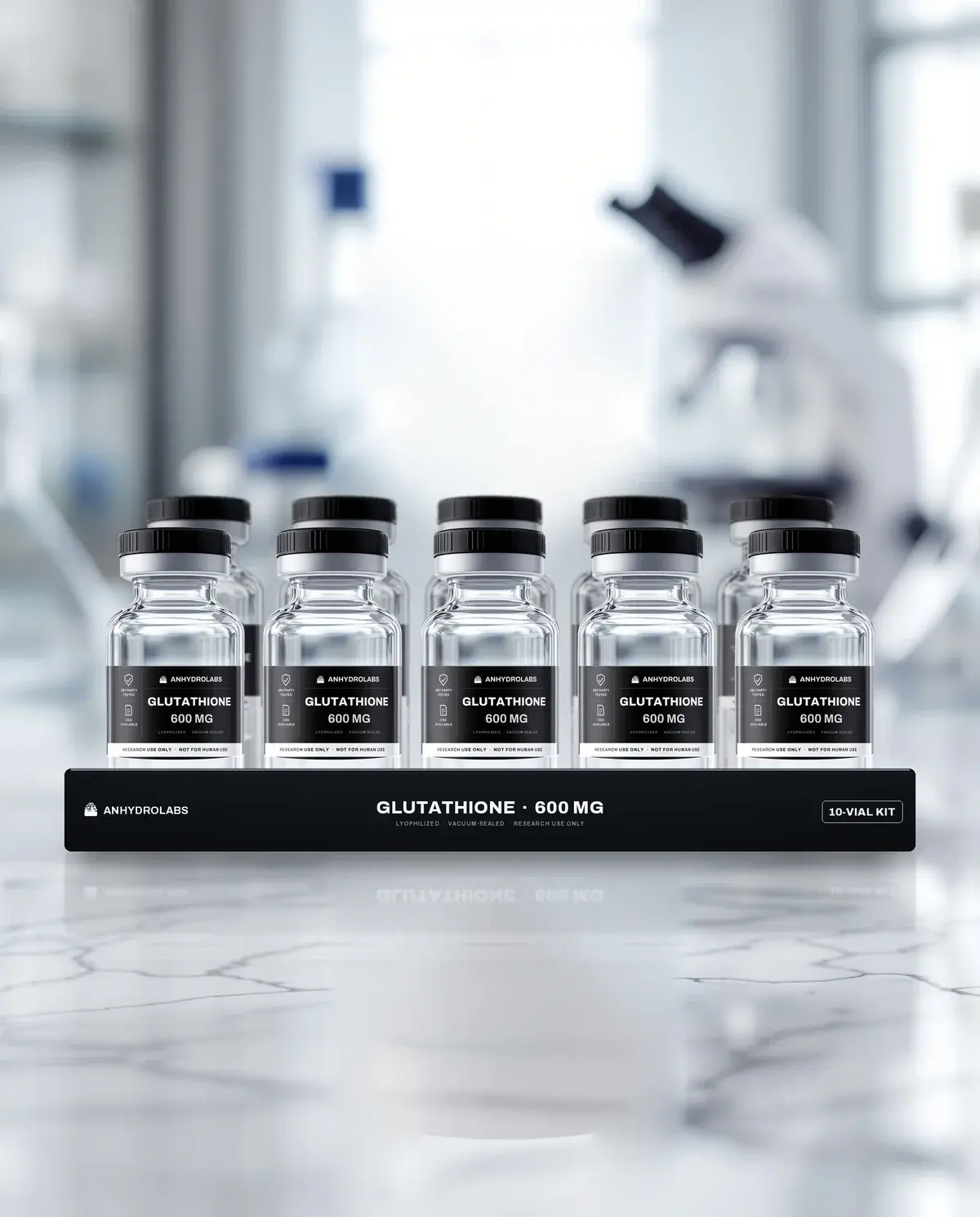
 ×10 · 10-vial kit
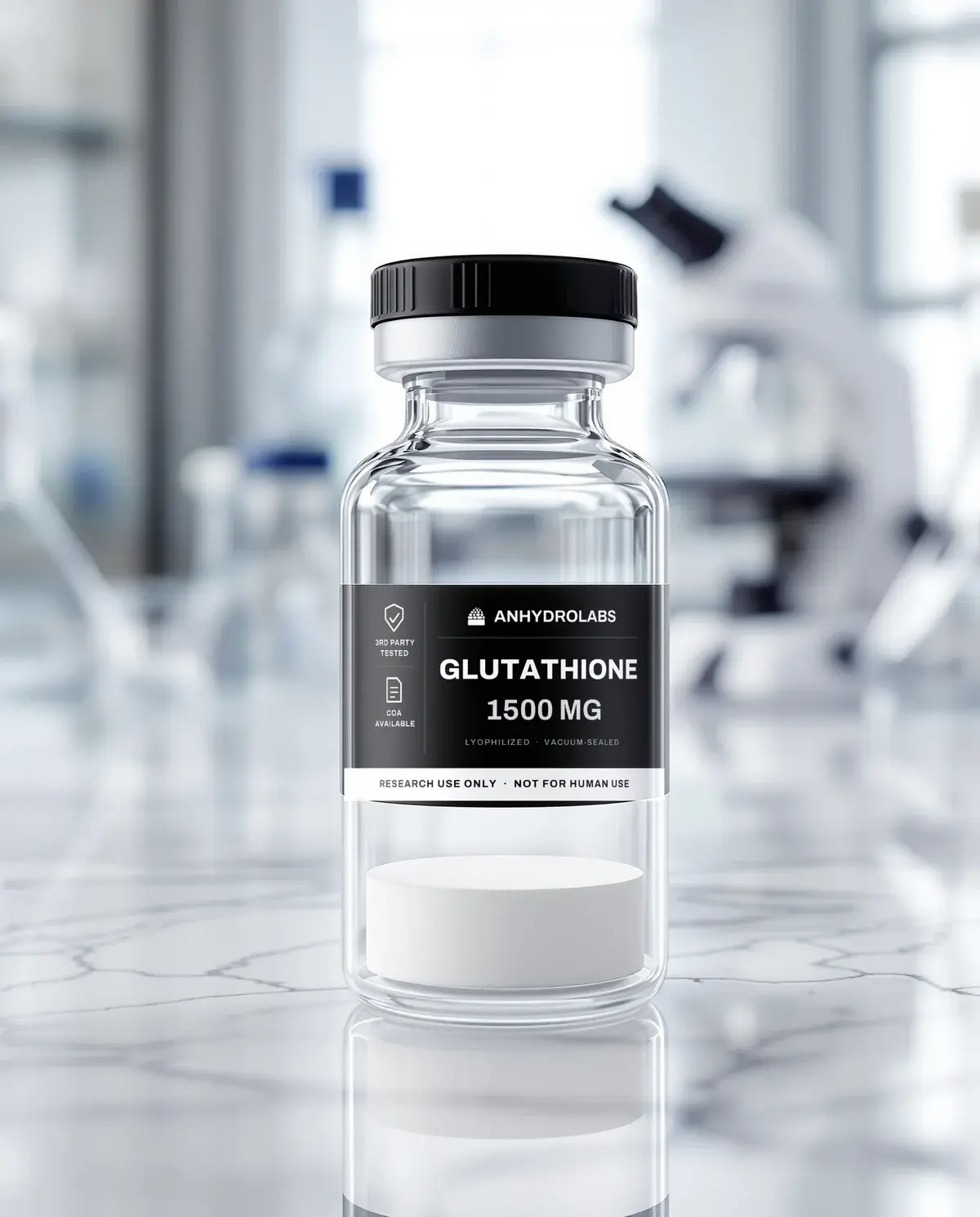
Glutathione
Also known as GSH. Lyophilized, vacuum-sealed, 10-vial kit.
- CAS
- 70-18-8
- Form
- Lyophilized powder
- Storage
- Frozen, in the dark
- Ships
- Kits by Dec 12, 2026
- Presale
- Ships within the US
- Pay by card or crypto
- All sales final
Glutathione is a tripeptide of glutamate, cysteine and glycine, written gamma-Glu-Cys-Gly and abbreviated GSH, in which glutamate is joined to cysteine through its side-chain carboxyl group instead of the usual alpha-carboxyl. It accounts for more than 90 percent of the non-protein thiols in mammalian cells and is known in the literature for the redox pair it forms with its disulfide, GSSG.
Supplied for laboratory research use only. Not for human or veterinary use, and not for diagnostic or therapeutic application.
Glutathione: compound data
- Molecular formula
- C10H17N3O6S
- Molecular weight
- 307.33 g/mol
- CAS number
- 70-18-8
- PubChem
- CID 124886
- Form supplied
- Lyophilized powder, vacuum-sealed
- Concentration
- mg/mL and molarity calculator
Reference values from PubChem, the chemistry database of the US National Library of Medicine, for the compound as registered there.
About Glutathione
Structure of Glutathione
Glutathione has three residues and two different amide bonds. The first joins the gamma-carboxyl of L-glutamate to the amino group of L-cysteine. The second, between cysteine and glycine, is an ordinary peptide bond. A 2023 review notes that the gamma linkage makes the molecule resistant to peptidases, and that the functional group is the thiol of the cysteine residue. Two glutathione molecules oxidized at that thiol give glutathione disulfide, GSSG, which PubChem holds as a separate record with a sulfur-sulfur bridge between the two chains. GSH names the reduced, free-thiol form, and that is the form the glutathione record describes.
Where Glutathione comes from
According to the 2023 review by Georgiou-Siafis and Tsiftsoglou, the substance was found in 1888 by de Rey-Pailhade in blood, sheep brain, fish and vegetables and named philothion, before the peptide bond had been formally proposed. Thirty-three years later Hopkins and Hunter renamed it glutathione, and Meister later did much of the work on its chemical structure. It is not read from a gene. Cells assemble it in two ATP-dependent steps: glutamate-cysteine ligase forms the gamma bond between glutamate and cysteine, and glutathione synthetase then adds glycine through a regular peptide bond.
What Glutathione binds
The chemistry is that of the cysteine thiol. Glutathione peroxidases use GSH as the reductant for reactive oxygen and nitrogen species, producing GSSG, and GSSG reductase converts GSSG back to GSH with NADPH as cofactor, so the usual ratio of GSH to GSSG is about 100 to 1. The review places the redox potential of the pair between -260 and -150 mV in different tissues. As a nucleophile, GSH also forms thioether conjugates with electrophilic compounds, a reaction that glutathione S-transferases catalyze, and it forms mixed disulfides with cysteine residues of proteins, a modification called S-glutathionylation.
Glutathione in the research literature
Most of the literature measures glutathione inside cells and tissues. Reported concentrations are 1 to 5 mM in cells generally, about 10 mM in liver and 0.4 to 3.0 mM in red blood cells. Buthionine sulfoximine, an inhibitor of glutamate-cysteine ligase, is described as the standard tool for depleting glutathione experimentally. Conjugates studied include those with NAPQI, cisplatin, leukotrienes and prostaglandins, and S-glutathionylation has been examined on proteins such as heat shock protein 70 and glyceraldehyde-3-phosphate dehydrogenase. Synthesis by glutamate-cysteine ligase is competitively inhibited by GSH itself, and cysteine is the limiting substrate.
Regulatory status of Glutathione
Glutathione appears in Category 1, bulk drug substances under evaluation, on the list of substances nominated for compounding under section 503A of the Federal Food, Drug, and Cosmetic Act that FDA updated on May 14, 2026. A place in Category 1 records a nomination that FDA is still evaluating. It is not an approval of any product, and this profile does not review how glutathione is regulated as a food or cosmetic ingredient. Glutathione is supplied here as a reference reagent for in-vitro laboratory research only, not for diagnostic or therapeutic application.
Handling Glutathione in the laboratory
The material is a lyophilized powder in a vacuum-sealed vial. Keep the sealed vial frozen at -4 °F and protected from light, and let it reach room temperature before breaking the seal so that moisture does not condense on the powder. Once in solution, keep it at 39 °F and plan to use it within about four weeks. Divide a solution into single-use aliquots instead of freezing and thawing one container repeatedly. PubChem lists an aqueous solubility of 292.5 mg/mL for glutathione. The free thiol oxidizes to GSSG, the change to expect in a kept solution; Hopkins's 1921 paper already called it an autoxidisable constituent of the cell.
Sources
- PubChem compound summary: Glutathione, CID 124886
- PubChem compound summary: Glutathione disulfide, CID 65359
- The Key Role of GSH in Keeping the Redox Balance in Mammalian Cells: Mechanisms and Significance of GSH in Detoxification via Formation of Conjugates (Georgiou-Siafis and Tsiftsoglou, Antioxidants, 2023)
- Bulk Drug Substances Nominated for Use in Compounding Under Section 503A of the Federal Food, Drug, and Cosmetic Act (FDA, updated May 14, 2026)
Research notes on Glutathione
- Glutathione: The Tripeptide AntioxidantThe glutathione peptide explained: its γ-linked tripeptide structure, identity data, GSH and GSSG redox chemistry, synthesis enzymes and lab handling.
Glutathione: common questions
Is GSH the same as Glutathione?
Yes. GSH is another name for Glutathione (CAS 70-18-8). It is the same compound, supplied here as a lyophilized powder for in-vitro laboratory research use only.
What is Glutathione supplied as?
Glutathione is supplied as a lyophilized (freeze-dried) powder in a vacuum-sealed vial, in 600 mg and 1500 mg, for in-vitro laboratory research use only.
Is Glutathione available as a 10-vial kit?
Yes. Glutathione comes in a 10-vial kit: 600 mg for $180.00 ($18.00 per vial), presale prices. A kit is ten sealed vials of the same size, priced below ten single vials.
When do Glutathione presale kits ship?
By Dec 12, 2026. Presale kits are 10% off. If we cannot ship by Dec 12, 2026, we tell you before that date and you can cancel for a full refund.
What is the CAS number of Glutathione?
The CAS registry number of Glutathione is 70-18-8.
How should Glutathione be stored?
Frozen at −4 °F and protected from light, from the day it arrives. Let the vial reach room temperature before breaking the seal; once reconstituted, stability holds for about four weeks refrigerated at 39 °F.
How fast does Glutathione ship?
Presale kits ship from the United States by Dec 12, 2026, to US addresses. Sizes marked in stock ship within 1 business day of payment.
Is Glutathione for human use?
No. It is supplied as a reference reagent for laboratory research use. Not for human or veterinary use, and not for diagnostic or therapeutic application.
What is the difference between glutathione (GSH) and GSSG?
GSH is reduced glutathione, a single gamma-Glu-Cys-Gly chain with a free thiol on its cysteine. GSSG is glutathione disulfide, two of those chains joined through their sulfur atoms. Glutathione peroxidases oxidize GSH to GSSG, and GSSG reductase converts it back using NADPH, which keeps the usual ratio near 100 to 1.
How do cells make glutathione?
Glutathione is built by two ATP-dependent enzymes, not by the ribosome. Glutamate-cysteine ligase joins glutamate to cysteine through the gamma-carboxyl and is the limiting enzyme, competitively inhibited by glutathione itself. Glutathione synthetase then adds glycine through a regular peptide bond.
Who discovered glutathione?
De Rey-Pailhade described it in 1888 in blood, sheep brain, fish and vegetables and called it philothion. Thirty-three years later Hopkins and Hunter renamed it glutathione and characterized its reducing power and solubility in water. Meister later contributed much of the structural work and wrote a history of the discovery.
$180.00
Glutathione · 600 mg · 10-vial kit