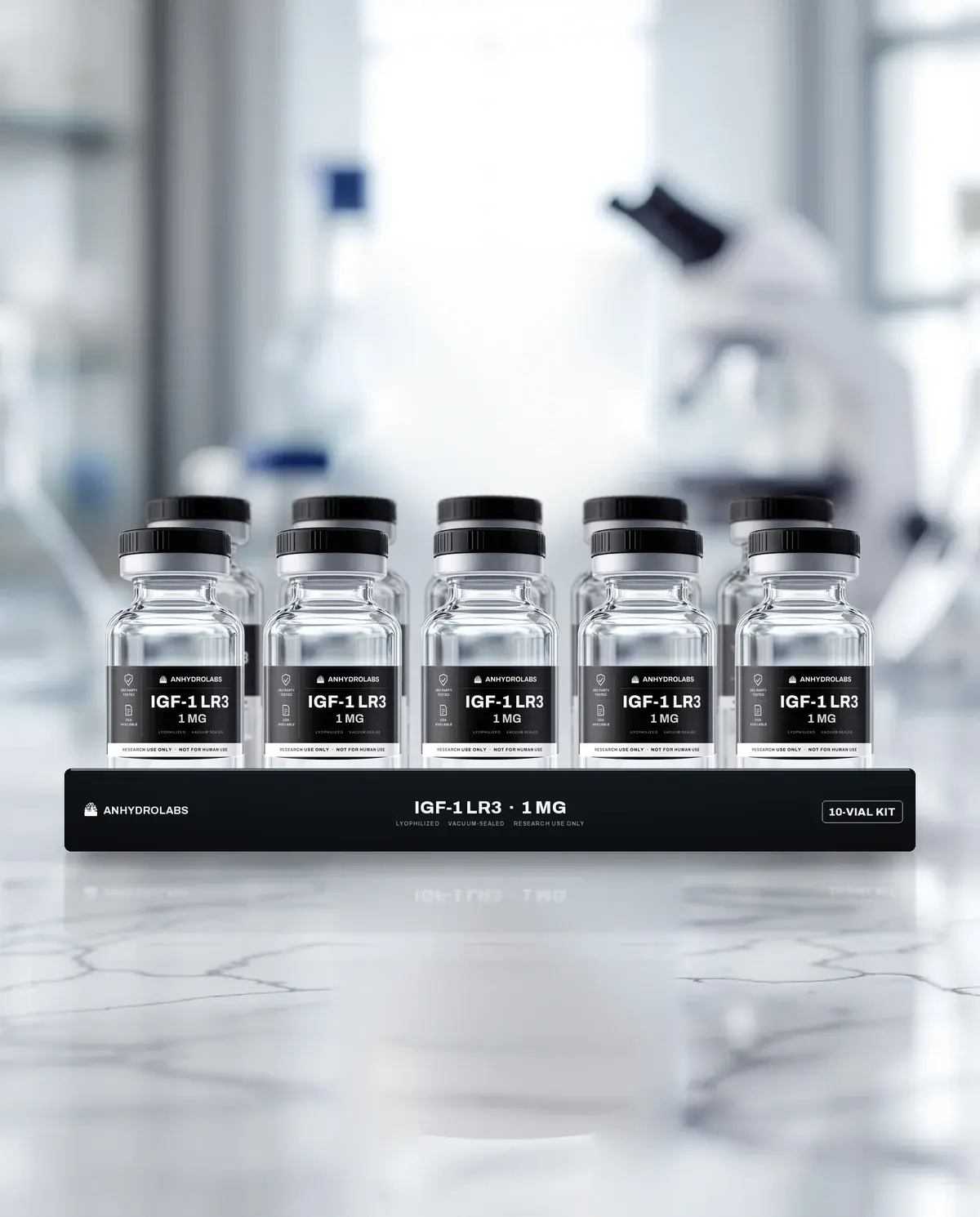
 ×10 · 10-vial kit
IGF-1 LR3
Also known as Long R3 IGF-1. Lyophilized, vacuum-sealed, 10-vial kit.
- Form
- Lyophilized powder
- Storage
- Frozen, in the dark
- Ships
- Kits by Dec 12, 2026
- Presale
- Ships within the US
- Pay by card or crypto
- All sales final
IGF-1 LR3 is an engineered analog of human insulin-like growth factor 1, also written Long R3 IGF-1, in which glutamic acid 3 is replaced by arginine and a 13-residue extension is added to the N-terminus, giving 83 residues. It is known in the literature as a laboratory reagent with very low affinity for IGF-binding proteins, and as a supplement for serum-free mammalian cell culture.
Supplied for laboratory research use only. Not for human or veterinary use, and not for diagnostic or therapeutic application.
IGF-1 LR3: compound data
- Molecular formula
- C400H625N111O115S9
- Molecular weight
- 9,117.6 g/mol
- Source
- Published formula
- Form supplied
- Lyophilized powder, vacuum-sealed
- Concentration
- mg/mL and molarity calculator
Reference values from PubChem, the chemistry database of the US National Library of Medicine, for the compound as registered there.
About IGF-1 LR3
Structure of IGF-1 LR3
The molecule is a single chain of 83 amino acids. The first 13 are an extension: the first 11 residues of methionyl porcine growth hormone followed by a Val-Asn linker. The remaining 70 are the mature human IGF-1 chain with one change, arginine in place of glutamic acid at position 3, which is the R3 of the name. The FDA label for recombinant human IGF-1 describes that parent chain as 70 amino acids with three intramolecular disulfide bridges, and UniProt maps those bridges in the IGF-1 entry. Native IGF-1 has neither the extension nor the arginine.
Where IGF-1 LR3 comes from
Francis and colleagues at the CSIRO Division of Human Nutrition in Adelaide, South Australia, described the analog in the Journal of Molecular Endocrinology in 1992. They expressed three fusion peptides in Escherichia coli, named Long IGF-I, Long Gly3 IGF-I and Long Arg3 IGF-I according to the IGF-1 sequence each carried, and noted that the hydrophobic N-terminal extension appeared to help the peptides fold correctly. The third is the molecule now called IGF-1 LR3, LR3-IGF-I or LONG R3 IGF-I. A 2006 paper from GroPep in South Australia says it was engineered for protein production in mammalian cells.
What IGF-1 LR3 binds
IGF-1 LR3 acts on the type 1 IGF receptor. UniProt describes how IGF-1 binds the alpha subunit of that receptor and activates its intrinsic tyrosine kinase, which autophosphorylates the beta subunit and starts signaling through the PI3K-AKT and Ras-MAPK pathways. What sets the analog apart is binding to the IGF-binding proteins: Grimes and Hammond described it as having very low affinity for them and only slightly reduced affinity for the receptor. In HEK293 cells, Voorhamme and Yandell found that it also activated the insulin receptor despite low affinity for it, and they suggested that hybrid receptors explain this.
IGF-1 LR3 in the research literature
The record is mostly cell biology. Francis and colleagues compared the analogs with IGF-1 in L6 rat myoblasts, H35 hepatoma cells and chicken embryo fibroblasts; in the fibroblasts, which secrete no detectable binding proteins, Long Arg3 IGF-I was less potent than IGF-1, evidence that its higher potency elsewhere comes from escaping those proteins. Grimes and Hammond used ovarian granulosa cells. Voorhamme and Yandell studied serum-free cultures of HEK293 and Chinese hamster ovary cells. In animals, Tomas and colleagues compared IGF-1 and two variants, including LR3-IGF-I, in rats with streptozotocin-induced diabetes. No human trial of the analog appears in these sources.
Regulatory status of IGF-1 LR3
The IGF-1 product with an FDA label, mecasermin (Increlex, initial United States approval 2005), is recombinant human IGF-1 whose sequence the label describes as identical to the endogenous hormone. IGF-1 LR3 carries an N-terminal extension and an arginine substitution, so it is a different molecule from mecasermin, and the literature describes it as a research reagent and a cell culture supplement, not as an approved drug. IGF-1 LR3 is supplied here as a reference reagent for in-vitro laboratory research only, not for diagnostic or therapeutic application.
Handling IGF-1 LR3 in the laboratory
The material is a lyophilized powder in a vacuum-sealed vial. Keep the sealed vial frozen at -4 °F and protected from light, and let it reach room temperature before breaking the seal so that moisture does not condense on the powder. Once in solution, keep it at 39 °F and plan to use it within about four weeks. Divide a solution into single-use aliquots instead of freezing and thawing one container repeatedly. IGF-1 LR3 is a small protein, not a short peptide, and its fold depends on the three disulfide bridges inherited from IGF-1. No solubility or stability figure specific to the analog appears in the sources consulted for this profile, so none is given here.
Sources
- Novel recombinant fusion protein analogues of insulin-like growth factor (IGF)-I indicate the relative importance of IGF-binding protein and receptor binding for enhanced biological potency (Francis et al., J Mol Endocrinol, 1992)
- Insulin and insulin-like growth factors (IGFs) stimulate production of IGF-binding proteins by ovarian granulosa cells (Grimes and Hammond, Endocrinology, 1992)
- Tomas et al., Biochem J, 1993. PubMed 7683875
- LONG R3IGF-I as a more potent alternative to insulin in serum-free culture of HEK293 cells (Voorhamme and Yandell, Mol Biotechnol, 2006)
- UniProt P05019: Insulin-like growth factor 1, human
- DailyMed: INCRELEX (mecasermin) injection, prescribing information
Research notes on IGF-1 LR3
- IGF-1 LR3: How It Differs From IGF-1IGF-1 LR3 is an 83-amino-acid recombinant analog of human IGF-1 with an Arg3 swap and an N-terminal extension. Sequence, IGFBP binding, assays and handling.
IGF-1 LR3: common questions
Is Long R3 IGF-1 the same as IGF-1 LR3?
Yes. Long R3 IGF-1 is another name for IGF-1 LR3. It is the same compound, supplied here as a lyophilized powder for in-vitro laboratory research use only.
What is IGF-1 LR3 supplied as?
IGF-1 LR3 is supplied as a lyophilized (freeze-dried) powder in a vacuum-sealed vial, in 1 mg, for in-vitro laboratory research use only.
Is IGF-1 LR3 available as a 10-vial kit?
Yes. IGF-1 LR3 comes in a 10-vial kit: 1 mg for $414.00 ($41.40 per vial), presale prices. A kit is ten sealed vials of the same size, priced below ten single vials.
When do IGF-1 LR3 presale kits ship?
By Dec 12, 2026. Presale kits are 10% off. If we cannot ship by Dec 12, 2026, we tell you before that date and you can cancel for a full refund.
How should IGF-1 LR3 be stored?
Frozen at −4 °F and protected from light, from the day it arrives. Let the vial reach room temperature before breaking the seal; once reconstituted, stability holds for about four weeks refrigerated at 39 °F.
How fast does IGF-1 LR3 ship?
Presale kits ship from the United States by Dec 12, 2026, to US addresses. Sizes marked in stock ship within 1 business day of payment.
Is IGF-1 LR3 for human use?
No. It is supplied as a reference reagent for laboratory research use. Not for human or veterinary use, and not for diagnostic or therapeutic application.
What does LR3 mean in IGF-1 LR3?
L stands for Long, the 13-residue extension on the N-terminus made of the first 11 residues of methionyl porcine growth hormone plus Val-Asn. R3 means arginine at position 3 of the IGF-1 chain, where the native hormone has glutamic acid. The original 1992 name was Long Arg3 IGF-I.
How is IGF-1 LR3 different from IGF-1?
Native IGF-1 has 70 residues. IGF-1 LR3 has 83: the same chain with arginine in place of glutamic acid 3 and a 13-residue N-terminal extension. The analog has very low affinity for the IGF-binding proteins and only slightly reduced affinity for the type 1 IGF receptor.
Who developed IGF-1 LR3?
Francis and colleagues in Adelaide, South Australia, described it in 1992 as one of three IGF-1 fusion peptides expressed in Escherichia coli. They presented the analogs as reagents for investigating how IGF-1 acts, and in particular how much the IGF-binding proteins limit its potency in cell culture.
$414.00
IGF-1 LR3 · 1 mg · 10-vial kit