Ipamorelin
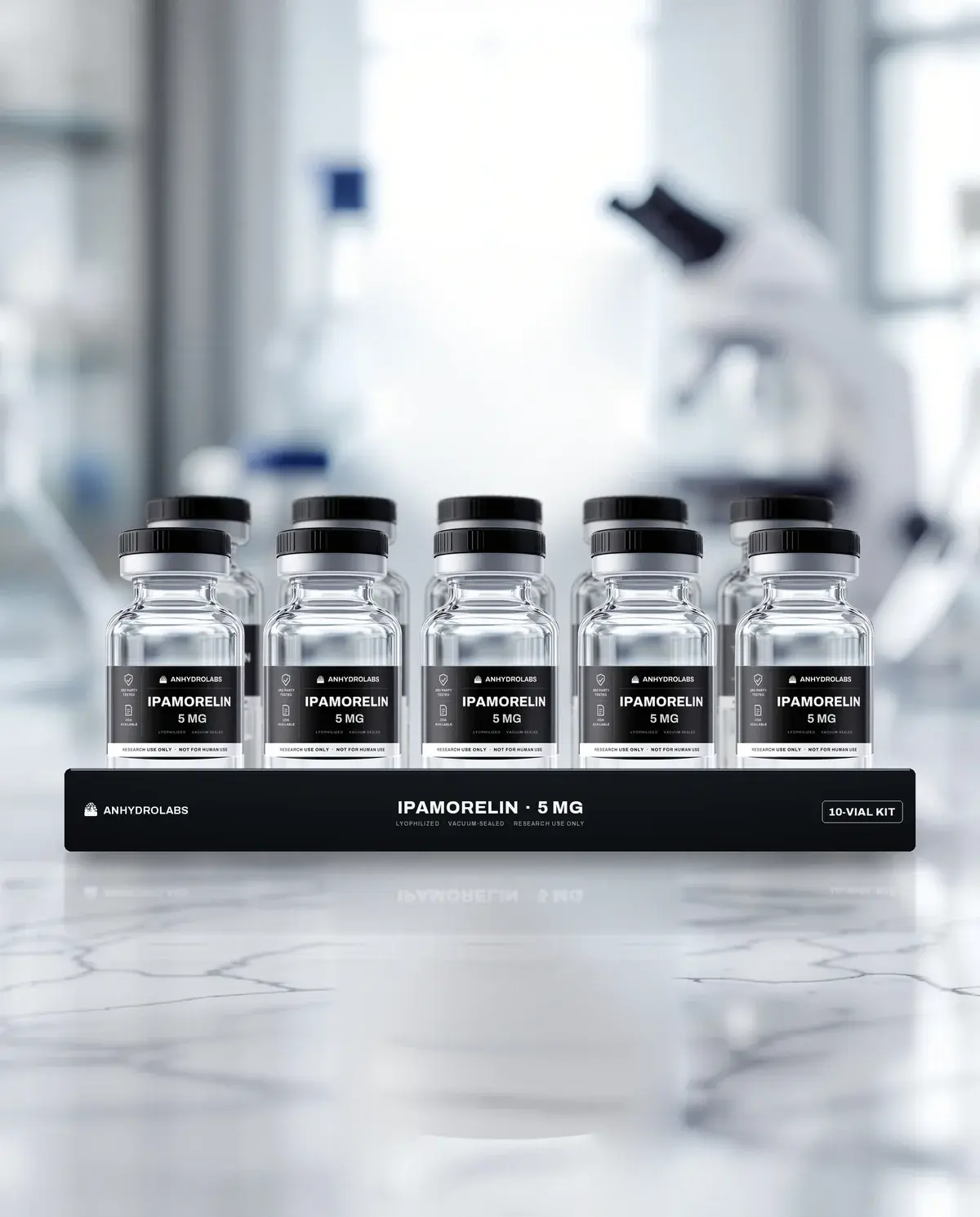
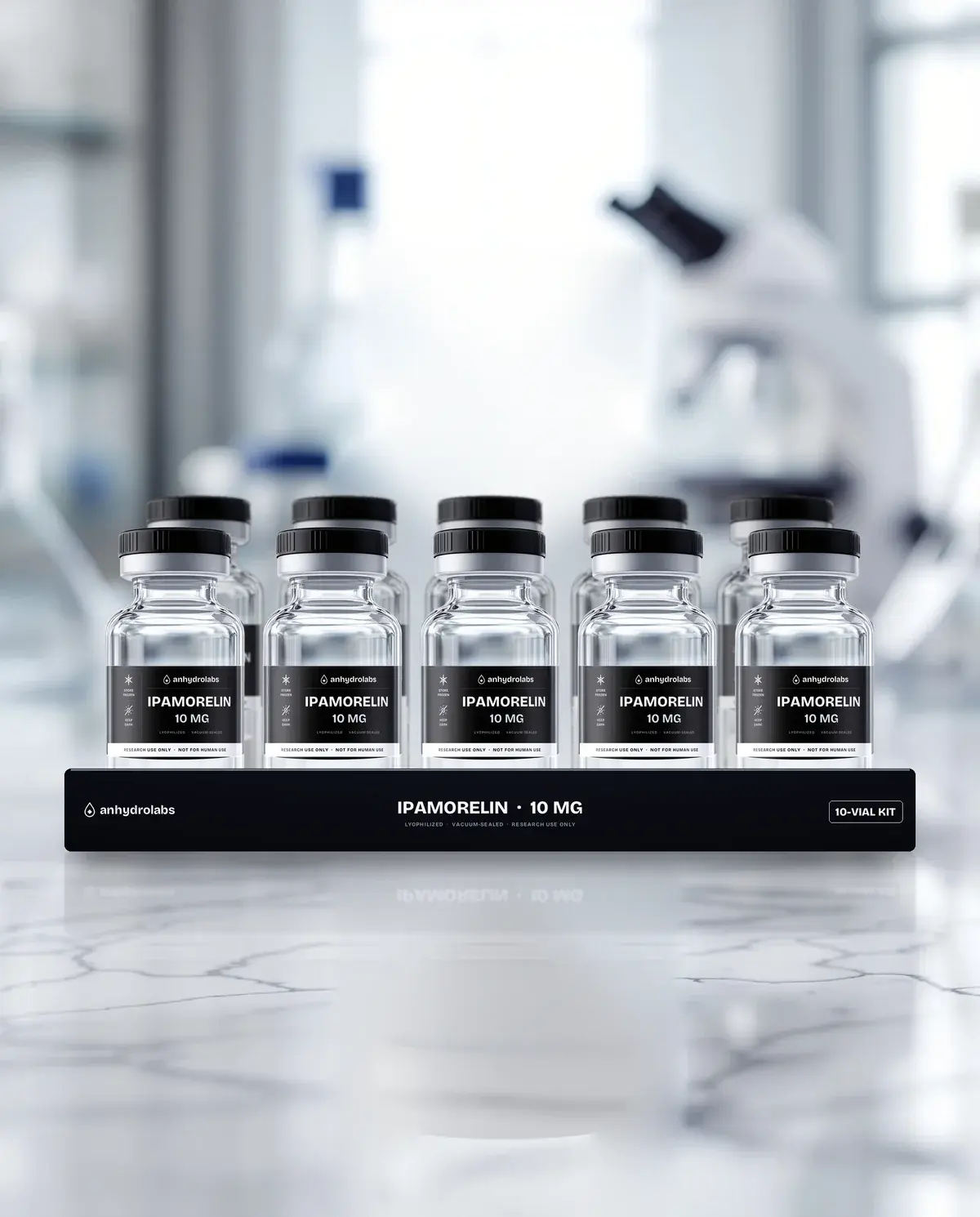
Also known as Ipa. Lyophilized, vacuum-sealed, 10-vial kit.
- CAS
- 170851-70-4
- Form
- Lyophilized powder
- Storage
- Frozen, in the dark
- Ships
- Kits by Dec 12, 2026
- Presale
- Ships within the US
- Pay by card or crypto
- All sales final
Ipamorelin is a synthetic pentapeptide, Aib-His-D-2-Nal-D-Phe-Lys-NH2, sometimes shortened to Ipa, that acts as an agonist at the receptor for growth hormone-releasing peptides, the ghrelin receptor. Scientists at Novo Nordisk described it in 1998 as the first agonist of that receptor whose selectivity for growth hormone release, in their animal experiments, resembled that of growth hormone-releasing hormone.
Supplied for laboratory research use only. Not for human or veterinary use, and not for diagnostic or therapeutic application.
Ipamorelin: compound data
- Molecular formula
- C38H49N9O5
- Molecular weight
- 711.9 g/mol
- CAS number
- 170851-70-4
- PubChem
- CID 9831659
- Form supplied
- Lyophilized powder, vacuum-sealed
- Concentration
- mg/mL and molarity calculator
Reference values from PubChem, the chemistry database of the US National Library of Medicine, for the compound as registered there.
About Ipamorelin
Structure of Ipamorelin
Ipamorelin has five residues: 2-aminoisobutyric acid (Aib, also called 2-methylalanine) at the N-terminus, L-histidine, D-3-(2-naphthyl)alanine, D-phenylalanine, and L-lysine carrying a C-terminal amide. Three of the five are not among the twenty protein amino acids, and FDA notes that these unnatural residues add to the complexity of characterizing the peptide. PubChem lists the code NNC 26-0161 and the international nonproprietary name ipamorelin, and records an acetate salt among the synonyms. It differs from growth hormone-releasing peptide 1 (GHRP-1) in lacking that peptide's central Ala-Trp dipeptide.
Where Ipamorelin comes from
Raun and colleagues in the Department of GH Biology at Novo Nordisk in Måløv, Denmark, published the compound in the European Journal of Endocrinology in 1998. They described it as the outcome of a major chemistry program and said it was identified within a series of compounds that lack the central Ala-Trp dipeptide of GHRP-1. The company code was NNC 26-0161. A later Phase 2 study was registered by Helsinn in 2008 under the same name. It is also sold under the short name Ipa.
What Ipamorelin binds
Using antagonists of GHRP and of growth hormone-releasing hormone (GHRH), the 1998 study showed that ipamorelin, like GHRP-6, stimulates growth hormone release through a GHRP-like receptor and not through the GHRH receptor. UniProt describes that receptor, growth hormone secretagogue receptor type 1, as a 366-residue G protein-coupled receptor specific to ghrelin that also binds growth hormone-releasing peptides. It is coupled to Gq proteins and, through phospholipase C, mediates production of diacylglycerol and inositol 1,4,5-trisphosphate. In primary rat pituitary cells ipamorelin released growth hormone with a half-maximal concentration of 1.3 nmol/L, close to the figure for GHRP-6.
Ipamorelin in the research literature
The founding paper used three systems: primary rat pituitary cells, pentobarbital-anesthetized rats, and conscious swine. In swine the authors measured plasma growth hormone alongside ACTH, cortisol, FSH, LH, prolactin and TSH to compare the hormone selectivity of ipamorelin with GHRP-6, GHRP-2 and GHRH. In human research, one Phase 2 trial is registered on ClinicalTrials.gov as NCT00672074: a randomized, placebo-controlled study sponsored by Helsinn and completed in 2009. FDA cites this study in its safety summary.
Regulatory status of Ipamorelin
Ipamorelin is an investigational compound; its most advanced registered study is the completed Phase 2 trial. FDA placed ipamorelin acetate in Category 2 of its interim policy for bulk substances nominated under section 503B on September 29, 2023, stating that compounded products containing it may pose a risk of immunogenicity from aggregation or peptide-related impurities. The same page also lists it among nominations withdrawn by the nominators. Ipamorelin is supplied here as a reference reagent for in-vitro laboratory research only, not for diagnostic or therapeutic application.
Handling Ipamorelin in the laboratory
The material is a lyophilized powder in a vacuum-sealed vial. Keep the sealed vial frozen at -4 °F and protected from light, and let it reach room temperature before breaking the seal so that moisture does not condense on the powder. Once in solution, keep it at 39 °F and plan to use it within about four weeks. Divide a solution into single-use aliquots instead of freezing and thawing one container repeatedly. No solubility or stability figure specific to ipamorelin appears in the sources consulted for this profile, so none is given here. PubChem lists an acetate salt alongside the free peptide, and the salt form changes the mass of material that corresponds to a given molar amount.
Sources
- Ipamorelin, the first selective growth hormone secretagogue (Raun et al., Eur J Endocrinol, 1998)
- PubChem compound summary: Ipamorelin, CID 9831659
- UniProt Q92847: Growth hormone secretagogue receptor type 1, human
- ClinicalTrials.gov NCT00672074
- Certain Bulk Drug Substances for Use in Compounding that May Present Significant Safety Risks (FDA, content current as of April 22, 2026)
Research notes on Ipamorelin
- CJC-1295 vs Ipamorelin, and DAC vs No DACCJC-1295 vs ipamorelin compared: GHRH vs ghrelin receptor, the four substitutions in mod GRF(1-29), and what the Drug Affinity Complex adds.
- Sermorelin vs Ipamorelin: GHRH vs Ghrelin PathwaysSermorelin vs ipamorelin: a GHRH(1-29) analog and a ghrelin-receptor pentapeptide compared by sequence, receptor, signaling and regulatory status.
Ipamorelin: common questions
Is Ipa the same as Ipamorelin?
Yes. Ipa is another name for Ipamorelin (CAS 170851-70-4). It is the same compound, supplied here as a lyophilized powder for in-vitro laboratory research use only.
What is Ipamorelin supplied as?
Ipamorelin is supplied as a lyophilized (freeze-dried) powder in a vacuum-sealed vial, in 5 mg and 10 mg, for in-vitro laboratory research use only.
Is Ipamorelin available as a 10-vial kit?
Yes. Ipamorelin comes in a 10-vial kit: 5 mg for $130.50 ($13.05 per vial); 10 mg for $225.00 ($22.50 per vial), presale prices. A kit is ten sealed vials of the same size, priced below ten single vials.
When do Ipamorelin presale kits ship?
By Dec 12, 2026. Presale kits are 10% off. If we cannot ship by Dec 12, 2026, we tell you before that date and you can cancel for a full refund.
What is the CAS number of Ipamorelin?
The CAS registry number of Ipamorelin is 170851-70-4.
How should Ipamorelin be stored?
Frozen at −4 °F and protected from light, from the day it arrives. Let the vial reach room temperature before breaking the seal; once reconstituted, stability holds for about four weeks refrigerated at 39 °F.
How fast does Ipamorelin ship?
Presale kits ship from the United States by Dec 12, 2026, to US addresses. Sizes marked in stock ship within 1 business day of payment.
Is Ipamorelin for human use?
No. It is supplied as a reference reagent for laboratory research use. Not for human or veterinary use, and not for diagnostic or therapeutic application.
What is the amino acid sequence of ipamorelin?
Ipamorelin is Aib-His-D-2-Nal-D-Phe-Lys-NH2. Aib is 2-aminoisobutyric acid, D-2-Nal is D-3-(2-naphthyl)alanine, and the C-terminal lysine is an amide. Only the histidine and the lysine are standard L-amino acids.
What receptor does ipamorelin bind?
Ipamorelin acts at the receptor for growth hormone-releasing peptides, which UniProt lists as growth hormone secretagogue receptor type 1, the receptor for ghrelin. The 1998 study established this with GHRP and GHRH antagonists. The receptor couples to Gq and phospholipase C.
Who developed ipamorelin?
Ipamorelin came from a chemistry program at Novo Nordisk in Måløv, Denmark, and was published by Raun and colleagues in 1998 under the code NNC 26-0161. It was found in a series of compounds lacking the central Ala-Trp dipeptide of GHRP-1. Helsinn later sponsored a Phase 2 study of it.
$130.50
Ipamorelin · 5 mg · 10-vial kit