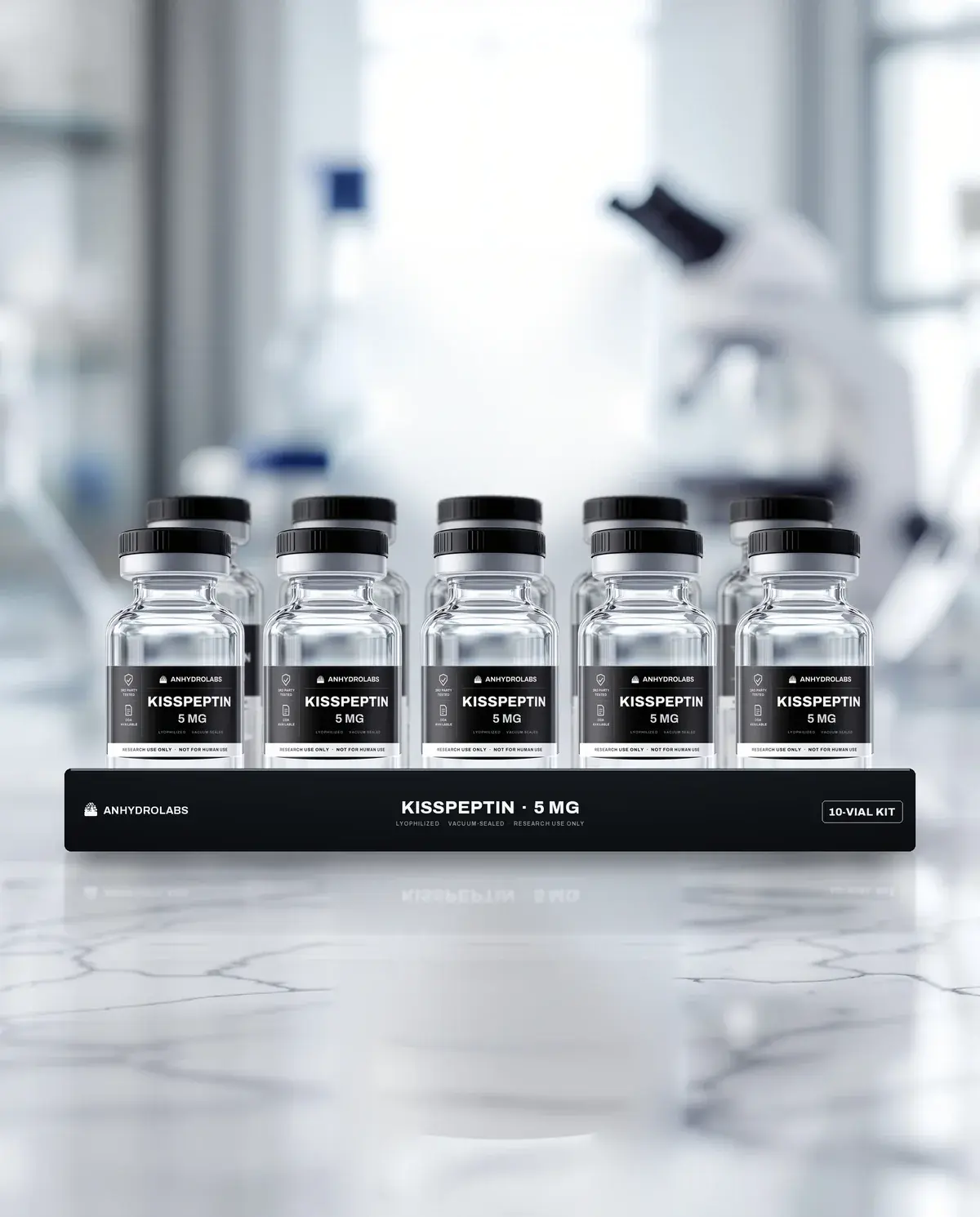
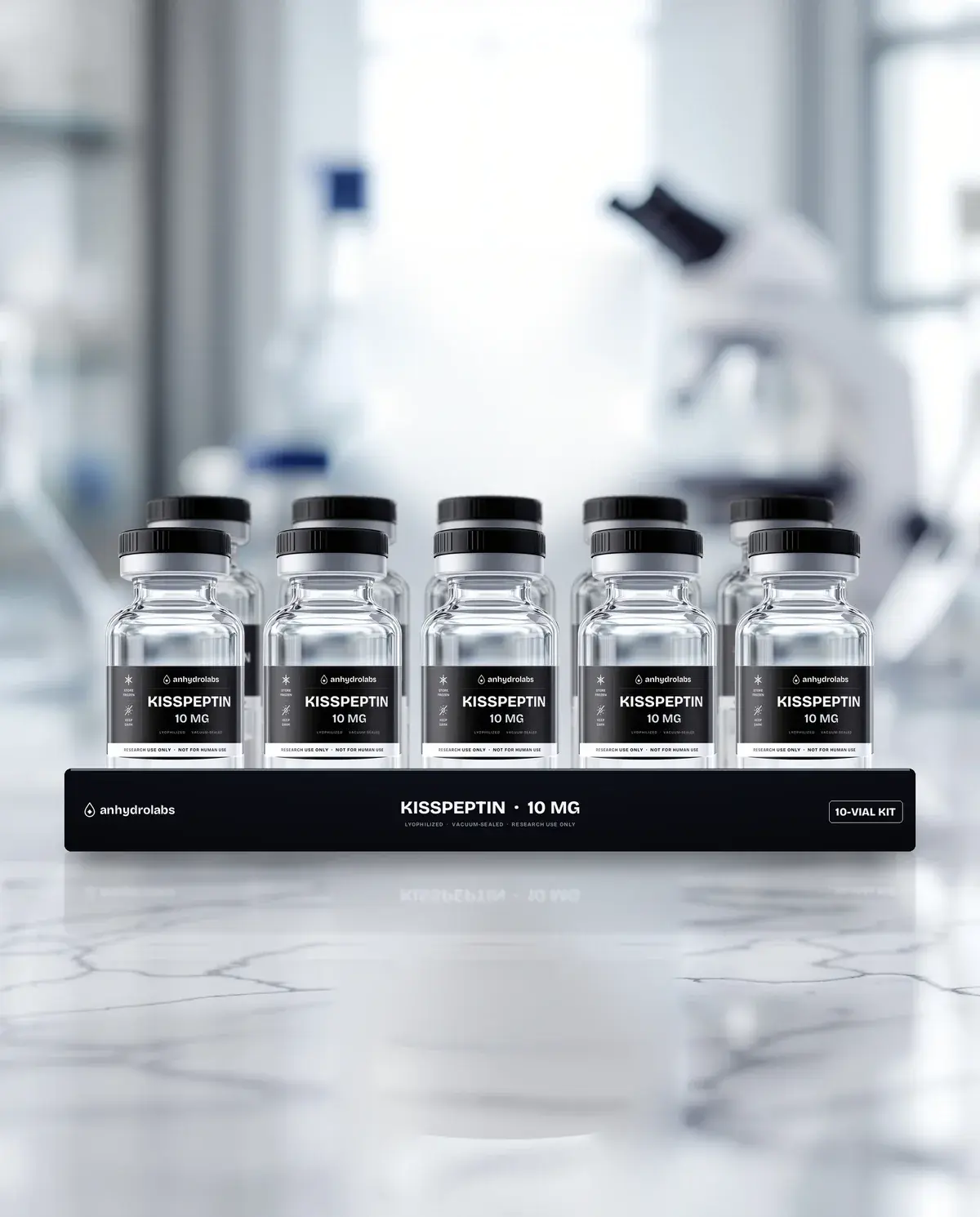
Kisspeptin
Also known as Kisspeptin-10 and KP-10. Lyophilized, vacuum-sealed, 10-vial kit.
- CAS
- 374675-21-5
- Form
- Lyophilized powder
- Storage
- Frozen, in the dark
- Ships
- Kits by Dec 12, 2026
- Presale
- Ships within the US
- Pay by card or crypto
- All sales final
Kisspeptin is the name for a family of peptides cut from the product of the human KISS1 gene, and the reagent sold under that name is usually kisspeptin-10 (KP-10), the ten-residue C-terminal fragment Tyr-Asn-Trp-Asn-Ser-Phe-Gly-Leu-Arg-Phe-NH2. Kisspeptins are the natural ligands of the G protein-coupled receptor KISS1R, also called GPR54, and are known for their part in controlling gonadotropin-releasing hormone neurons.
Supplied for laboratory research use only. Not for human or veterinary use, and not for diagnostic or therapeutic application.
Kisspeptin: compound data
- Molecular formula
- C63H83N17O14
- Molecular weight
- 1,302.4 g/mol
- CAS number
- 374675-21-5
- PubChem
- CID 25240297
- Form supplied
- Lyophilized powder, vacuum-sealed
- Concentration
- mg/mL and molarity calculator
Reference values from PubChem, the chemistry database of the US National Library of Medicine, for the compound as registered there.
About Kisspeptin
Structure of Kisspeptin
Kisspeptin-10 is a linear decapeptide ending in a phenylalanine amide. UniProt maps it to residues 112 to 121 of the 138-residue KISS1 precursor, which also yields kisspeptin-13 (residues 109 to 121), kisspeptin-14 (108 to 121) and the 54-residue peptide called metastin or kisspeptin-54 (68 to 121). All four share the same C-terminus, Arg-Phe-NH2, the feature that the 2001 discovery paper called a common RF-amide C terminus. PubChem lists kisspeptin-10 under the synonyms KP-10 and metastin 45-54, the second name counting from the start of the 54-residue peptide.
Where Kisspeptin comes from
The gene came first. KiSS-1 was known as a metastasis suppressor gene for melanoma cells before any peptide product was identified. In 2001 Kotani and colleagues in Brussels isolated peptides of 54, 14 and 13 residues from human placenta as natural agonists of the orphan receptor GPR54, showed that they derive from the KiSS-1 product, and named them kisspeptins. In 2003 Seminara and colleagues reported GPR54 mutations in a human genetic study and described a Gpr54-deficient mouse, which tied the receptor to gonadotropin-releasing hormone physiology. The receptor is now named KISS1R.
What Kisspeptin binds
Kisspeptins bind KISS1R, a G protein-coupled receptor. Kotani and colleagues measured low nanomolar binding to rat and human GPR54 expressed in Chinese hamster ovary cells, followed by hydrolysis of phosphatidylinositol 4,5-bisphosphate, calcium mobilization, arachidonic acid release and phosphorylation of ERK1/2 and p38 MAP kinase. UniProt summarizes the pathway in gonadotropin-releasing hormone neurons: Gq-dependent activation of phospholipase C raises intracellular calcium, which inhibits inward rectifier potassium channels and activates TRPC-like cation channels, depolarizing the neuron. A second, Gq-independent route through beta-arrestin leads to ERK1 and ERK2 phosphorylation.
Kisspeptin in the research literature
Recombinant receptor systems are the commonest format: CHO-K1 cells expressing GPR54 in the 2001 work, and COS-7 cells transfected with mutant receptors in the 2003 study, where accumulation of inositol phosphate was the readout. Animal work includes the Gpr54-deficient mouse line. In human research, ClinicalTrials.gov lists Phase 1 and Phase 2 studies with kisspeptin peptides as the intervention, most of them run by academic hospitals such as Massachusetts General Hospital and Imperial College London and concerned with the reproductive hormone axis. A registration records that a study exists and says nothing about its outcome.
Regulatory status of Kisspeptin
Kisspeptin-10 is investigational. FDA added it to Category 2 of its interim policy for bulk substances nominated under section 503A on September 29, 2023, stating that compounded products containing it may pose a risk of immunogenicity and that the agency has no, or only limited, safety-related information for the proposed uses. The entry was still in Category 2 on the page as current on April 22, 2026. Kisspeptin is supplied here as a reference reagent for in-vitro laboratory research only, not for diagnostic or therapeutic application.
Handling Kisspeptin in the laboratory
The material is a lyophilized powder in a vacuum-sealed vial. Keep the sealed vial frozen at -4 °F and protected from light, and let it reach room temperature before breaking the seal so that moisture does not condense on the powder. Once in solution, keep it at 39 °F and plan to use it within about four weeks. Divide a solution into single-use aliquots instead of freezing and thawing one container repeatedly. No solubility or stability figure specific to kisspeptin-10 appears in the sources consulted for this profile, so none is given here. The C-terminal amide is part of the identity of the peptide: UniProt annotates residue 121 as a phenylalanine amide in every kisspeptin.
Sources
- PubChem compound summary: Kisspeptin-10, CID 25240297
- UniProt Q15726: Metastasis-suppressor KiSS-1, human
- The metastasis suppressor gene KiSS-1 encodes kisspeptins, the natural ligands of the orphan G protein-coupled receptor GPR54 (Kotani et al., J Biol Chem, 2001)
- The GPR54 gene as a regulator of puberty (Seminara et al., N Engl J Med, 2003)
- ClinicalTrials.gov: registered studies with kisspeptin as the intervention
- Certain Bulk Drug Substances for Use in Compounding that May Present Significant Safety Risks (FDA, content current as of April 22, 2026)
Research notes on Kisspeptin
- Kisspeptin: KISS1R Signaling in ResearchWhat the kisspeptin peptide is: how kisspeptin-10 and kisspeptin-54 signal through KISS1R to control reproductive hormone release, and lab handling.
Kisspeptin: common questions
Is Kisspeptin-10 the same as Kisspeptin?
Yes. Kisspeptin-10 is another name for Kisspeptin, which is also written KP-10 (CAS 374675-21-5). It is the same compound, supplied here as a lyophilized powder for in-vitro laboratory research use only.
What is Kisspeptin supplied as?
Kisspeptin is supplied as a lyophilized (freeze-dried) powder in a vacuum-sealed vial, in 5 mg and 10 mg, for in-vitro laboratory research use only.
Is Kisspeptin available as a 10-vial kit?
Yes. Kisspeptin comes in a 10-vial kit: 5 mg for $103.50 ($10.35 per vial); 10 mg for $198.00 ($19.80 per vial), presale prices. A kit is ten sealed vials of the same size, priced below ten single vials.
When do Kisspeptin presale kits ship?
By Dec 12, 2026. Presale kits are 10% off. If we cannot ship by Dec 12, 2026, we tell you before that date and you can cancel for a full refund.
What is the CAS number of Kisspeptin?
The CAS registry number of Kisspeptin is 374675-21-5.
How should Kisspeptin be stored?
Frozen at −4 °F and protected from light, from the day it arrives. Let the vial reach room temperature before breaking the seal; once reconstituted, stability holds for about four weeks refrigerated at 39 °F.
How fast does Kisspeptin ship?
Presale kits ship from the United States by Dec 12, 2026, to US addresses. Sizes marked in stock ship within 1 business day of payment.
Is Kisspeptin for human use?
No. It is supplied as a reference reagent for laboratory research use. Not for human or veterinary use, and not for diagnostic or therapeutic application.
What is the sequence of kisspeptin-10?
Kisspeptin-10 is Tyr-Asn-Trp-Asn-Ser-Phe-Gly-Leu-Arg-Phe-NH2, a decapeptide with a C-terminal phenylalanine amide. It corresponds to residues 112 to 121 of the 138-residue human KISS1 precursor in UniProt, and to positions 45 to 54 of the 54-residue peptide metastin.
What receptor does kisspeptin bind?
Kisspeptins bind KISS1R, a G protein-coupled receptor that was an orphan known as GPR54 until 2001. The receptor signals through Gq and phospholipase C, with a rise in intracellular calcium, and also through beta-arrestin to ERK1 and ERK2.
How is kisspeptin-10 different from kisspeptin-54?
Both come from the same KISS1 precursor and end at the same amidated phenylalanine. Kisspeptin-54, also called metastin, spans residues 68 to 121, while kisspeptin-10 is only the last ten, residues 112 to 121. UniProt lists both, with kisspeptin-13 and kisspeptin-14, as ligands of KISS1R.
$103.50
Kisspeptin · 5 mg · 10-vial kit