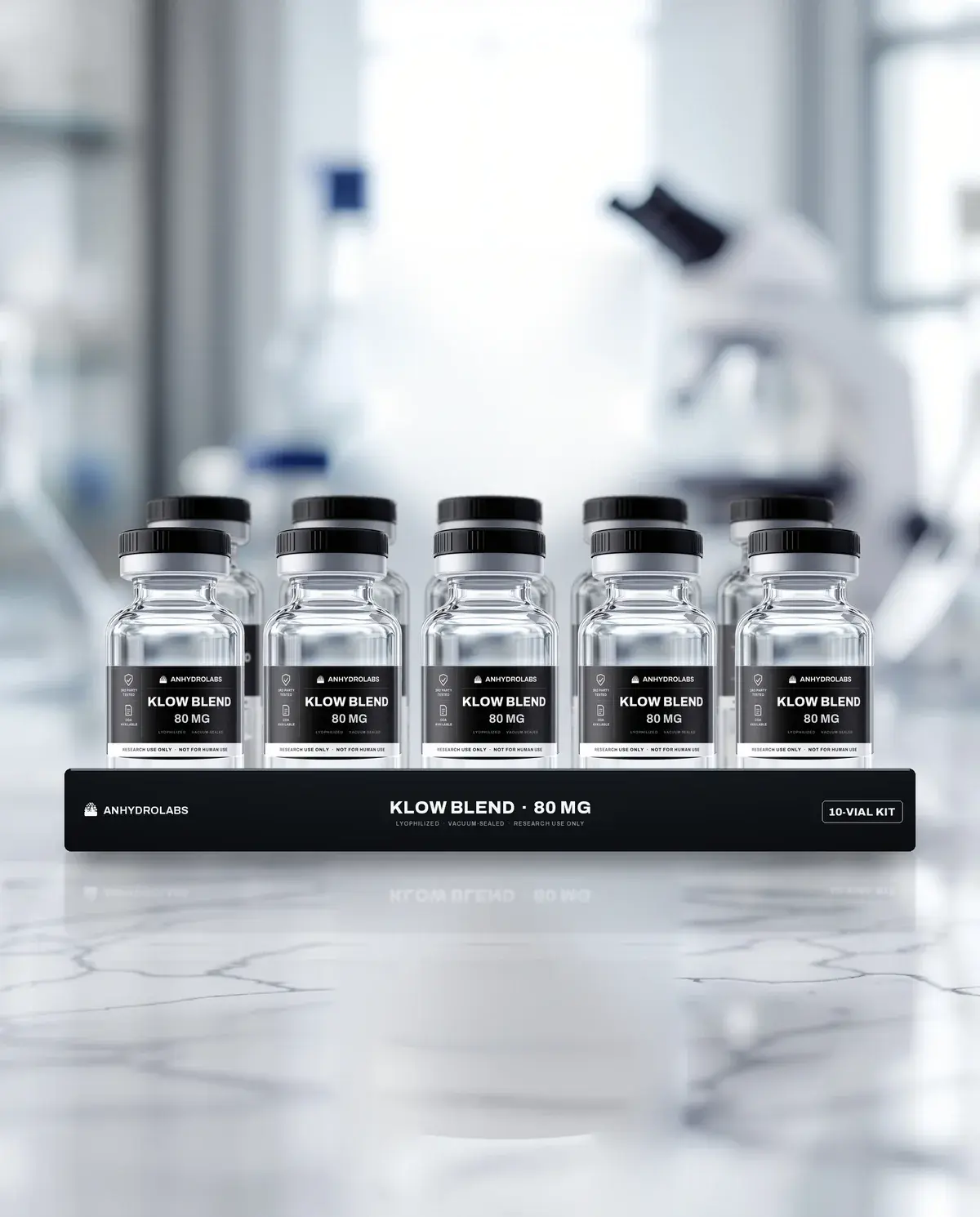
 ×10 · 10-vial kit
KLOW Blend
Lyophilized, vacuum-sealed, 10-vial kit.
- Form
- Lyophilized powder
- Storage
- Frozen, in the dark
- Ships
- Kits by Dec 12, 2026
- Presale
- Ships within the US
- Pay by card or crypto
- All sales final
KLOW is a supplier name for a blend of four research peptides in one lyophilized vial: GHK-Cu, KPV, BPC-157 and TB-500. It is not a compound name from the scientific literature. Each component has publications of its own, mostly in cell culture and animal models, and no published study has examined the four together, so what is known about KLOW is what is known about its parts.
Supplied for laboratory research use only. Not for human or veterinary use, and not for diagnostic or therapeutic application.
About KLOW Blend
Structure of KLOW Blend
An 80 mg vial contains GHK-Cu 50 mg, KPV 10 mg, BPC-157 10 mg and TB-500 10 mg. GHK-Cu is the copper(II) complex of the tripeptide glycyl-L-histidyl-L-lysine; PubChem holds the one-to-one complex under the name prezatide copper. KPV is the tripeptide Lys-Pro-Val. BPC-157 is a synthetic peptide of 15 amino acids. TB-500 is the acetylated heptapeptide Ac-Leu-Lys-Lys-Thr-Glu-Thr-Gln, residues 17 to 23 of thymosin beta 4. Being a mixture, KLOW has no single formula, molecular weight or registry number. The GLOW blend is the same combination without KPV.
Where KLOW Blend comes from
The components come from four unrelated lines of work. Pickart and colleagues reported in Nature in 1980 that the plasma tripeptide co-isolated with roughly equimolar copper and readily forms complexes with copper(II). KPV was the subject of a 2008 study from Emory University on its uptake into intestinal cells. BPC-157 was described in 1993 by Sikiric and colleagues in Zagreb as a 15-amino-acid fragment of BPC, a protein isolated from gastric juice. TB-500 entered the literature in 2012, when a doping control laboratory at Ghent University identified the acetylated 17-23 fragment of thymosin beta 4 in a product sold under that name. The name KLOW comes from suppliers.
What KLOW Blend binds
No mechanism has been described for the blend, and the component data should not be assumed to add up. For GHK, the 1980 paper proposed that the tripeptide acts as a copper transport factor, having shown that it enhanced copper uptake into cultured hepatoma cells. For KPV, a 2008 study reported uptake by the di- and tripeptide transporter PepT1 and inhibition of NF-kappaB and MAP kinase activation in cytokine-stimulated cells. The 1993 BPC paper called that peptide's final mechanism poorly understood. The TB-500 paper is analytical and describes detection, not a mechanism. Whether copper moves between the peptides in a mixed solution has not been reported.
KLOW Blend in the research literature
Each component has been studied in its own systems. GHK was examined in HTC4 hepatoma cell cultures. KPV was studied in the human intestinal lines Caco2-BBE and HT29-Cl.19A, in Jurkat T cells, and in two mouse models of colitis. The BPC-157 overview summarizes experiments in several animal species. The TB-500 work synthesized the heptapeptide and proposed mass spectrometry methods for finding it in plasma and urine. FDA states that it has not identified human exposure data for KPV or for the thymosin beta-4 fragment. No study of the four-peptide combination, in cells, animals or people, was found.
Regulatory status of KLOW Blend
KLOW is not an approved product, and FDA's page on bulk substances that may present significant safety risks, current as of April 22, 2026, lists all four components among nominations withdrawn by the nominators, with GHK-Cu limited to injectable forms. For KPV and for the thymosin beta-4 fragment, FDA states that it has not identified any human exposure data; for BPC-157 and GHK-Cu it cites a possible risk of immunogenicity and limited safety information. KLOW is supplied here as a reference reagent for in-vitro laboratory research only, not for diagnostic or therapeutic application.
Handling KLOW Blend in the laboratory
The material is a lyophilized powder in a vacuum-sealed vial. Keep the sealed vial frozen at -4 °F and protected from light, and let it reach room temperature before breaking the seal so that moisture does not condense on the powder. Once in solution, keep it at 39 °F and plan to use it within about four weeks. Divide a solution into single-use aliquots instead of freezing and thawing one container repeatedly. No solubility or stability figure for the four-peptide mixture appears in the sources consulted, so none is given here. Because the components differ about fourfold in size, their masses in the vial are far from equal molar amounts, and GHK-Cu is the largest share by either measure.
Sources
- Growth-modulating plasma tripeptide may function by facilitating copper uptake into cells (Pickart et al., Nature, 1980)
- PubChem compound summary: Prezatide copper, CID 71587328
- Dalmasso et al., Gastroenterology, 2008. PubMed Central PMC2431115
- A new gastric juice peptide, BPC. An overview of the stomach-stress-organoprotection hypothesis and beneficial effects of BPC (Sikiric et al., J Physiol Paris, 1993)
- Esposito et al., Drug Test Anal, 2012. PubMed 22962027
- Certain Bulk Drug Substances for Use in Compounding that May Present Significant Safety Risks (FDA, content current as of April 22, 2026)
Research notes on KLOW Blend
- KLOW Peptide Blend: What Is in ItThe KLOW peptide blend is four peptides in one 80mg vial: GHK-Cu, KPV, BPC-157 and TB-500. What each is, the molar ratios, COA checks and KLOW vs GLOW.
KLOW Blend: common questions
What is KLOW Blend supplied as?
KLOW Blend is supplied as a lyophilized (freeze-dried) powder in a vacuum-sealed vial, in 80 mg, for in-vitro laboratory research use only.
Is KLOW Blend available as a 10-vial kit?
Yes. KLOW Blend comes in a 10-vial kit: 80 mg for $450.00 ($45.00 per vial), presale prices. A kit is ten sealed vials of the same size, priced below ten single vials.
When do KLOW Blend presale kits ship?
By Dec 12, 2026. Presale kits are 10% off. If we cannot ship by Dec 12, 2026, we tell you before that date and you can cancel for a full refund.
How should KLOW Blend be stored?
Frozen at −4 °F and protected from light, from the day it arrives. Let the vial reach room temperature before breaking the seal; once reconstituted, stability holds for about four weeks refrigerated at 39 °F.
How fast does KLOW Blend ship?
Presale kits ship from the United States by Dec 12, 2026, to US addresses. Sizes marked in stock ship within 1 business day of payment.
Is KLOW Blend for human use?
No. It is supplied as a reference reagent for laboratory research use. Not for human or veterinary use, and not for diagnostic or therapeutic application.
What peptides are in the KLOW blend?
Four: GHK-Cu, the copper(II) complex of glycyl-L-histidyl-L-lysine; KPV, the tripeptide Lys-Pro-Val; BPC-157, a 15-residue peptide; and TB-500, the acetylated heptapeptide Ac-Leu-Lys-Lys-Thr-Glu-Thr-Gln. An 80 mg vial holds 50 mg of GHK-Cu and 10 mg of each of the other three.
How is KLOW different from GLOW?
The two blends share three components: GHK-Cu, BPC-157 and TB-500. KLOW adds a fourth, the tripeptide KPV (Lys-Pro-Val), which a 2008 study reported is taken up into cells by the transporter PepT1. Neither name comes from the scientific literature; both are supplier designations.
Has the KLOW combination been studied?
No published study of the four peptides together was found. Each component has its own literature, mostly in cell culture and animal models, and nothing in it describes how the peptides behave in one solution. The blend is best treated as its own material and not as the sum of four known ones.
$450.00
KLOW Blend · 80 mg · 10-vial kit