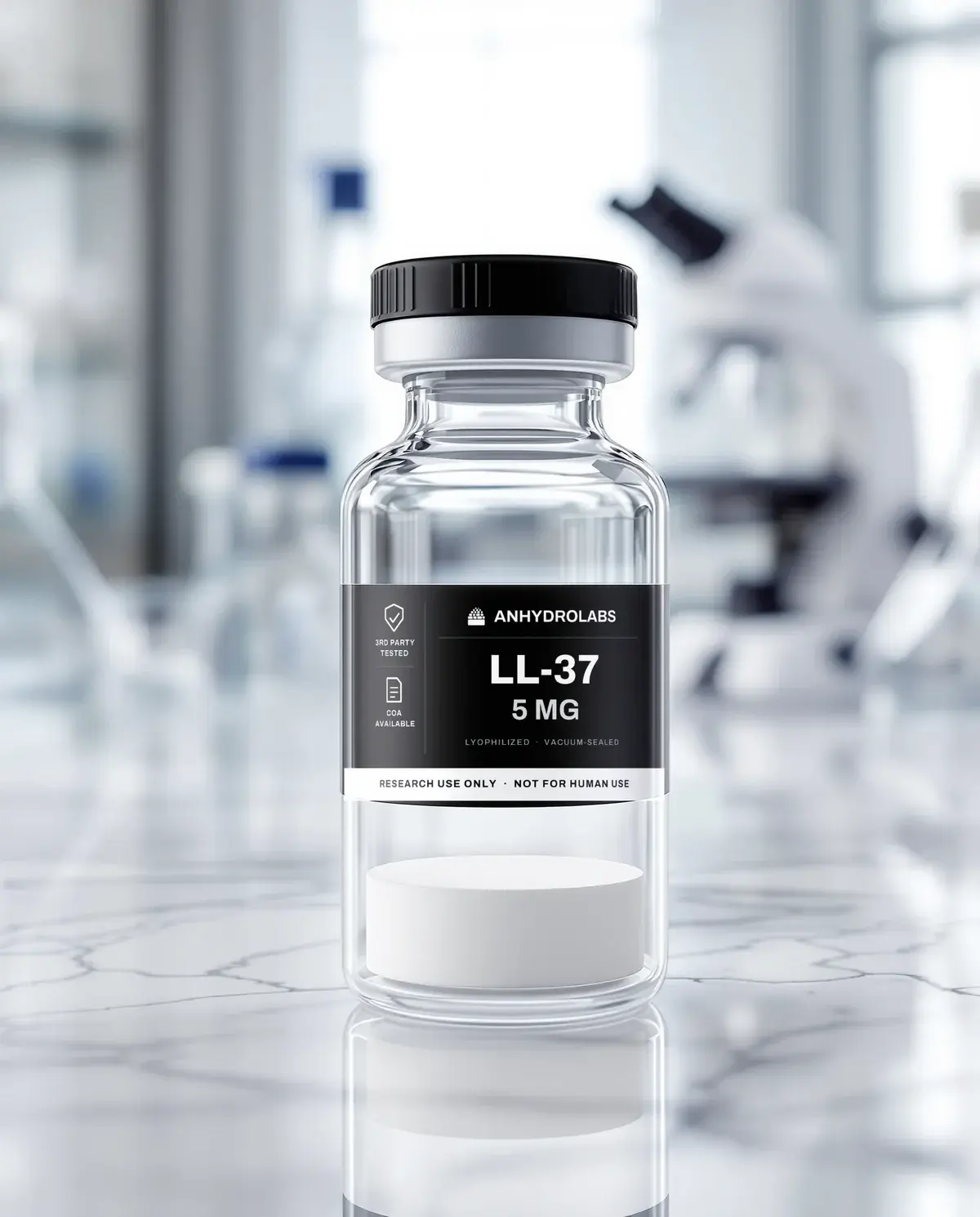
LL-37
Also known as cathelicidin LL-37. Lyophilized, vacuum-sealed, single vial.
- CAS
- 154947-66-7
- Form
- Lyophilized powder
- Storage
- Frozen, in the dark
- Ships
- Within the US
Get an email when LL-37 is available
- Coming soon
- Ships within the US
- Pay by card or crypto
- All sales final
LL-37 is a 37-residue antimicrobial peptide, also written cathelicidin LL-37, released from the C-terminus of the human precursor protein hCAP-18. The 1996 paper that characterized its gene concluded it is the only member of the cathelin family in the human genome. In the literature it is known for binding bacterial lipopolysaccharide, permeabilizing membranes in vitro, and signaling through a formyl peptide receptor on leukocytes.
Supplied for laboratory research use only. Not for human or veterinary use, and not for diagnostic or therapeutic application.
LL-37: compound data
- Molecular formula
- C205H340N60O53
- Molecular weight
- 4,493 g/mol
- CAS number
- 154947-66-7
- PubChem
- CID 16198951
- Form supplied
- Lyophilized powder, vacuum-sealed
- Concentration
- mg/mL and molarity calculator
Reference values from PubChem, the chemistry database of the US National Library of Medicine, for the compound as registered there.
About LL-37
Structure of LL-37
LL-37 is a linear peptide of 37 amino acids with the one-letter sequence LLGDFFRKSKEKIGKEFKRIVQRIKDFLRNLVPRTES, which UniProt maps to residues 134 to 170 of the 170-residue CAMP gene product. The name records its two leading leucines and its length. The chain holds six lysines and five arginines against two aspartates and three glutamates, so it is strongly cationic. It has no cysteine, and therefore no disulfide bond, and no tryptophan or tyrosine. UniProt also lists shorter peptides cut from the same region, among them FF-33, RK-31, KS-30 and KR-20, and the longer predicted form FALL-39 at residues 132 to 170.
Where LL-37 comes from
The peptide was first predicted from an open reading frame in a cDNA clone from a human bone marrow library and called FALL-39. In 1996 Gudmundsson, Agerberth and colleagues at Stockholm University sequenced the complete gene, a compact 1,963 base pair gene of four exons in which exon 4 carries the mature peptide, and isolated the natural peptide from granulocytes after degranulation. Structural analysis showed it to be two residues shorter than predicted, hence LL-37. UniProt names the precursor cathelicidin antimicrobial peptide, with the alternative names CAP-18 and hCAP-18, and records that proteinase 3 cleaves it to give LL-37.
What LL-37 binds
UniProt summarizes in-vitro evidence that LL-37 binds bacterial lipopolysaccharide and permeabilizes membranes by forming transmembrane pores. Wang's 2008 NMR structure in SDS micelles shows a curved amphipathic helix-bend-helix spanning residues 2 to 31, a bend between Gly-14 and Glu-16, and a disordered C-terminal tail, with the four phenylalanine rings and the arginines in contact with anionic lipid. On host cells, De Yang and colleagues reported in 2000 that LL-37 induces calcium mobilization through formyl peptide receptor-like 1, a G protein-coupled receptor, in human monocytes and in HEK 293 cells transfected with that receptor.
LL-37 in the research literature
Work on LL-37 spans several systems. Structural studies use isotope-labeled peptide in detergent and phospholipid micelles. Antibacterial assays use cultured bacteria such as Escherichia coli, and UniProt records oligomers of the peptide in solution. Receptor studies have used human peripheral blood monocytes, neutrophils and T lymphocytes in chemotaxis assays, together with receptor-transfected HEK 293 cells. Fragment studies compare shortened forms; Wang identified KR-12, residues 18 to 29, as the smallest antibacterial fragment in that work. In people, ClinicalTrials.gov lists a completed Phase 1/2 study of LL-37 sponsored by M.D. Anderson Cancer Center, NCT02225366.
Regulatory status of LL-37
LL-37 is not the active ingredient of an FDA-approved drug. On FDA's page about bulk substances that may present significant safety risks in compounding, current as of April 22, 2026, cathelicidin LL-37 appears among nominations that were withdrawn, with the agency noting a possible risk of immunogenicity and complexities with peptide-related impurities and characterization of the substance. A registered trial is not an approval. Here LL-37 is supplied as a reference reagent for in-vitro laboratory research only, not for human or veterinary diagnosis, treatment, or consumption.
Handling LL-37 in the laboratory
LL-37 arrives lyophilized in a vacuum-sealed vial. Keep the sealed vial frozen at -4 °F and protected from light, and let it reach room temperature before breaking the seal so that moisture does not condense on the powder. Once in solution, hold it at about 39 °F and use it within roughly four weeks; divide a stock into single-use aliquots instead of freezing and thawing one tube repeatedly. Because the sequence has no tryptophan or tyrosine, absorbance at 280 nm is a poor measure of concentration for this peptide, and its conformation in published work depends on the lipid or detergent present.
Sources
- UniProt P49913: Cathelicidin antimicrobial peptide (CAMP), human
- Intratumoral Injections of LL37 for Melanoma, NCT02225366 (ClinicalTrials.gov)
- The human gene FALL39 and processing of the cathelin precursor to the antibacterial peptide LL-37 in granulocytes (Gudmundsson et al., Eur J Biochem, 1996)
- Structures of human host defense cathelicidin LL-37 and its smallest antimicrobial peptide KR-12 in lipid micelles (Wang, J Biol Chem, 2008)
- LL-37, the neutrophil granule- and epithelial cell-derived cathelicidin, utilizes formyl peptide receptor-like 1 (FPRL1) as a receptor (De Yang et al., J Exp Med, 2000)
- Certain Bulk Drug Substances for Use in Compounding that May Present Significant Safety Risks (FDA)
Research notes on LL-37
- LL-37: The Human Cathelicidin PeptideLL-37 peptide explained: the 37-residue human cathelicidin cut from hCAP-18. Sequence, formula, CAS, helical structure, receptors studied and lab handling.
LL-37: common questions
Is cathelicidin LL-37 the same as LL-37?
Yes. cathelicidin LL-37 is another name for LL-37 (CAS 154947-66-7). It is the same compound, supplied here as a lyophilized powder for in-vitro laboratory research use only.
What is LL-37 supplied as?
LL-37 is supplied as a lyophilized (freeze-dried) powder in a vacuum-sealed vial, in 5 mg, for in-vitro laboratory research use only.
When will LL-37 be available?
LL-37 is coming soon. Join the newsletter on this page to get an email as soon as it can be ordered.
What is the CAS number of LL-37?
The CAS registry number of LL-37 is 154947-66-7.
How should LL-37 be stored?
Frozen at −4 °F and protected from light, from the day it arrives. Let the vial reach room temperature before breaking the seal; once reconstituted, stability holds for about four weeks refrigerated at 39 °F.
How fast does LL-37 ship?
Orders ship from the United States, to US addresses. Sizes in stock ship within 1 business day of payment.
Is LL-37 for human use?
No. It is supplied as a reference reagent for laboratory research use. Not for human or veterinary use, and not for diagnostic or therapeutic application.
What is the amino acid sequence of LL-37?
LL-37 is LLGDFFRKSKEKIGKEFKRIVQRIKDFLRNLVPRTES, 37 residues with free termini. UniProt places it at residues 134 to 170 of the human CAMP gene product, entry P49913. The name comes from the two leucines at its start and its length.
What receptor does LL-37 bind on human cells?
A 2000 study in the Journal of Experimental Medicine identified formyl peptide receptor-like 1, a G protein-coupled receptor, as a receptor for LL-37. The peptide induced calcium mobilization in monocytes and in HEK 293 cells transfected with the receptor, and it was chemotactic for neutrophils, monocytes and T cells in vitro.
Is LL-37 approved by the FDA?
No. LL-37 is not the active ingredient of any FDA-approved drug. FDA's compounding page lists cathelicidin LL-37 among bulk substance nominations that were withdrawn, and notes possible immunogenicity and impurity concerns for compounded products containing it.