Oxytocin
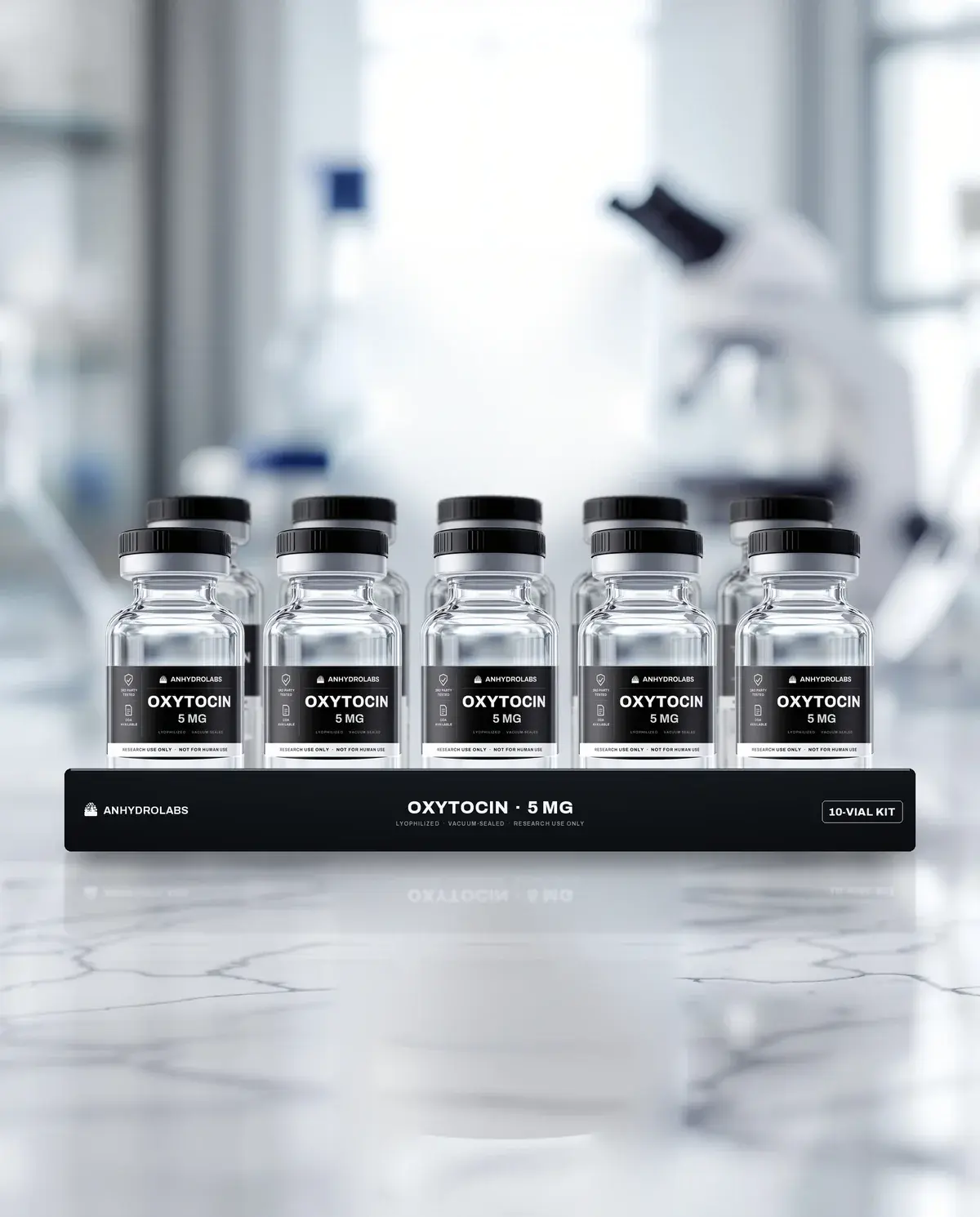
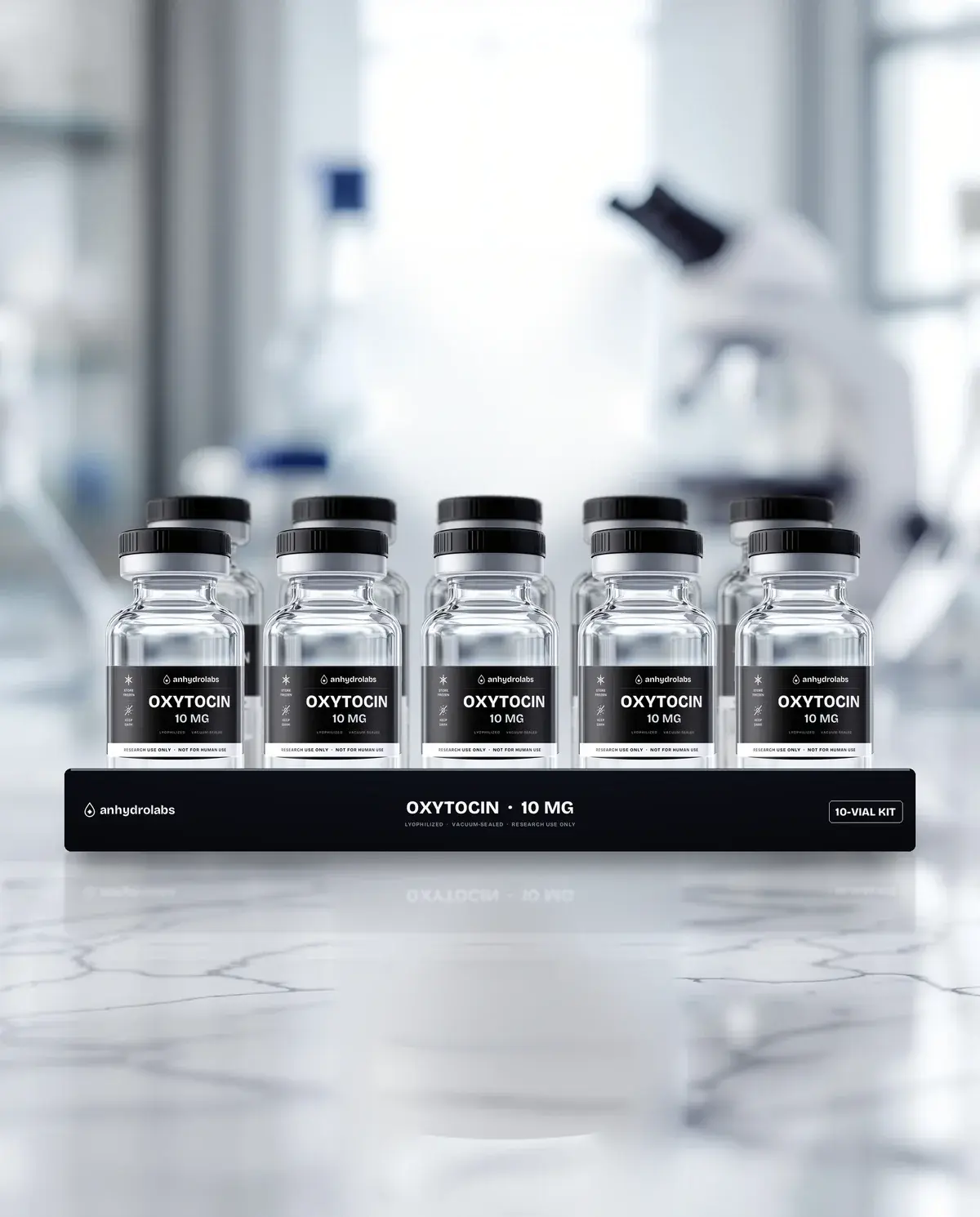
Lyophilized, vacuum-sealed, 10-vial kit.
- CAS
- 50-56-6
- Form
- Lyophilized powder
- Storage
- Frozen, in the dark
- Ships
- Kits by Dec 12, 2026
- Presale
- Ships within the US
- Pay by card or crypto
- All sales final
Oxytocin is a cyclic nonapeptide hormone with the sequence CYIQNCPLG, closed by a disulfide bond between its two cysteines and ending in a glycine amide. It is made in hypothalamic neurons, released from the posterior pituitary, and acts through the oxytocin receptor, a G protein-coupled receptor. Its amino acid sequence was published in 1953 by du Vigneaud, Ressler and Trippett, and synthetic oxytocin is an FDA-approved drug substance.
Supplied for laboratory research use only. Not for human or veterinary use, and not for diagnostic or therapeutic application.
Oxytocin: compound data
- Molecular formula
- C43H66N12O12S2
- Molecular weight
- 1,007.2 g/mol
- CAS number
- 50-56-6
- PubChem
- CID 439302
- Form supplied
- Lyophilized powder, vacuum-sealed
- Concentration
- mg/mL and molarity calculator
Reference values from PubChem, the chemistry database of the US National Library of Medicine, for the compound as registered there.
About Oxytocin
Structure of Oxytocin
Oxytocin has nine residues, Cys-Tyr-Ile-Gln-Asn-Cys-Pro-Leu-Gly. UniProt records a disulfide bond between the cysteines at positions 1 and 6 of the peptide and a glycine amide at the carboxyl terminus, so the molecule is a six-residue ring carrying a three-residue amidated tail. ChEBI classes it as a heterodetic cyclic peptide. It belongs to the vasopressin/oxytocin family: human arginine vasopressin, CYFQNCPRG, has the same ring closure and the same amidated end, and differs at two positions, phenylalanine for isoleucine at position 3 and arginine for leucine at position 8. PubChem lists the trade names Pitocin and Syntocinon as synonyms.
Where Oxytocin comes from
Oxytocin is a natural hormone. In 1953 du Vigneaud, Ressler and Trippett published the sequence of its amino acids with a proposal for its structure in the Journal of Biological Chemistry. In people it is encoded by the OXT gene as part of a 125-residue precursor, oxytocin-neurophysin 1. UniProt describes the precursor as cleaved by endopeptidases such as PCSK1 and PCSK2 into oxytocin and its carrier protein neurophysin 1, after which the peptide is amidated at the carboxyl terminus. The main site of gene expression is the magnocellular neurons of the hypothalamic paraventricular and supraoptic nuclei, and the processed peptide is held in the posterior pituitary until release.
What Oxytocin binds
Oxytocin binds the oxytocin receptor, which a 2001 review in Physiological Reviews describes as a typical class I G protein-coupled receptor coupled primarily through Gq proteins to phospholipase C-beta. The same review reports that the high-affinity state of the receptor requires both magnesium ions and cholesterol, which probably act as allosteric modulators, and that the agonist-binding region differs from the antagonist-binding site. The FDA label for synthetic oxytocin describes the downstream event in smooth muscle as a rise in intracellular calcium, which drives the calcium-dependent enzyme myosin light-chain kinase. UniProt also records that oxytocin interacts with the vasopressin receptors AVPR1A, AVPR1B and AVPR2.
Oxytocin in the research literature
The receptor has been characterized by mutagenesis and molecular modeling of its ligand-binding regions. Receptor regulation has been followed in uterine myometrium and decidua, and oxytocin receptors have been identified in kidney, heart, thymus, pancreas and adipocytes. Oxytocin-deficient and other transgenic mice have been used to separate its roles in milk ejection and parturition. Peripheral synthesis has been described in uterus, placenta, amnion, corpus luteum, testis and heart. In the central nervous system, studies follow oxytocin-releasing neurons and their projections. Steroid regulation of the system is described in the same review as one of its least understood features.
Regulatory status of Oxytocin
Synthetic oxytocin is approved by the FDA. Pitocin (oxytocin injection, USP) is a sterile aqueous solution of synthetic oxytocin, and its FDA label is the primary source for the approved product's composition, pharmacology and labeled uses. Those approvals cover finished sterile products made under drug manufacturing controls, not loose peptide. A vial of lyophilized oxytocin reagent is not one of those products. Here oxytocin is supplied as a reference reagent for in-vitro laboratory research only, not for human or veterinary diagnosis, treatment, or consumption.
Handling Oxytocin in the laboratory
Oxytocin arrives lyophilized in a vacuum-sealed vial. Keep the sealed vial frozen at -4 °F and protected from light, and let it reach room temperature before breaking the seal so that moisture does not condense on the powder. Once in solution, hold it at about 39 °F and use it within roughly four weeks; divide a stock into single-use aliquots instead of freezing and thawing one tube repeatedly. The ring is held by a single disulfide bond, and the label for the approved injection describes a solution buffered with acetic acid and ammonium acetate to a target pH of 3.5, which is a useful reference point when choosing a solvent for a stock.
Sources
- Oxytocin, PubChem CID 439302
- UniProt P01178: Oxytocin-neurophysin 1 proprotein (OXT), human
- UniProt P01185: Vasopressin-neurophysin 2-copeptin (AVP), human
- The sequence of amino acids in oxytocin, with a proposal for the structure of oxytocin (du Vigneaud, Ressler and Trippett, J Biol Chem, 1953)
- The oxytocin receptor system: structure, function, and regulation (Gimpl and Fahrenholz, Physiol Rev, 2001)
- PITOCIN (oxytocin injection, USP): label (DailyMed)
Oxytocin: common questions
What is Oxytocin supplied as?
Oxytocin is supplied as a lyophilized (freeze-dried) powder in a vacuum-sealed vial, in 5 mg and 10 mg, for in-vitro laboratory research use only.
Is Oxytocin available as a 10-vial kit?
Yes. Oxytocin comes in a 10-vial kit: 5 mg for $157.50 ($15.75 per vial); 10 mg for $256.50 ($25.65 per vial), presale prices. A kit is ten sealed vials of the same size, priced below ten single vials.
When do Oxytocin presale kits ship?
By Dec 12, 2026. Presale kits are 10% off. If we cannot ship by Dec 12, 2026, we tell you before that date and you can cancel for a full refund.
What is the CAS number of Oxytocin?
The CAS registry number of Oxytocin is 50-56-6.
How should Oxytocin be stored?
Frozen at −4 °F and protected from light, from the day it arrives. Let the vial reach room temperature before breaking the seal; once reconstituted, stability holds for about four weeks refrigerated at 39 °F.
How fast does Oxytocin ship?
Presale kits ship from the United States by Dec 12, 2026, to US addresses. Sizes marked in stock ship within 1 business day of payment.
Is Oxytocin for human use?
No. It is supplied as a reference reagent for laboratory research use. Not for human or veterinary use, and not for diagnostic or therapeutic application.
What is the amino acid sequence of oxytocin?
Oxytocin is Cys-Tyr-Ile-Gln-Asn-Cys-Pro-Leu-Gly, written CYIQNCPLG. A disulfide bond joins the two cysteines to form a six-residue ring, and the final glycine is amidated. UniProt maps the peptide to residues 20 to 28 of the human oxytocin-neurophysin 1 precursor.
How is oxytocin different from vasopressin?
The two hormones are nine-residue peptides with the same disulfide ring and the same amidated glycine at the end. Human arginine vasopressin has phenylalanine where oxytocin has isoleucine at position 3, and arginine where oxytocin has leucine at position 8. UniProt places both in the vasopressin/oxytocin family.
What receptor does oxytocin bind?
Oxytocin binds the oxytocin receptor, a class I G protein-coupled receptor that signals mainly through Gq proteins and phospholipase C-beta. Its high-affinity state requires magnesium ions and cholesterol. UniProt also records interaction of oxytocin with three vasopressin receptors.
$157.50
Oxytocin · 5 mg · 10-vial kit