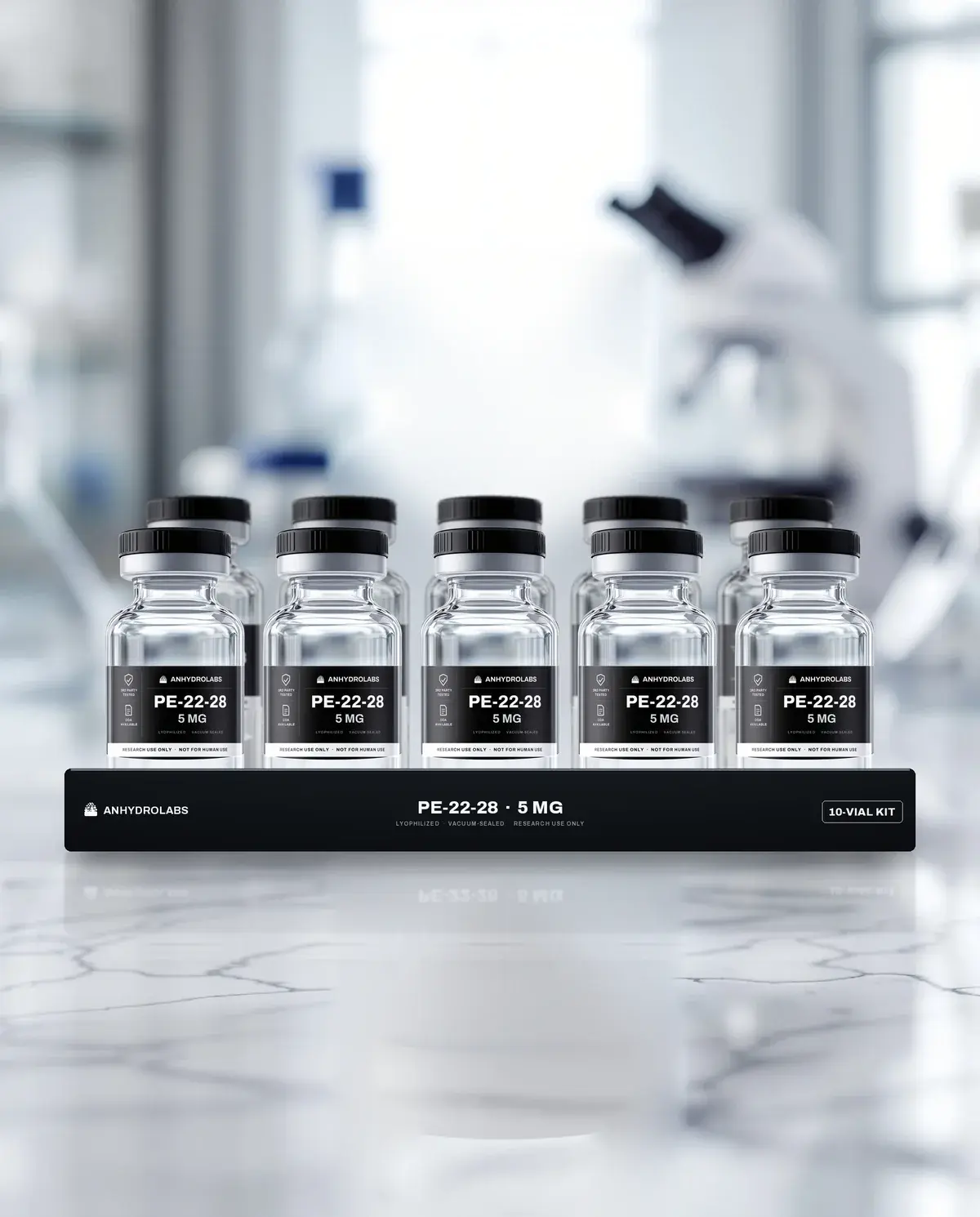
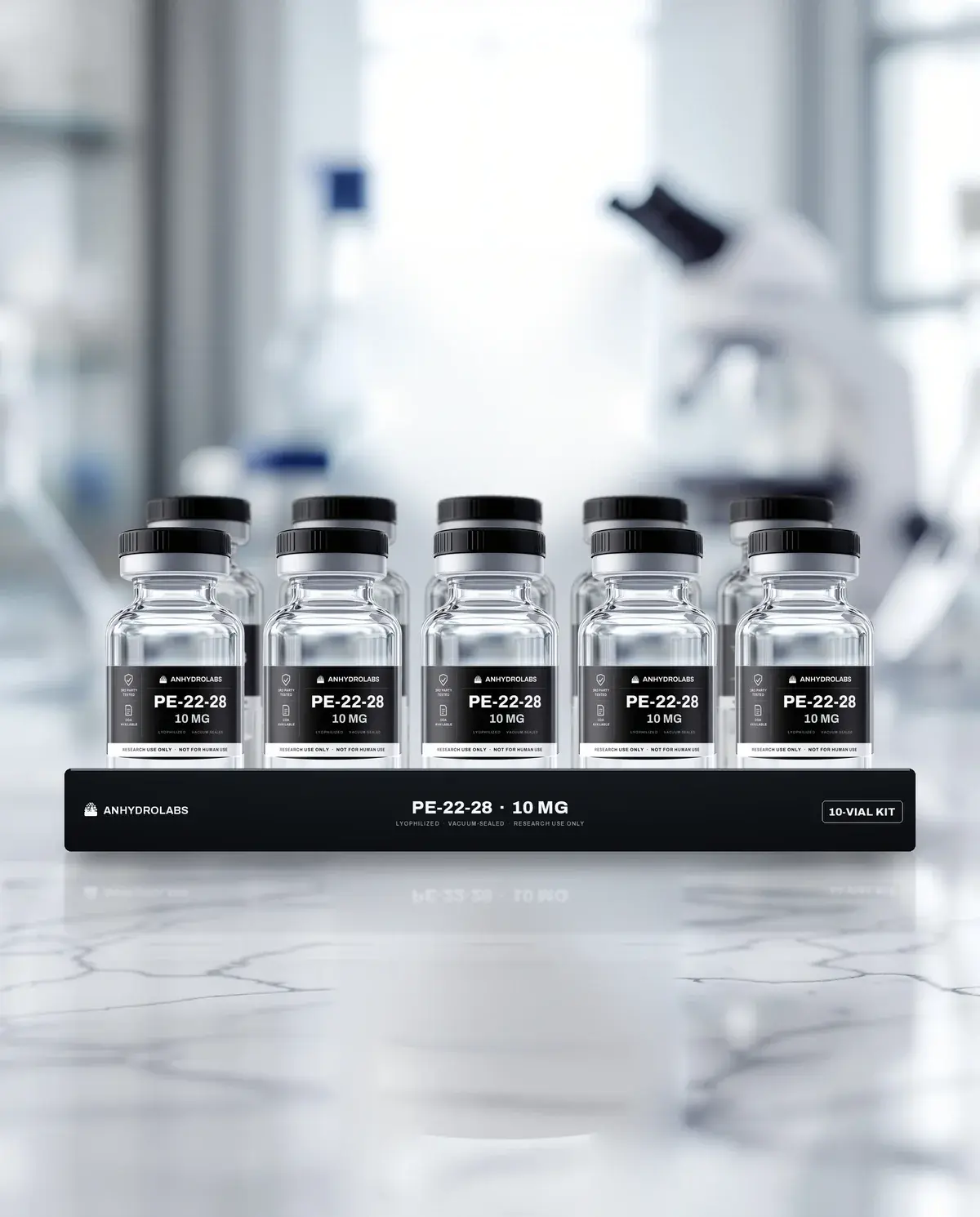
PE-22-28
Lyophilized, vacuum-sealed, 10-vial kit.
- CAS
- 1801959-12-5
- Form
- Lyophilized powder
- Storage
- Frozen, in the dark
- Ships
- Kits by Dec 12, 2026
- Presale
- Ships within the US
- Pay by card or crypto
- All sales final
PE-22-28 is the heptapeptide Gly-Val-Ser-Trp-Gly-Leu-Arg, a shortened analog of spadin, which is itself a fragment of the propeptide released when the protein sortilin matures. It was described in 2017 by Djillani, Borsotto and colleagues at a CNRS institute in Valbonne, France, as an inhibitor of the TREK-1 potassium channel. Its literature is small: one laboratory, cell and mouse work only, and no registered human trial.
Supplied for laboratory research use only. Not for human or veterinary use, and not for diagnostic or therapeutic application.
PE-22-28: compound data
- Molecular formula
- C35H55N11O9
- Molecular weight
- 773.9 g/mol
- CAS number
- 1801959-12-5
- PubChem
- CID 165437303
- Form supplied
- Lyophilized powder, vacuum-sealed
- Concentration
- mg/mL and molarity calculator
Reference values from PubChem, the chemistry database of the US National Library of Medicine, for the compound as registered there.
About PE-22-28
Structure of PE-22-28
PE-22-28 is a linear peptide of seven residues, GVSWGLR, which PubChem names glycyl-L-valyl-L-seryl-L-tryptophylglycyl-L-leucyl-L-arginine, with a free amino terminus and a free carboxyl terminus. The name is a residue range: PE is the sortilin propeptide, and 22 to 28 are the positions of these residues within it. Spadin is PE 12-28, so PE-22-28 is its seven C-terminal residues. The chain has one arginine, no acidic side chain and a single tryptophan. PubChem lists an acetate form as a synonym. A close relative, G/A-PE 22-28, replaces the first glycine with alanine and is a different compound.
Where PE-22-28 comes from
The lineage starts with sortilin, also called neurotensin receptor 3. UniProt lists human sortilin with a signal peptide at residues 1 to 33 and a propeptide at residues 34 to 77 that is removed in the mature form. In 2010 Mazella and colleagues at the Institut de Pharmacologie Moléculaire et Cellulaire in Valbonne reported that a secreted peptide derived from that propeptide, which they named spadin, binds and blocks TREK-1. In 2017 Djillani and colleagues from the same institute studied the products of spadin breakdown in mouse serum, screened shorter sequences, and arrived at the seven-residue PE 22-28.
What PE-22-28 binds
The target described for PE-22-28 is TREK-1, a two-pore-domain potassium channel encoded by KCNK2. UniProt describes the channel as converting to a voltage-independent leak conductance on stimulation by membrane stretch, acidic pH, heat and lipids, and as forming homodimers and heterodimers. In whole-cell patch-clamp recordings from HEK cells expressing human TREK-1, the 2017 paper reported an IC50 of 0.12 nM for PE 22-28, against 40 to 60 nM for spadin. The authors reported no effect on currents carried by TREK-2, TRAAK, TRESK or TASK-1, or on the cardiac hERG channel. How the peptide contacts the channel has not been described structurally.
PE-22-28 in the research literature
All published work on PE-22-28 is preclinical and comes from the group that designed it. The systems are HEK cells stably expressing human TREK-1, used for electrophysiology; cultured mouse cortical neurons, in which expression of the synaptic protein PSD-95 was measured; and male C57Bl/6J mice, studied in standard rodent behavioral assays, including the forced swimming and novelty-suppressed feeding assays, with hippocampal cell proliferation as a further endpoint. The same paper characterized the G/A analog and biotinylated versions. A search of ClinicalTrials.gov for PE-22-28 and for spadin as an intervention finds no registered human study of the peptide.
Regulatory status of PE-22-28
PE-22-28 is not approved as a medicine by any agency named in the sources for this profile, and it has no approved counterpart. It does not appear on FDA's page of bulk substances that raise safety concerns in compounding, and no human trial of it is registered. It is a laboratory compound known from a single 2017 paper and the spadin work that preceded it, and that thin record should be kept in mind when reading claims made for it elsewhere. Here PE-22-28 is supplied as a reference reagent for in-vitro laboratory research only, not for human or veterinary diagnosis, treatment, or consumption.
Handling PE-22-28 in the laboratory
PE-22-28 arrives lyophilized in a vacuum-sealed vial. Keep the sealed vial frozen at -4 °F and protected from light, and let it reach room temperature before breaking the seal so that moisture does not condense on the powder. Once in solution, hold it at about 39 °F and use it within roughly four weeks; divide a stock into single-use aliquots instead of freezing and thawing one tube repeatedly. The sequence contains one tryptophan, so solutions are best kept away from light. The published IC50 is sub-nanomolar, which means working solutions in channel assays are very dilute and are prepared fresh from a concentrated stock.
Sources
- PE 22-28, PubChem CID 165437303
- Djillani et al., Front Pharmacol, 2017. PubMed Central PMC5601071
- Mazella et al., PLoS Biol, 2010. PubMed Central PMC2854129
- UniProt Q99523: Sortilin (SORT1), human
- UniProt O95069: Potassium channel subfamily K member 2 (KCNK2, TREK-1), human
- Search for spadin as an intervention (ClinicalTrials.gov)
PE-22-28: common questions
What is PE-22-28 supplied as?
PE-22-28 is supplied as a lyophilized (freeze-dried) powder in a vacuum-sealed vial, in 5 mg and 10 mg, for in-vitro laboratory research use only.
Is PE-22-28 available as a 10-vial kit?
Yes. PE-22-28 comes in a 10-vial kit: 5 mg for $130.50 ($13.05 per vial); 10 mg for $207.00 ($20.70 per vial), presale prices. A kit is ten sealed vials of the same size, priced below ten single vials.
When do PE-22-28 presale kits ship?
By Dec 12, 2026. Presale kits are 10% off. If we cannot ship by Dec 12, 2026, we tell you before that date and you can cancel for a full refund.
What is the CAS number of PE-22-28?
The CAS registry number of PE-22-28 is 1801959-12-5.
How should PE-22-28 be stored?
Frozen at −4 °F and protected from light, from the day it arrives. Let the vial reach room temperature before breaking the seal; once reconstituted, stability holds for about four weeks refrigerated at 39 °F.
How fast does PE-22-28 ship?
Presale kits ship from the United States by Dec 12, 2026, to US addresses. Sizes marked in stock ship within 1 business day of payment.
Is PE-22-28 for human use?
No. It is supplied as a reference reagent for laboratory research use. Not for human or veterinary use, and not for diagnostic or therapeutic application.
What is the sequence of PE-22-28?
PE-22-28 is Gly-Val-Ser-Trp-Gly-Leu-Arg, written GVSWGLR. It is a linear heptapeptide with free termini, corresponding to positions 22 to 28 of the sortilin propeptide and to the last seven residues of spadin.
How is PE-22-28 related to spadin?
Spadin is residues 12 to 28 of the sortilin propeptide and was reported in 2010 as a blocker of the TREK-1 channel. PE-22-28 is a shortened analog designed in 2017 from the study of spadin breakdown products in serum. In patch-clamp recordings on human TREK-1 its reported IC50 was 0.12 nM, against 40 to 60 nM for spadin.
Has PE-22-28 been studied in humans?
No human study is described in the paper that introduced PE-22-28, and a search of ClinicalTrials.gov for the peptide and for spadin as an intervention finds no registered trial of it. The published work is limited to cells expressing human TREK-1, cultured mouse neurons and mice.
$130.50
PE-22-28 · 5 mg · 10-vial kit