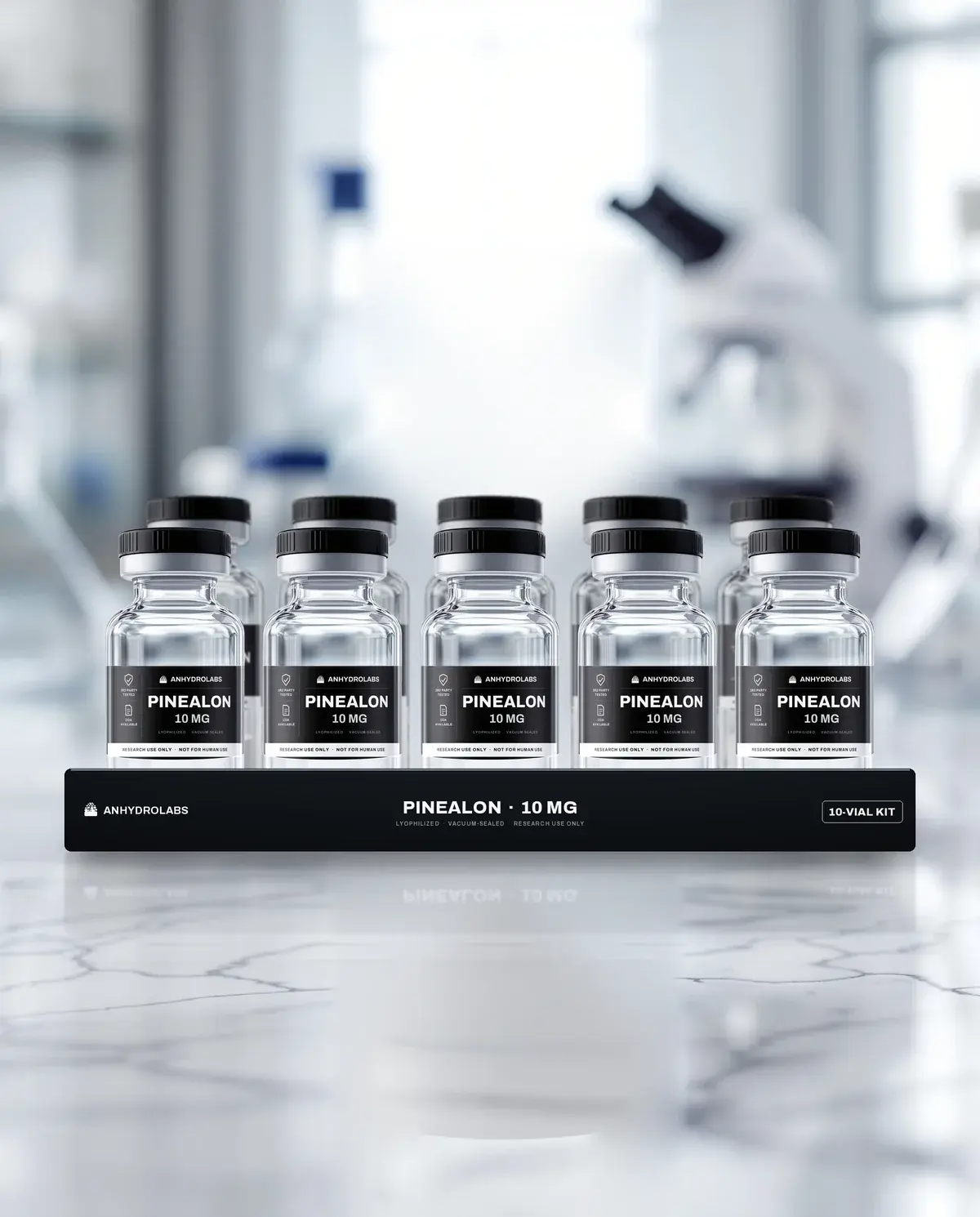
 ×10 · 10-vial kit
Pinealon
Also known as Glu-Asp-Arg. Lyophilized, vacuum-sealed, 10-vial kit.
- CAS
- 175175-23-2
- Form
- Lyophilized powder
- Storage
- Frozen, in the dark
- Ships
- Kits by Dec 12, 2026
- Presale
- Ships within the US
- Pay by card or crypto
- All sales final
Pinealon is a synthetic tripeptide with the sequence Glu-Asp-Arg, also written EDR. It belongs to the family of very short peptides described by Vladimir Khavinson's group at the Saint Petersburg Institute of Bioregulation and Gerontology. The published work on it is small, comes largely from that one group, and centers on cultured cells, where the peptide is proposed to enter the nucleus and bind DNA.
Supplied for laboratory research use only. Not for human or veterinary use, and not for diagnostic or therapeutic application.
Pinealon: compound data
- Molecular formula
- C15H26N6O8
- Molecular weight
- 418.4 g/mol
- CAS number
- 175175-23-2
- PubChem
- CID 10273502
- Form supplied
- Lyophilized powder, vacuum-sealed
- Concentration
- mg/mL and molarity calculator
Reference values from PubChem, the chemistry database of the US National Library of Medicine, for the compound as registered there.
About Pinealon
Structure of Pinealon
Pinealon is three L-amino acids joined by two ordinary peptide bonds: glutamic acid at the N-terminus, aspartic acid in the middle and arginine at the C-terminus. PubChem lists it as Glu-Asp-Arg, with the systematic name L-glutamyl-L-aspartyl-L-arginine and the shorthand H-Glu-Asp-Arg-OH, which means both ends are free and unmodified. Two acidic side chains and one basic guanidinium group make it small, polar and charged. PubChem also records an acetate salt form among the synonyms, so the counter-ion of a given lot should be read from its paperwork before molar concentrations are calculated.
Where Pinealon comes from
The peptide comes from the short-peptide program led by Vladimir Khavinson at the Saint Petersburg Institute of Bioregulation and Gerontology. A 2020 review from that institute describes EDR as a tripeptide isolated from Cortexin, a polypeptide preparation made from brain tissue, and uses the names EDR peptide and Pinealon for the same molecule. The earliest paper opened for this profile is from 2011, when Khavinson and colleagues published a cell study under the name pinealon. Independent replication outside the originating group is scarce, and that should be kept in mind when reading the literature.
What Pinealon binds
No cell-surface receptor has been identified for Pinealon. The originating group proposes a direct action on the genome instead. In a 2011 study, fluorescein-labeled pinealon appeared in the cytoplasm, nucleus and nucleolus of HeLa cells, and the unlabeled peptide quenched the fluorescence of labeled oligonucleotides to a degree that depended on their sequence, with a stated preference for CNG and CAG sites. The 2020 review says the peptide is assumed to bind histone proteins or nucleic acids and so alter expression of genes in the MAPK/ERK pathway. This model rests on fluorescence and modeling data and has not been confirmed by structural methods.
Pinealon in the research literature
The systems are mostly cell cultures. The 2011 paper in Rejuvenation Research used rat cerebellar granule cells, neutrophils and PC12 pheochromocytoma cells under induced oxidative stress, and measured reactive oxygen species accumulation, necrotic cell death by propidium iodide staining, the timing of ERK 1/2 activation and the distribution of cells across division phases. The DNA-binding work used HeLa cells and synthetic oligonucleotides. The 2020 review also cites neuronal cultures from transgenic mouse models used in amyloid research and studies in rats. A search of ClinicalTrials.gov for pinealon returns no registered study.
Regulatory status of Pinealon
Pinealon is not approved by the FDA. A search of Drugs@FDA returns no application for it under the names pinealon or Glu-Asp-Arg, and no approval by another major regulator was found in the sources opened for this profile. It has no United States Adopted Name or International Nonproprietary Name in its PubChem record. In the United States it is a research chemical with a thin published record. Anhydrolabs supplies it as a reference reagent for in-vitro laboratory research only, not for human or veterinary diagnosis, treatment, or consumption.
Handling Pinealon in the laboratory
The material is a lyophilized powder in a vacuum-sealed vial. Keep it frozen at -4 °F and protected from light. Let the vial reach room temperature before breaking the seal, so that moisture from the air does not condense on the cold powder. Once dissolved for in-vitro work, a solution keeps for about four weeks at 39 °F. Divide a stock solution into single-use aliquots instead of freezing and thawing it repeatedly. No compound-specific solubility or stability figure for Pinealon was found in a primary source; its three charged side chains are consistent with a peptide that dissolves in water or aqueous buffer.
Sources
- PubChem compound summary: Glu-Asp-Arg, CID 10273502
- Pinealon increases cell viability by suppression of free radical levels and activating proliferative processes (Rejuvenation Research, 2011)
- Penetration of short fluorescence-labeled peptides into the nucleus in HeLa cells and in vitro specific interaction of the peptides with deoxyribooligonucleotides and DNA (Biochemistry Moscow, 2011)
- Molecules, 2020. PubMed Central PMC7795577
- Drugs@FDA: FDA-Approved Drugs
Pinealon: common questions
Is Glu-Asp-Arg the same as Pinealon?
Yes. Glu-Asp-Arg is another name for Pinealon (CAS 175175-23-2). It is the same compound, supplied here as a lyophilized powder for in-vitro laboratory research use only.
What is Pinealon supplied as?
Pinealon is supplied as a lyophilized (freeze-dried) powder in a vacuum-sealed vial, in 10 mg, for in-vitro laboratory research use only.
Is Pinealon available as a 10-vial kit?
Yes. Pinealon comes in a 10-vial kit: 10 mg for $153.00 ($15.30 per vial), presale prices. A kit is ten sealed vials of the same size, priced below ten single vials.
When do Pinealon presale kits ship?
By Dec 12, 2026. Presale kits are 10% off. If we cannot ship by Dec 12, 2026, we tell you before that date and you can cancel for a full refund.
What is the CAS number of Pinealon?
The CAS registry number of Pinealon is 175175-23-2.
How should Pinealon be stored?
Frozen at −4 °F and protected from light, from the day it arrives. Let the vial reach room temperature before breaking the seal; once reconstituted, stability holds for about four weeks refrigerated at 39 °F.
How fast does Pinealon ship?
Presale kits ship from the United States by Dec 12, 2026, to US addresses. Sizes marked in stock ship within 1 business day of payment.
Is Pinealon for human use?
No. It is supplied as a reference reagent for laboratory research use. Not for human or veterinary use, and not for diagnostic or therapeutic application.
What is the amino acid sequence of Pinealon?
Pinealon is the tripeptide Glu-Asp-Arg, written EDR in one-letter code. PubChem lists it as L-glutamyl-L-aspartyl-L-arginine with free N- and C-termini. All three residues are standard L-amino acids, with no cyclization or capping groups.
Does Pinealon bind a receptor?
No receptor has been identified for Pinealon. The group that described it proposes that the peptide enters the cell nucleus and binds DNA or histones directly. That proposal is based on fluorescence experiments in HeLa cells and with synthetic oligonucleotides, and it has not been confirmed by independent structural work.
Who developed Pinealon?
Pinealon comes from the short-peptide program of Vladimir Khavinson at the Saint Petersburg Institute of Bioregulation and Gerontology in Russia. A 2020 review from that institute describes it as a tripeptide isolated from the brain-derived polypeptide preparation Cortexin. Most of the published work on it carries Khavinson's name.
$153.00
Pinealon · 10 mg · 10-vial kit