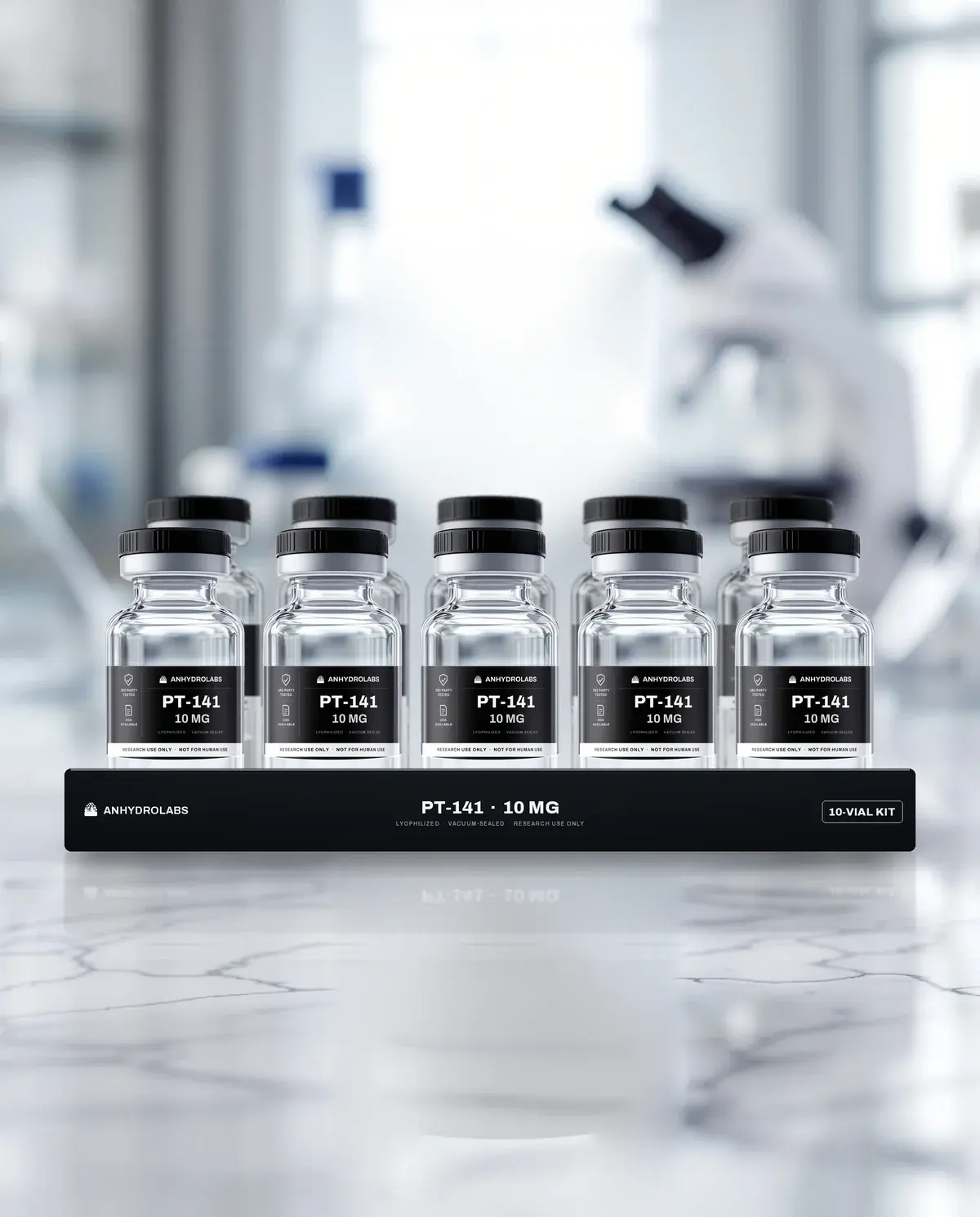
 ×10 · 10-vial kit
PT-141
Also known as bremelanotide. Lyophilized, vacuum-sealed, 10-vial kit.
- CAS
- 189691-06-3
- Form
- Lyophilized powder
- Storage
- Frozen, in the dark
- Ships
- Kits by Dec 12, 2026
- Presale
- Ships within the US
- Pay by card or crypto
- All sales final
PT-141 is the development code for bremelanotide, a synthetic cyclic heptapeptide analog of alpha-melanocyte-stimulating hormone with a free acid at its carboxyl terminus and an acetylated amino terminus. It was developed by Palatin Technologies and is a melanocortin receptor agonist that nonselectively activates several receptor subtypes. Bremelanotide is the active ingredient of the FDA-approved product Vyleesi, and it differs from Melanotan II at a single position.
Supplied for laboratory research use only. Not for human or veterinary use, and not for diagnostic or therapeutic application.
PT-141: compound data
- Molecular formula
- C50H68N14O10
- Molecular weight
- 1,025.2 g/mol
- CAS number
- 189691-06-3
- PubChem
- CID 9941379
- Form supplied
- Lyophilized powder, vacuum-sealed
- Concentration
- mg/mL and molarity calculator
Reference values from PubChem, the chemistry database of the US National Library of Medicine, for the compound as registered there.
About PT-141
Structure of PT-141
The FDA label gives the structure as Ac-Nle-cyclo-(Asp-His-D-Phe-Arg-Trp-Lys-OH): seven residues, with norleucine at the acetylated amino terminus and lysine at the carboxyl terminus. PubChem's name for the compound describes a lactam between residues 2 and 7, that is, between the aspartate side chain and the lysine side chain, so the ring is closed through side chains and the molecule keeps distinct ends. The carboxyl terminus is a free acid. Melanotan II has the same residues and the same ring with an amide in that position. In the approved product the peptide is an acetate salt with one to two equivalents of acetic acid.
Where PT-141 comes from
The ring comes from the University of Arizona. In 1989 Al-Obeidi, Castrucci, Hadley and Hruby reported cyclic lactam analogs of alpha-MSH fragments, among them the 4 to 10 analog with norleucine at position 4, aspartate at 5, D-phenylalanine at 7 and lysine at 10, ending in an amide. Bremelanotide is that scaffold with a free acid at the end. Palatin Technologies of Cranbury, New Jersey, developed it under the code PT-141; a 2003 paper from the company describes it as a synthetic peptide analog of alpha-MSH with agonist activity at melanocortin receptors including MC3R and MC4R. PubChem lists the names bremelanotide, PT 141 and PT-141 free base.
What PT-141 binds
The Vyleesi label describes bremelanotide as a melanocortin receptor agonist that nonselectively activates several receptor subtypes, with the order of potency MC1R, MC4R, MC3R, MC5R, MC2R, and notes that neurons expressing MC4R are present in many areas of the central nervous system. A 2011 review describes the five melanocortin receptors as signaling mainly through intracellular cyclic AMP, and reports that MC4R can also couple to Gi/o and Gq proteins. The same review names agouti and agouti-related protein as the only known natural antagonists of the family and places MC1R on melanocytes and leukocytes, MC2R in the adrenal cortex and MC4R predominantly in the central nervous system.
PT-141 in the research literature
Preclinical work from the developer includes a rat study in which systemic delivery of PT-141 was followed by increased c-Fos immunoreactivity in hypothalamic neurons, a marker of neuronal activation, together with tracing of the same brain region by pseudorabies virus. The cyclic scaffold itself was first ranked against alpha-MSH in isolated frog and lizard skin bioassays in 1989. In people, bremelanotide has been through registered human trials at Phase 1, Phase 2 and Phase 3, which ClinicalTrials.gov lists. This profile does not summarize behavioral findings in animals or findings in human trials.
Regulatory status of PT-141
Bremelanotide is approved by the FDA. Vyleesi (bremelanotide injection) received its initial US approval in 2019, supplied as a single-use autoinjector, and its label is the primary source for the approved product's composition and pharmacology. The approval covers a finished sterile solution made under drug manufacturing controls, not the loose peptide. A vial labeled PT-141 is not Vyleesi. Here PT-141 is supplied as a reference reagent for in-vitro laboratory research only, not for human or veterinary diagnosis, treatment, or consumption.
Handling PT-141 in the laboratory
PT-141 arrives lyophilized in a vacuum-sealed vial. Keep the sealed vial frozen at -4 °F and protected from light, and let it reach room temperature before breaking the seal so that moisture does not condense on the powder. Once in solution, hold it at about 39 °F and use it within roughly four weeks; divide a stock into single-use aliquots instead of freezing and thawing one tube repeatedly. The ring contains one tryptophan, so solutions are best kept away from light. Its mass is within about one unit of Melanotan II, so identity checks by mass need enough resolution to separate the two.
Sources
- VYLEESI (bremelanotide injection), for subcutaneous use: prescribing information (FDA, 2019)
- Bremelanotide, PubChem CID 9941379
- Potent and prolonged acting cyclic lactam analogues of alpha-melanotropin: design based on molecular dynamics (Al-Obeidi et al., J Med Chem, 1989)
- Molinoff et al., Ann N Y Acad Sci, 2003. PubMed 12851303
- Structure, function and regulation of the melanocortin receptors (Yang, Eur J Pharmacol, 2011)
- Studies with bremelanotide as an intervention (ClinicalTrials.gov)
Research notes on PT-141
- PT-141 (Bremelanotide): Structure and ReceptorsWhat the PT-141 peptide is at the molecular level: bremelanotide's cyclic heptapeptide structure, its melanocortin receptor profile and lab handling.
PT-141: common questions
Is bremelanotide the same as PT-141?
Yes. bremelanotide is another name for PT-141 (CAS 189691-06-3). It is the same compound, supplied here as a lyophilized powder for in-vitro laboratory research use only.
What is PT-141 supplied as?
PT-141 is supplied as a lyophilized (freeze-dried) powder in a vacuum-sealed vial, in 10 mg, for in-vitro laboratory research use only.
Is PT-141 available as a 10-vial kit?
Yes. PT-141 comes in a 10-vial kit: 10 mg for $157.50 ($15.75 per vial), presale prices. A kit is ten sealed vials of the same size, priced below ten single vials.
When do PT-141 presale kits ship?
By Dec 12, 2026. Presale kits are 10% off. If we cannot ship by Dec 12, 2026, we tell you before that date and you can cancel for a full refund.
What is the CAS number of PT-141?
The CAS registry number of PT-141 is 189691-06-3.
How should PT-141 be stored?
Frozen at −4 °F and protected from light, from the day it arrives. Let the vial reach room temperature before breaking the seal; once reconstituted, stability holds for about four weeks refrigerated at 39 °F.
How fast does PT-141 ship?
Presale kits ship from the United States by Dec 12, 2026, to US addresses. Sizes marked in stock ship within 1 business day of payment.
Is PT-141 for human use?
No. It is supplied as a reference reagent for laboratory research use. Not for human or veterinary use, and not for diagnostic or therapeutic application.
What is the structure of PT-141?
PT-141 is Ac-Nle-cyclo-(Asp-His-D-Phe-Arg-Trp-Lys-OH), a synthetic cyclic heptapeptide. The ring is a lactam between the aspartate and lysine side chains, the amino terminus is acetylated, and the carboxyl terminus is a free acid, as described on the FDA label for bremelanotide.
How is PT-141 different from Melanotan II?
The two peptides have the same seven residues and the same lactam ring. PT-141 ends in a free carboxylic acid and Melanotan II ends in an amide, which shifts the formula by one nitrogen and one oxygen and the mass by about one unit. Bremelanotide is an approved drug substance; Melanotan II is not.
Which receptors does PT-141 act on?
The FDA label describes bremelanotide as a nonselective melanocortin receptor agonist and gives the order of potency as MC1R, MC4R, MC3R, MC5R, then MC2R. The melanocortin receptors are G protein-coupled receptors that signal mainly through intracellular cyclic AMP.
$157.50
PT-141 · 10 mg · 10-vial kit