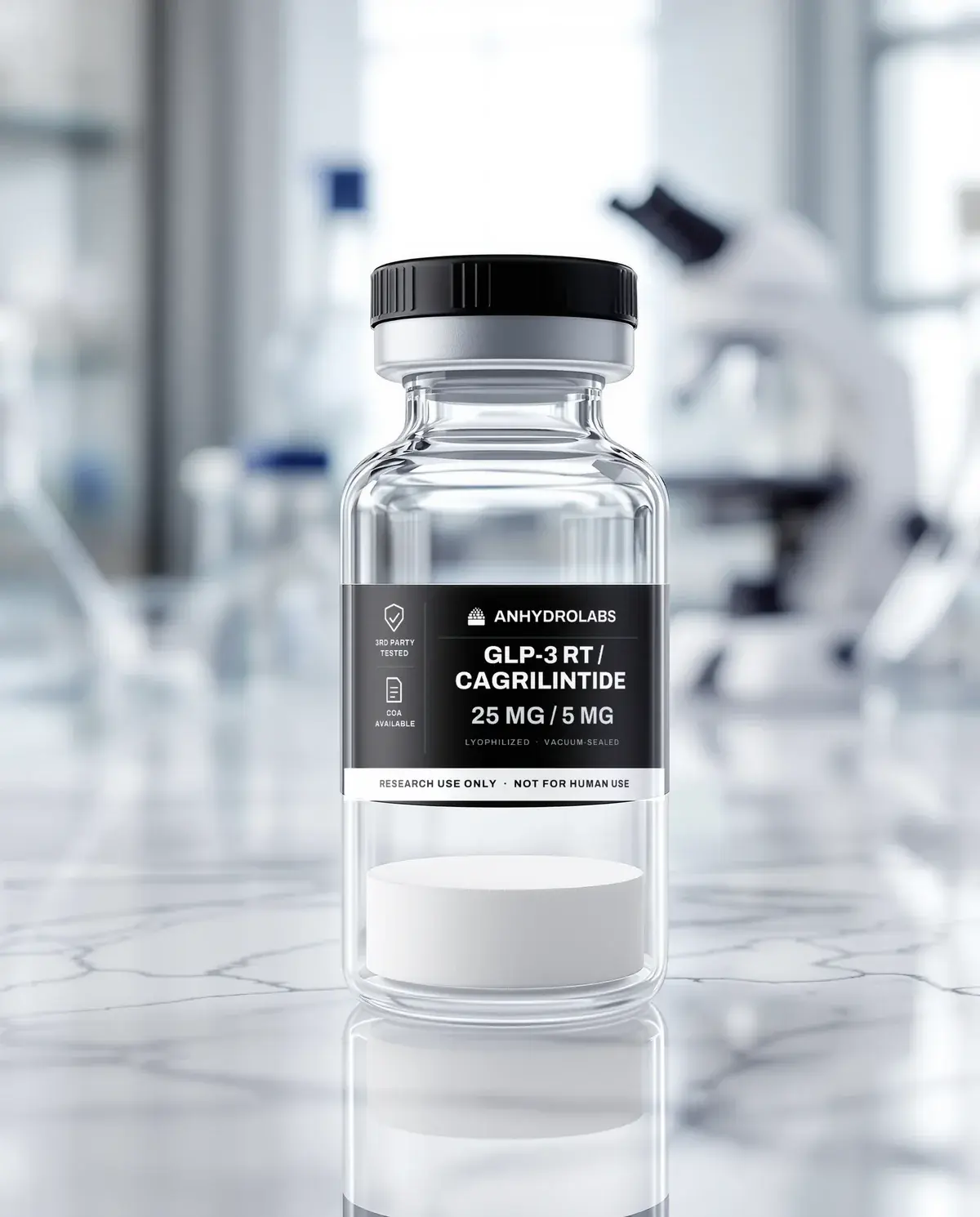
Retatrutide / Cagrilintide
Also known as Reta / Cagri. Lyophilized, vacuum-sealed, single vial.
- Form
- Lyophilized powder
- Storage
- Frozen, in the dark
- Ships
- Within the US
Get an email when Retatrutide / Cagrilintide is available
- Coming soon
- Ships within the US
- Pay by card or crypto
- All sales final
Retatrutide / Cagrilintide is a blend of two separate lipidated peptides in one vial, sometimes shortened to Reta / Cagri. Retatrutide is a 39-residue agonist of the GIP, GLP-1 and glucagon receptors from Eli Lilly. Cagrilintide is a 37-residue analog of the hormone amylin from Novo Nordisk. Each has its own literature. The pairing has very little: one 2026 rat study and no registered human trial.
Supplied for laboratory research use only. Not for human or veterinary use, and not for diagnostic or therapeutic application.
About Retatrutide / Cagrilintide
Structure of Retatrutide / Cagrilintide
The vial holds two distinct molecules, not a conjugate. Retatrutide is a linear 39-residue peptide with α-aminoisobutyric acid at positions 2 and 20, α-methyl-L-leucine at position 13 and a C20 fatty diacid on the side chain of lysine 17. Cagrilintide, as recorded in PubChem, is a 37-residue chain ending in a prolinamide, with a disulfide bond between its two cysteines and a C20 fatty diacid joined through γ-glutamic acid to the N-terminal lysine. The two differ in sequence, in ring structure and in where the lipid sits, so they separate cleanly by mass spectrometry.
Where Retatrutide / Cagrilintide comes from
The components come from two unrelated company programs. Retatrutide was described by Coskun and colleagues at Eli Lilly in 2022 under the code LY3437943. Cagrilintide was described by Kruse and colleagues at Novo Nordisk in 2021 as compound 23 of a series built to overcome the tendency of amylin to form amyloid fibrils, and it also carries the code NN0174-0833. Neither company has published on a mixture of the two. The one paper found on the pairing, in Nature Metabolism in 2026, comes from an academic group at the University of Copenhagen, and it gave the two as separate compounds together, not as a premixed vial.
What Retatrutide / Cagrilintide binds
The two peptides act on different receptor systems. Retatrutide activates the GIP, GLP-1 and glucagon receptors, three related receptors that its discovery paper characterized in vitro. Cagrilintide is an analog of amylin, the 37-residue islet amyloid polypeptide. UniProt states that amylin acts through complexes of the calcitonin receptor with receptor activity-modifying proteins, and can also bind the calcitonin receptor alone; the 2026 paper calls cagrilintide a co-agonist of the amylin and calcitonin receptors. No study opened for this profile measures whether the two ligands affect each other's receptor binding or signaling in a cell assay.
Retatrutide / Cagrilintide in the research literature
Each component has been studied separately: retatrutide in cell lines expressing recombinant receptors, in mouse models and in human studies through Phase 3, and cagrilintide in the structure-activity work that selected it and in human studies run by Novo Nordisk. For the pairing, PubMed holds one primary study with both names in its title: a 2026 paper that gave the two compounds together to diet-induced obese male rats and profiled the plasma proteome and brain transcriptome. ClinicalTrials.gov returns no study that combines them. A fixed mixture also cannot vary one ligand independently of the other, which limits it in assay design.
Regulatory status of Retatrutide / Cagrilintide
Neither component is an approved product. As of October 2026 a search of Drugs@FDA returns no application for retatrutide or for cagrilintide, and both remain investigational compounds in the programs of their developers. The blend has no regulatory standing of its own: no application for it appears in Drugs@FDA, and no human trial of it is registered on ClinicalTrials.gov. Anhydrolabs supplies it as a reference reagent for in-vitro laboratory research only, not for human or veterinary diagnosis, treatment, or consumption.
Handling Retatrutide / Cagrilintide in the laboratory
The material is a lyophilized powder in a vacuum-sealed vial. Keep it frozen at -4 °F and protected from light. Let the vial reach room temperature before breaking the seal, so that moisture from the air does not condense on the cold powder. Once dissolved for in-vitro work, a solution keeps for about four weeks at 39 °F. Divide a stock solution into single-use aliquots instead of freezing and thawing it repeatedly. Cagrilintide contains a disulfide bond, which a reducing agent in the buffer would break. No solubility or stability data for the mixture were found in a primary source.
Sources
- PubChem compound summary: Triple G (retatrutide, LY3437943), CID 171390338
- PubChem compound summary: Cagrilintide, CID 171397054
- Cell Metabolism, 2022. PubMed 35985340
- Development of Cagrilintide, a Long-Acting Amylin Analogue (Journal of Medicinal Chemistry, 2021)
- Nature Metabolism, 2026. PubMed 42744908
- UniProt P10997: Islet amyloid polypeptide (IAPP), human
Research notes on Retatrutide / Cagrilintide
- Cagrilintide: The Long-Acting Amylin AnalogCagrilintide is a lipidated 37-residue amylin analog from Novo Nordisk. Learn its sequence, receptor targets, half-life, trial status and lab handling.
- What Is Retatrutide? The Triple Agonist ExplainedRetatrutide is a 39-residue lipidated peptide that activates the GLP-1, GIP and glucagon receptors. Learn its structure, receptor data and lab handling.
Retatrutide / Cagrilintide: common questions
Is Reta / Cagri the same as Retatrutide / Cagrilintide?
Yes. Reta / Cagri is another name for Retatrutide / Cagrilintide. It is the same compound, supplied here as a lyophilized powder for in-vitro laboratory research use only.
What is Retatrutide / Cagrilintide supplied as?
Retatrutide / Cagrilintide is supplied as a lyophilized (freeze-dried) powder in a vacuum-sealed vial, in 25 mg / 5 mg, for in-vitro laboratory research use only.
When will Retatrutide / Cagrilintide be available?
Retatrutide / Cagrilintide is coming soon. Join the newsletter on this page to get an email as soon as it can be ordered.
How should Retatrutide / Cagrilintide be stored?
Frozen at −4 °F and protected from light, from the day it arrives. Let the vial reach room temperature before breaking the seal; once reconstituted, stability holds for about four weeks refrigerated at 39 °F.
How fast does Retatrutide / Cagrilintide ship?
Orders ship from the United States, to US addresses. Sizes in stock ship within 1 business day of payment.
Is Retatrutide / Cagrilintide for human use?
No. It is supplied as a reference reagent for laboratory research use. Not for human or veterinary use, and not for diagnostic or therapeutic application.
What is in the Retatrutide / Cagrilintide blend?
Two separate peptides. Retatrutide is a 39-residue lipidated agonist of the GIP, GLP-1 and glucagon receptors from Eli Lilly. Cagrilintide is a 37-residue lipidated amylin analog from Novo Nordisk with one disulfide bond. They are mixed, not chemically linked.
Is there published research on Retatrutide / Cagrilintide as a combination?
Very little. PubMed holds one primary study of the pairing, a 2026 Nature Metabolism paper in diet-induced obese male rats from the University of Copenhagen, and ClinicalTrials.gov lists no human study that combines the two. Neither developer has published on a premixed blend.
Do retatrutide and cagrilintide act on one receptor family?
No. Retatrutide activates the GIP, GLP-1 and glucagon receptors. Cagrilintide is an amylin analog, and UniProt describes amylin as acting through the calcitonin receptor in complex with receptor activity-modifying proteins. The Retatrutide / Cagrilintide blend therefore contains ligands for two distinct receptor systems.