Selank
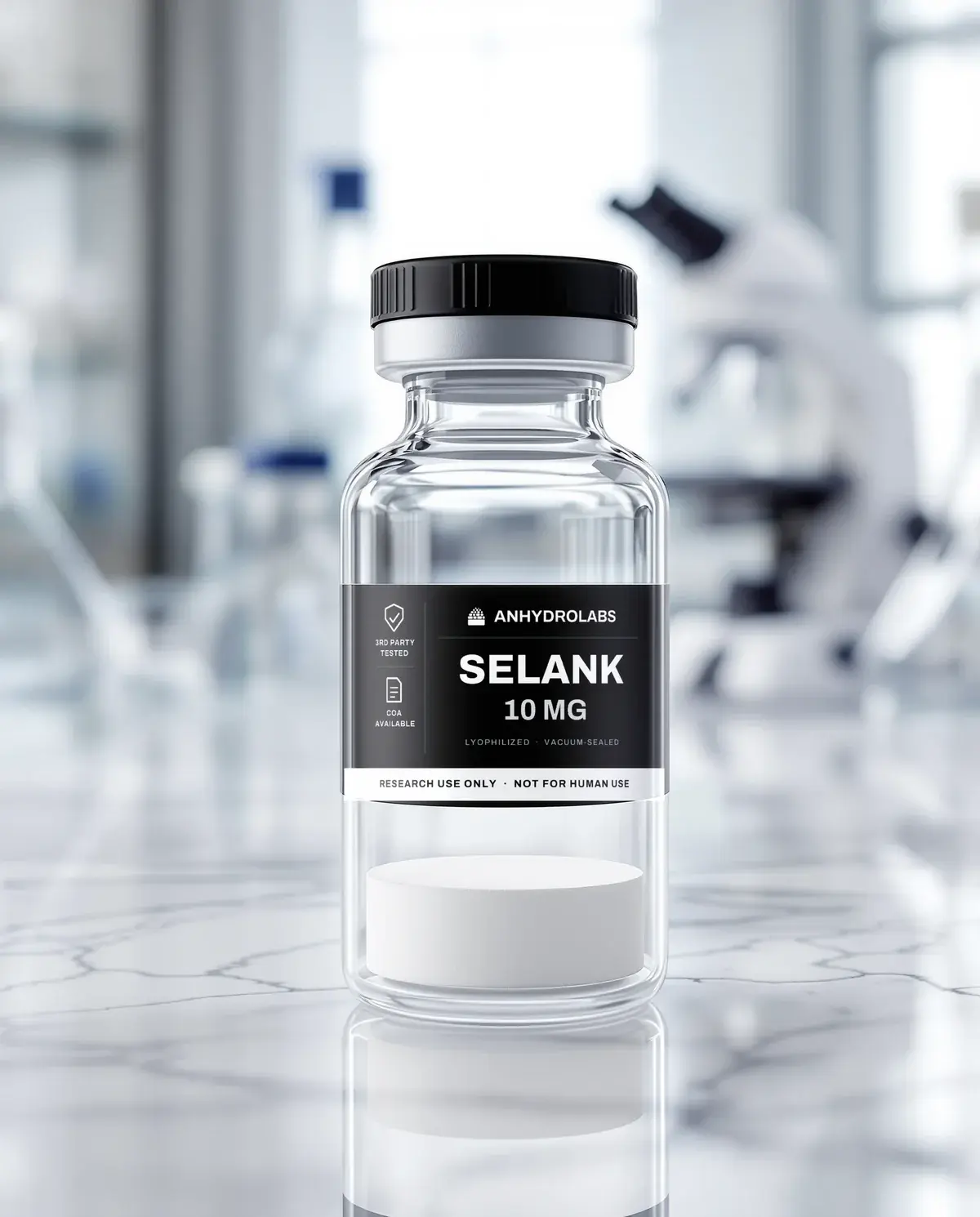
Lyophilized, vacuum-sealed, single vial.
- CAS
- 129954-34-3
- Form
- Lyophilized powder
- Storage
- Frozen, in the dark
- Ships
- Vials within 1 business day, kits by Dec 12, 2026
- In stock
- Ships within the US
- Pay by card or crypto
- All sales final
Selank is a synthetic heptapeptide with the sequence Thr-Lys-Pro-Arg-Pro-Gly-Pro, also listed as TP-7. It was designed at the Institute of Molecular Genetics of the Russian Academy of Sciences as an analog of tuftsin, a four-residue fragment of the immunoglobulin G heavy chain, extended with Pro-Gly-Pro. The literature, most of it from Russian institutes, examines GABA receptor binding and enkephalin-degrading enzymes.
Supplied for laboratory research use only. Not for human or veterinary use, and not for diagnostic or therapeutic application.
Selank: compound data
- Molecular formula
- C33H57N11O9
- Molecular weight
- 751.9 g/mol
- CAS number
- 129954-34-3
- PubChem
- CID 11765600
- Form supplied
- Lyophilized powder, vacuum-sealed
- Concentration
- mg/mL and molarity calculator
Reference values from PubChem, the chemistry database of the US National Library of Medicine, for the compound as registered there.
About Selank
Structure of Selank
Selank is a linear chain of seven L-amino acids: threonine, lysine, proline, arginine, proline, glycine and proline, with a free N-terminus and a free C-terminal carboxyl group. The first four residues are the tuftsin sequence and the last three are the tripeptide Pro-Gly-Pro. Three of the seven residues are proline. Lysine and arginine give it two basic side chains, and it has no cysteine, methionine or aromatic residue. PubChem lists the synonyms Selanc and TP-7 and records a diacetate form. Semax, a related peptide, ends in the same Pro-Gly-Pro but starts with four residues from ACTH.
Where Selank comes from
Selank was designed and produced at the Institute of Molecular Genetics of the Russian Academy of Sciences in Moscow, in cooperation with the V. V. Zakusov Research Institute of Pharmacology. Papers from that institute describe it as a synthetic analog of the endogenous peptide tuftsin, the short Thr-Lys-Pro-Arg fragment of the human immunoglobulin G heavy chain, lengthened at the C-terminus with three natural L-amino acids, Pro-Gly-Pro, to improve metabolic stability and extend its duration of action. The same design, a short active fragment capped with Pro-Gly-Pro, was used by this group for Semax. The name TP-7 appears in the pharmacology literature.
What Selank binds
The mechanism is not settled. In a 2018 radioligand study on rat brain membrane preparations, Vyunova and colleagues reported that Selank changed the specific binding of tritiated GABA in the manner of a positive allosteric modulator of GABA receptors, and that it altered the modulation produced by diazepam and olanzapine, which suggests a binding site that differs from theirs but may partly overlap. A separate 2001 study reported that Selank inhibited the enzymatic hydrolysis of enkephalin in human plasma in vitro, with an IC50 of 15 micromolar. Both lines of work come from Russian groups linked to the developers.
Selank in the research literature
The systems are biochemical preparations, cultured cells and rats. A 2016 study measured mRNA for 84 genes involved in neurotransmission in the frontal cortex of male Wistar rats one and three hours after exposure to Selank or GABA. A 2017 study used the human neuroblastoma line IMR-32, chosen because it expresses functional GABA-A receptors; Selank alone did not change mRNA levels of the genes studied, while Selank together with GABA nearly abolished the expression changes seen with GABA alone. The developers' papers refer to use in people in Russia, but a search of ClinicalTrials.gov finds no study with Selank as the intervention.
Regulatory status of Selank
Selank is not approved by the FDA, and a search of Drugs@FDA returns no application under its name. Papers from the Institute of Molecular Genetics refer to it as a drug of peptide nature in Russia; this profile did not open a Russian registration record, so that standing is reported here only as the developers describe it. ClinicalTrials.gov lists no Selank study. Anhydrolabs supplies it as a reference reagent for in-vitro laboratory research only, not for human or veterinary diagnosis, treatment, or consumption.
Handling Selank in the laboratory
The material is a lyophilized powder in a vacuum-sealed vial. Keep it frozen at -4 °F and protected from light. Let the vial reach room temperature before breaking the seal, so that moisture from the air does not condense on the cold powder. Once dissolved for in-vitro work, a solution keeps for about four weeks at 39 °F. Divide a stock solution into single-use aliquots instead of freezing and thawing it repeatedly. No compound-specific solubility or stability figure for Selank was found in a primary source. PubChem records both the free peptide and a diacetate, and the form of a given lot changes its formula weight.
Sources
- PubChem compound summary: Selank, CID 11765600
- Selank Administration Affects the Expression of Some Genes Involved in GABAergic Neurotransmission (Frontiers in Pharmacology, 2016)
- GABA, Selank, and Olanzapine Affect the Expression of Genes Involved in GABAergic Neurotransmission in IMR-32 Cells (Frontiers in Pharmacology, 2017)
- Protein and Peptide Letters, 2018. PubMed 30255741
- Bulletin of Experimental Biology and Medicine, 2001. PubMed 11550013
- Drugs@FDA: FDA-Approved Drugs
Research notes on Selank
- Selank vs Semax: Two Synthetic Peptides ComparedSelank vs Semax compared: sequences, parent molecules (tuftsin and ACTH), molecular data, research models, regulatory status and lab handling.
Selank: common questions
What is Selank supplied as?
Selank is supplied as a lyophilized (freeze-dried) powder in a vacuum-sealed vial, in 5 mg and 10 mg, for in-vitro laboratory research use only.
How much does Selank cost?
Selank is $34.95 for any size, in US dollars. Volume pricing is quoted on request.
Is Selank available as a 10-vial kit?
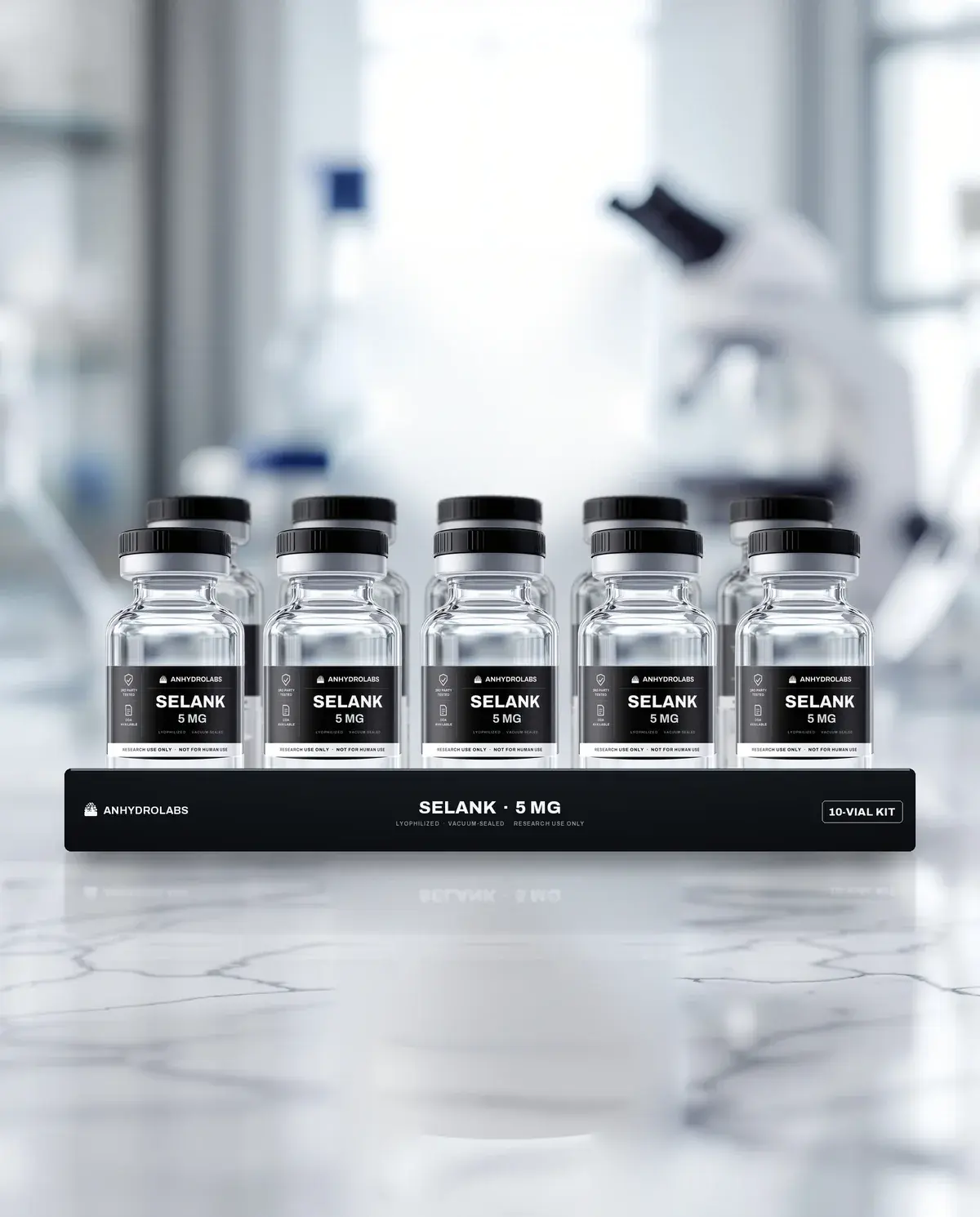
Yes. Selank comes in a 10-vial kit: 5 mg for $112.50 ($11.25 per vial); 10 mg for $180.00 ($18.00 per vial), presale prices. A kit is ten sealed vials of the same size, priced below ten single vials.
When do Selank presale kits ship?
By Dec 12, 2026. Presale kits are 10% off. If we cannot ship by Dec 12, 2026, we tell you before that date and you can cancel for a full refund.
What is the CAS number of Selank?
The CAS registry number of Selank is 129954-34-3.
How should Selank be stored?
Frozen at −4 °F and protected from light, from the day it arrives. Let the vial reach room temperature before breaking the seal; once reconstituted, stability holds for about four weeks refrigerated at 39 °F.
How fast does Selank ship?
Presale kits ship from the United States by Dec 12, 2026, to US addresses. Sizes marked in stock ship within 1 business day of payment.
Is Selank for human use?
No. It is supplied as a reference reagent for laboratory research use. Not for human or veterinary use, and not for diagnostic or therapeutic application.
What is the sequence of Selank?
Selank is Thr-Lys-Pro-Arg-Pro-Gly-Pro, or TKPRPGP in one-letter code. The first four residues are the natural peptide tuftsin and the last three are a Pro-Gly-Pro extension. All seven are standard L-amino acids, and both ends of the chain are unmodified.
How is Selank different from Semax?
Selank and Semax share the C-terminal tripeptide Pro-Gly-Pro and come from the same Moscow institute, but their first four residues differ. Selank begins with tuftsin, Thr-Lys-Pro-Arg, from immunoglobulin G. Semax begins with Met-Glu-His-Phe, residues 4 to 7 of adrenocorticotropic hormone.
What does Selank bind?
No single receptor has been established for Selank. A 2018 radioligand study on rat brain membranes described it as a positive allosteric modulator of GABA binding, and a 2001 study reported that it inhibits enkephalin-degrading enzymes in human plasma with an IC50 of 15 micromolar.
$34.95
Selank · 10 mg