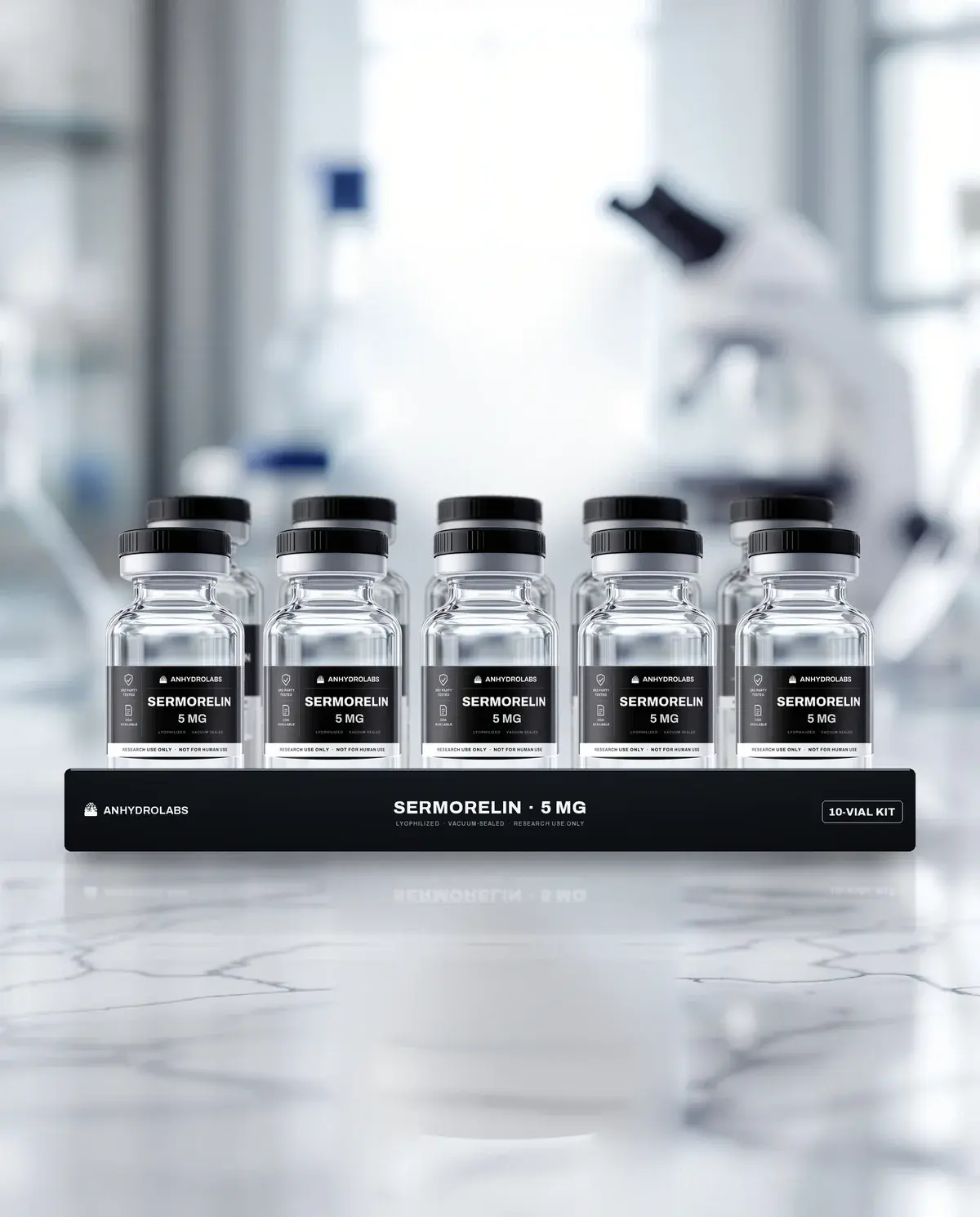
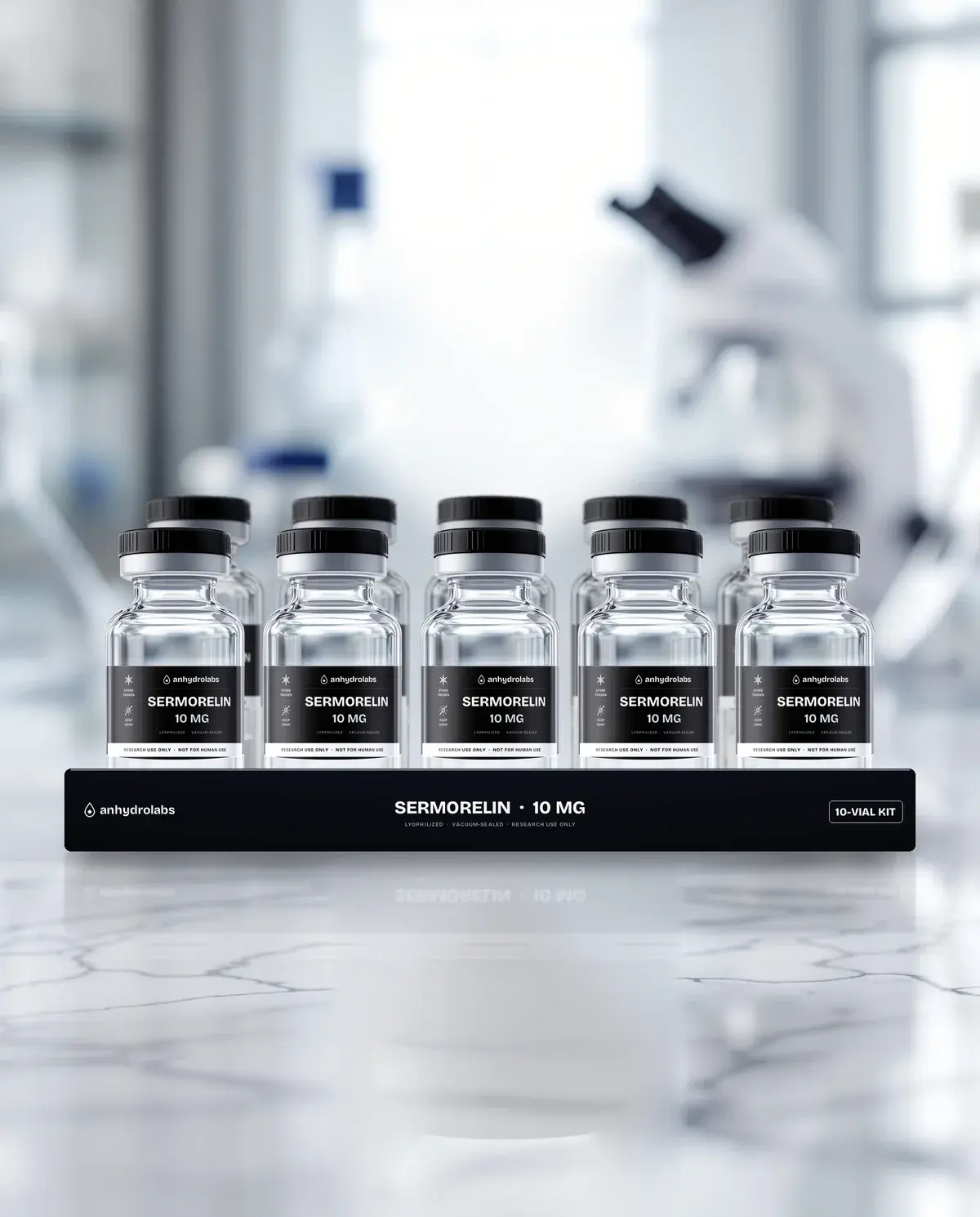
Sermorelin
Also known as GRF 1-29. Lyophilized, vacuum-sealed, 10-vial kit.
- CAS
- 86168-78-7
- Form
- Lyophilized powder
- Storage
- Frozen, in the dark
- Ships
- Kits by Dec 12, 2026
- Presale
- Ships within the US
- Pay by card or crypto
- All sales final
Sermorelin is a 29-residue peptide amide identical to the first 29 amino acids of human growth hormone-releasing hormone, and is also written GRF 1-29 or GHRH(1-29)NH2. It is the shortest fragment shown in 1982 to match the full hormone in vitro, and it activates the GHRH receptor on pituitary somatotroph cells. Sermorelin acetate was once FDA-approved as Geref; those approvals were withdrawn in 2009.
Supplied for laboratory research use only. Not for human or veterinary use, and not for diagnostic or therapeutic application.
Sermorelin: compound data
- Molecular formula
- C149H246N44O42S
- Molecular weight
- 3,357.9 g/mol
- CAS number
- 86168-78-7
- PubChem
- CID 16132413
- Form supplied
- Lyophilized powder, vacuum-sealed
- Concentration
- mg/mL and molarity calculator
Reference values from PubChem, the chemistry database of the US National Library of Medicine, for the compound as registered there.
About Sermorelin
Structure of Sermorelin
PubChem gives the sequence as Tyr-Ala-Asp-Ala-Ile-Phe-Thr-Asn-Ser-Tyr-Arg-Lys-Val-Leu-Gly-Gln-Leu-Ser-Ala-Arg-Lys-Leu-Leu-Gln-Asp-Ile-Met-Ser-Arg-NH2. Every residue is a standard L-amino acid, the chain is linear with no disulfide bond, and the C-terminal arginine is amidated. The sequence is the native one: the 44-residue hormone reported in 1982 begins with the same 29 residues. It contains a single methionine, at position 27. Sermorelin is that fragment without substitutions, cut at residue 29 and amidated. The formerly approved product was the acetate salt.
Where Sermorelin comes from
Sermorelin follows directly from the isolation of growth hormone-releasing factor in 1982. Guillemin and colleagues reported a 44-residue peptide from a human pancreatic tumor that had caused acromegaly, and Spiess, Rivier, Thorner and Vale sequenced a releasing factor from a second pancreatic islet tumor. Spiess and colleagues found that the synthetic fragment hpGRF(1-29)-NH2 had in-vitro activity equivalent to the natural product and to the 40-residue forms, which showed that the C-terminal part of the hormone adds little to potency. That fragment became sermorelin. PubChem lists the names GRF(1-29)NH2, hGHRH(1-29)NH2 and Groliberin.
What Sermorelin binds
Sermorelin acts at the growth hormone-releasing hormone receptor. UniProt describes the human receptor, a 423-residue protein, as coupled to G proteins that activate adenylyl cyclase, and as stimulating somatotroph cell growth, growth hormone gene transcription and growth hormone secretion. The N-terminus of the ligand is essential. Frohman and colleagues showed in 1986 that plasma removes the first two residues of GRH(1-44)-NH2 through a dipeptidylaminopeptidase, leaving a 3-44 product with less than one thousandth of the activity. Sermorelin begins with the same Tyr-Ala pair, so it carries the same cleavage site.
Sermorelin in the research literature
The founding experiments measured growth hormone secretion from rat anterior pituitary in vitro and in vivo in response to synthetic releasing-factor peptides of different lengths. The 1986 degradation study incubated the 44-residue hormone with human plasma and followed it by HPLC, radioimmunoassay and bioassay; the intact peptide disappeared with a half-life of 17 minutes in vitro and 6.8 minutes after intravenous injection in volunteers. Sermorelin acetate later reached the market under two FDA applications, described below. ClinicalTrials.gov lists 27 studies that name sermorelin as an intervention.
Regulatory status of Sermorelin
Sermorelin acetate was approved by the FDA as Geref, held by EMD Serono, under two applications: NDA 19-863, approved December 28, 1990, and NDA 20-443, approved September 26, 1997. The company discontinued both in 2008, and FDA withdrew the approvals effective June 18, 2009. In 2013 FDA determined that Geref was not withdrawn from sale for reasons of safety or effectiveness. Anhydrolabs supplies sermorelin as a reference reagent for in-vitro laboratory research only.
Handling Sermorelin in the laboratory
The material is a lyophilized powder in a vacuum-sealed vial. Keep it frozen at -4 °F and protected from light. Let the vial reach room temperature before breaking the seal, so that moisture from the air does not condense on the cold powder. Once dissolved for in-vitro work, a solution keeps for about four weeks at 39 °F. Divide a stock solution into single-use aliquots instead of freezing and thawing it repeatedly. No compound-specific solubility figure for sermorelin was found in a primary source. Its sequence includes one methionine, whose sulfur can oxidize, and plasma or serum in an assay medium will contain the peptidase that removes its first two residues.
Sources
- PubChem compound summary: Sermorelin, CID 16132413
- Sequence analysis of a growth hormone releasing factor from a human pancreatic islet tumor (Biochemistry, 1982)
- Growth hormone-releasing factor from a human pancreatic tumor that caused acromegaly (Science, 1982)
- Journal et al., 1986. PubMed 3093533
- UniProt Q02643: Growth hormone-releasing hormone receptor (GHRHR), human
- Determination That GEREF (Sermorelin Acetate) Injection Was Not Withdrawn From Sale for Reasons of Safety or Effectiveness (Federal Register, March 4, 2013)
Research notes on Sermorelin
- Sermorelin vs Ipamorelin: GHRH vs Ghrelin PathwaysSermorelin vs ipamorelin: a GHRH(1-29) analog and a ghrelin-receptor pentapeptide compared by sequence, receptor, signaling and regulatory status.
Sermorelin: common questions
Is GRF 1-29 the same as Sermorelin?
Yes. GRF 1-29 is another name for Sermorelin (CAS 86168-78-7). It is the same compound, supplied here as a lyophilized powder for in-vitro laboratory research use only.
What is Sermorelin supplied as?
Sermorelin is supplied as a lyophilized (freeze-dried) powder in a vacuum-sealed vial, in 5 mg and 10 mg, for in-vitro laboratory research use only.
Is Sermorelin available as a 10-vial kit?
Yes. Sermorelin comes in a 10-vial kit: 5 mg for $157.50 ($15.75 per vial); 10 mg for $252.00 ($25.20 per vial), presale prices. A kit is ten sealed vials of the same size, priced below ten single vials.
When do Sermorelin presale kits ship?
By Dec 12, 2026. Presale kits are 10% off. If we cannot ship by Dec 12, 2026, we tell you before that date and you can cancel for a full refund.
What is the CAS number of Sermorelin?
The CAS registry number of Sermorelin is 86168-78-7.
How should Sermorelin be stored?
Frozen at −4 °F and protected from light, from the day it arrives. Let the vial reach room temperature before breaking the seal; once reconstituted, stability holds for about four weeks refrigerated at 39 °F.
How fast does Sermorelin ship?
Presale kits ship from the United States by Dec 12, 2026, to US addresses. Sizes marked in stock ship within 1 business day of payment.
Is Sermorelin for human use?
No. It is supplied as a reference reagent for laboratory research use. Not for human or veterinary use, and not for diagnostic or therapeutic application.
Is sermorelin identical to human GHRH?
Sermorelin is the first 29 residues of human growth hormone-releasing hormone with an amidated C-terminus; the full hormone has 44 residues. Over those 29 positions the two sequences are identical. A 1982 study found the 1-29 amide equivalent to the longer forms in vitro.
What receptor does sermorelin bind?
Sermorelin binds the growth hormone-releasing hormone receptor on pituitary somatotroph cells. UniProt describes that receptor as coupled to G proteins that activate adenylyl cyclase, leading to growth hormone gene transcription and secretion.
Is sermorelin approved by the FDA?
Not currently. Sermorelin acetate was approved as Geref in 1990 and 1997, the manufacturer discontinued it in 2008, and FDA withdrew the approvals effective June 18, 2009. In 2013 FDA determined that the withdrawal was not for reasons of safety or effectiveness.
$157.50
Sermorelin · 5 mg · 10-vial kit