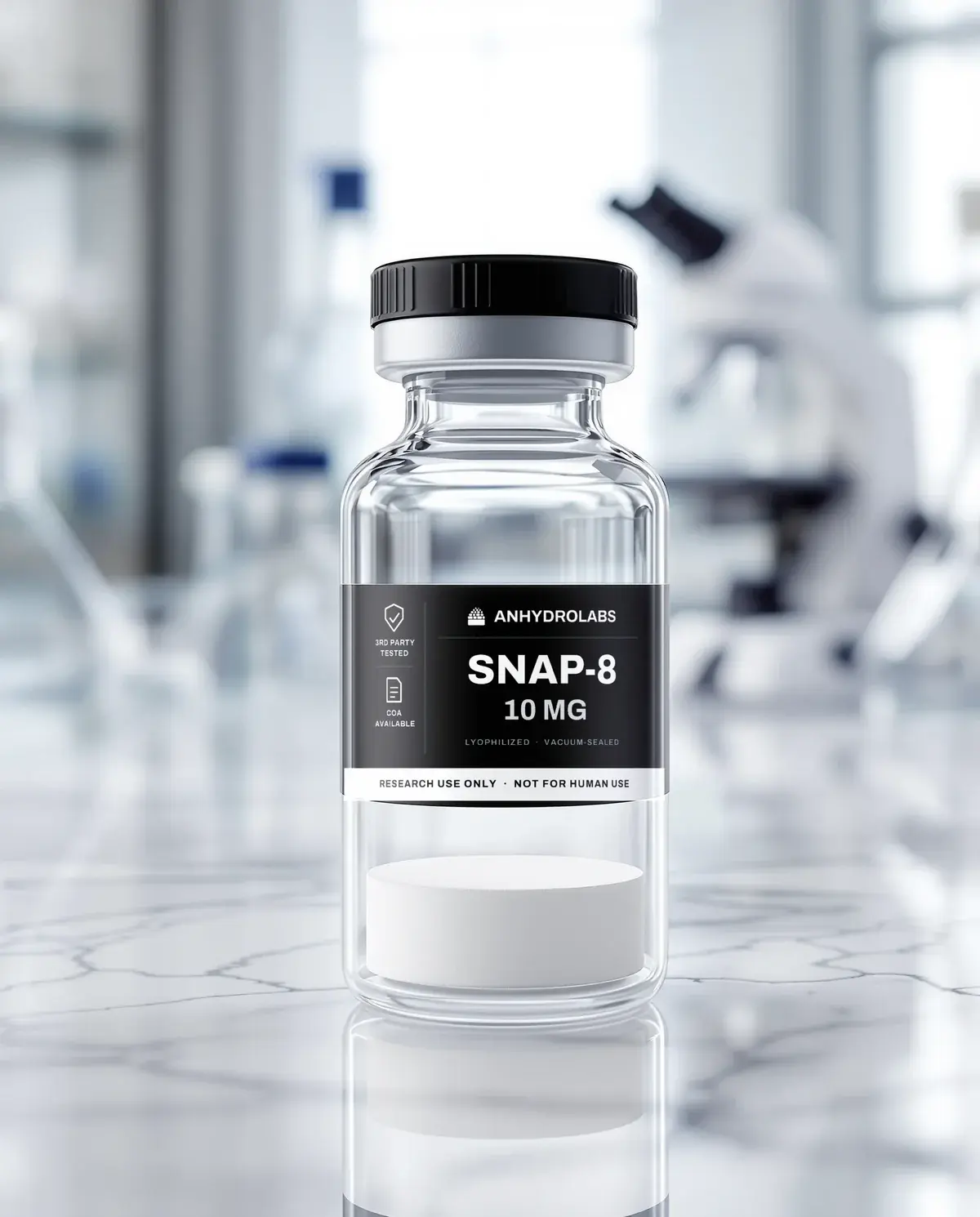
Snap-8
Also known as acetyl octapeptide-3. Lyophilized, vacuum-sealed, single vial.
- CAS
- 868844-74-0
- Form
- Lyophilized powder
- Storage
- Frozen, in the dark
- Ships
- Within the US
Get an email when Snap-8 is available
- Coming soon
- Ships within the US
- Pay by card or crypto
- All sales final
Snap-8 is a synthetic eight-residue peptide, also listed as acetyl octapeptide-3, with the sequence Ac-Glu-Glu-Met-Gln-Arg-Arg-Ala-Asp-NH2. The sequence matches residues 12 to 19 of human SNAP-25, a SNARE protein involved in neurotransmitter release. It extends the hexapeptide Argireline by two residues and is known mainly as a cosmetic ingredient. Peer-reviewed data on the octapeptide itself are sparse.
Supplied for laboratory research use only. Not for human or veterinary use, and not for diagnostic or therapeutic application.
Snap-8: compound data
- Molecular formula
- C41H70N16O16S
- Molecular weight
- 1,075.2 g/mol
- CAS number
- 868844-74-0
- PubChem
- CID 76283482
- Form supplied
- Lyophilized powder, vacuum-sealed
- Concentration
- mg/mL and molarity calculator
Reference values from PubChem, the chemistry database of the US National Library of Medicine, for the compound as registered there.
About Snap-8
Structure of Snap-8
Snap-8 is a linear octapeptide with an acetyl group on the N-terminal glutamate and an amide at the C-terminal aspartate. PubChem records it as Ac-Glu-Glu-Met-Gln-Arg-Arg-Ala-Asp-NH2 and lists the synonyms acetyl octapeptide-3, acetyl glutamyl heptapeptide-3 and SNAP8. The chain has three acidic side chains (two glutamates and one aspartate), two arginines, one methionine and one glutamine, and no cysteine, tryptophan or tyrosine. Its first six residues are the sequence of Argireline, Ac-EEMQRR-NH2. Snap-8 adds alanine and aspartate, which are the next two residues of the parent protein.
Where Snap-8 comes from
The parent molecule is SNAP-25, a 206-residue human protein (UniProt P60880). In 2002 Blanes-Mira and colleagues reported the hexapeptide Ac-EEMQRR-NH2, which they named Argireline, as the product of a rational design program looking for non-toxic molecules that mimic the action of botulinum neurotoxins. Snap-8 is the two-residue extension of that hexapeptide along the SNAP-25 sequence. No journal article describing the design of the octapeptide itself was located for this profile. A 2018 paper in Frontiers in Immunology mentions Argireline and SNAP-8 together as commercialized SNAP-25-derived peptides used in cosmetics.
What Snap-8 binds
UniProt describes SNAP-25 as a t-SNARE involved in the molecular regulation of neurotransmitter release, with two coiled-coil homology domains at residues 19 to 81 and 140 to 202. Residues 12 to 19, the segment Snap-8 copies, sit at the N-terminal edge of the first domain. The 2002 Argireline paper reported that the hexapeptide inhibited neurotransmitter release and attributed this to interference with the formation or stability of the SNARE complex that drives calcium-dependent exocytosis. Snap-8 is presumed to compete with SNAP-25 in the same way, but that presumption rests on the hexapeptide data and has not been established for the octapeptide in the sources cited here.
Snap-8 in the research literature
Direct literature on Snap-8 is thin, and most of what is said about it is inferred from related peptides. The Argireline study combined neurotransmitter release assays with analysis of SNARE complex formation. In 2018 Yang and colleagues examined seventeen 17-residue peptides copied from the SNARE motifs of SNAP-23, syntaxin 4 and several VAMP proteins in RBL-2H3 mast cells, using histamine and beta-hexosaminidase release and proteoliposome lipid-mixing assays. Peptides from the N-terminal regions were the most active, and a protein transduction domain was needed for entry into intact cells. ClinicalTrials.gov returns no registered study with acetyl octapeptide as an intervention.
Regulatory status of Snap-8
Snap-8 is not an approved drug. A search of the Drugs@FDA data returns no application with acetyl octapeptide as an active ingredient, and no interventional trial of it is registered on ClinicalTrials.gov. Its public identity is that of a cosmetic ingredient: PubChem lists it under ingredient-style names such as acetyl octapeptide-3. An ingredient name is a naming convention and is not an authorization for any use. The material described on this page is supplied as a reference reagent for in-vitro laboratory research only.
Handling Snap-8 in the laboratory
Snap-8 is supplied lyophilized in a vacuum-sealed vial. Keep the sealed vial frozen at -4 °F and protected from light, and let it reach room temperature before breaking the seal so that moisture does not condense on the powder. Once in solution the peptide keeps for about four weeks at 39 °F. Divide a stock into single-use aliquots instead of freezing and thawing it repeatedly. No compound-specific solubility or stability study from a primary source was located for the octapeptide, so the general conditions above apply.
Sources
- PubChem compound summary: Acetyl octapeptide-3, CID 76283482
- UniProt P60880: Synaptosomal-associated protein 25 (SNAP25), human
- A synthetic hexapeptide (Argireline) with antiwrinkle activity (Blanes-Mira et al., Int J Cosmet Sci, 2002)
- Soluble N-Ethylmaleimide-Sensitive Factor Attachment Protein Receptor-Derived Peptides for Regulation of Mast Cell Degranulation (Yang et al., Front Immunol, 2018)
- Drugs@FDA: FDA-Approved Drugs
- ClinicalTrials.gov search: acetyl octapeptide as intervention
Research notes on Snap-8
- Snap-8: The Acetyl Octapeptide-3 ExplainedThe Snap-8 peptide, acetyl octapeptide-3: its eight-residue sequence, the SNAP-25 segment it copies, how it relates to Argireline, and lab handling.
Snap-8: common questions
Is acetyl octapeptide-3 the same as Snap-8?
Yes. acetyl octapeptide-3 is another name for Snap-8 (CAS 868844-74-0). It is the same compound, supplied here as a lyophilized powder for in-vitro laboratory research use only.
What is Snap-8 supplied as?
Snap-8 is supplied as a lyophilized (freeze-dried) powder in a vacuum-sealed vial, in 10 mg, for in-vitro laboratory research use only.
When will Snap-8 be available?
Snap-8 is coming soon. Join the newsletter on this page to get an email as soon as it can be ordered.
What is the CAS number of Snap-8?
The CAS registry number of Snap-8 is 868844-74-0.
How should Snap-8 be stored?
Frozen at −4 °F and protected from light, from the day it arrives. Let the vial reach room temperature before breaking the seal; once reconstituted, stability holds for about four weeks refrigerated at 39 °F.
How fast does Snap-8 ship?
Orders ship from the United States, to US addresses. Sizes in stock ship within 1 business day of payment.
Is Snap-8 for human use?
No. It is supplied as a reference reagent for laboratory research use. Not for human or veterinary use, and not for diagnostic or therapeutic application.
What is the amino acid sequence of Snap-8?
PubChem gives the sequence as Ac-Glu-Glu-Met-Gln-Arg-Arg-Ala-Asp-NH2, or Ac-EEMQRRAD-NH2 in one-letter code. It is a linear octapeptide with an acetylated N-terminus and an amidated C-terminus, and it matches residues 12 to 19 of human SNAP-25.
How is Snap-8 different from Argireline?
Argireline is the hexapeptide Ac-EEMQRR-NH2, described by Blanes-Mira and colleagues in 2002. Snap-8 has the same six residues followed by alanine and aspartate, the next two residues of SNAP-25. The published mechanistic work was done on the hexapeptide, and comparable peer-reviewed data on the octapeptide were not found.
Is Snap-8 approved by the FDA?
No. The Drugs@FDA data contain no application with acetyl octapeptide as an active ingredient, and ClinicalTrials.gov lists no interventional study of it. It is known as a cosmetic ingredient name and, as a reagent, belongs to in-vitro laboratory research.