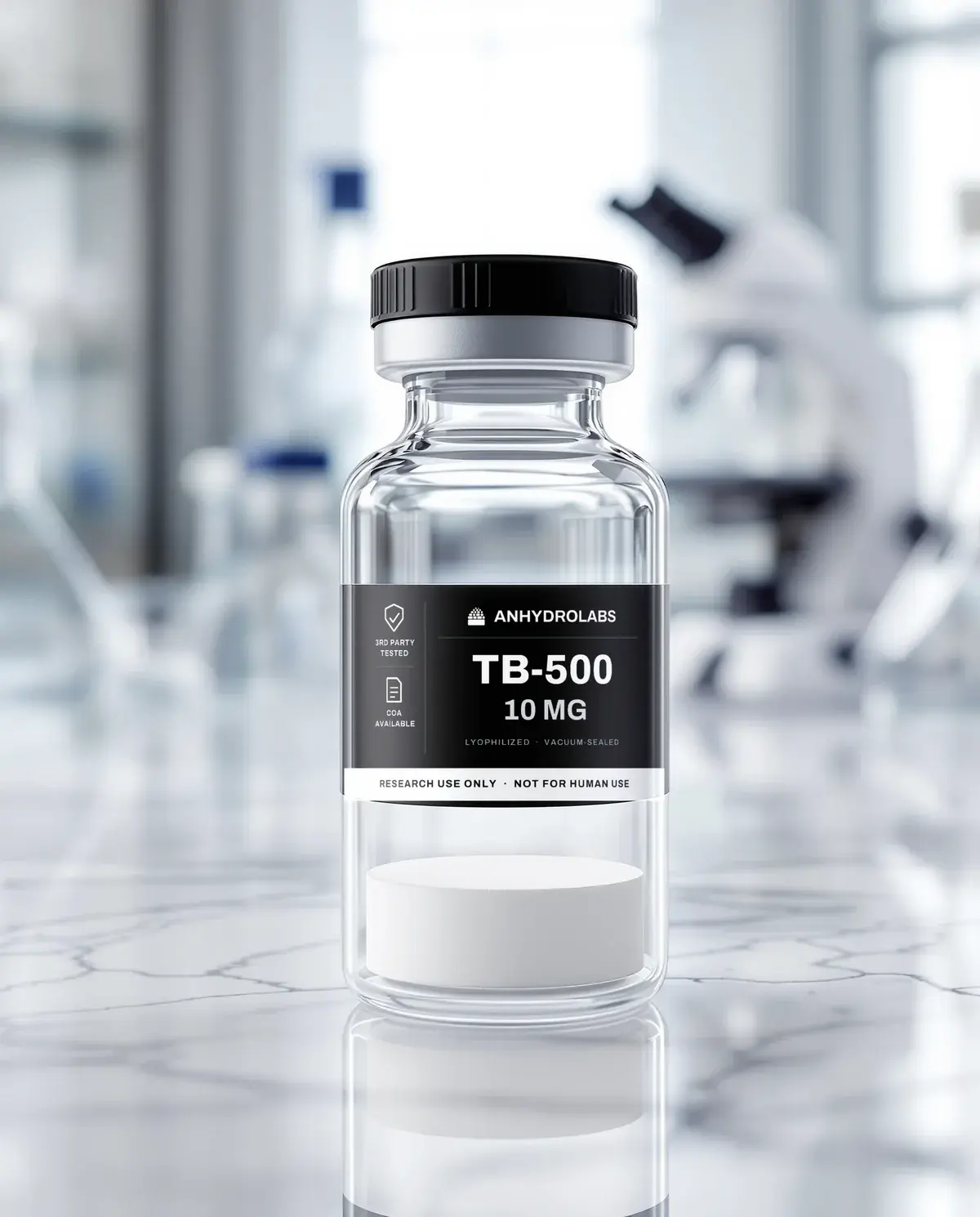
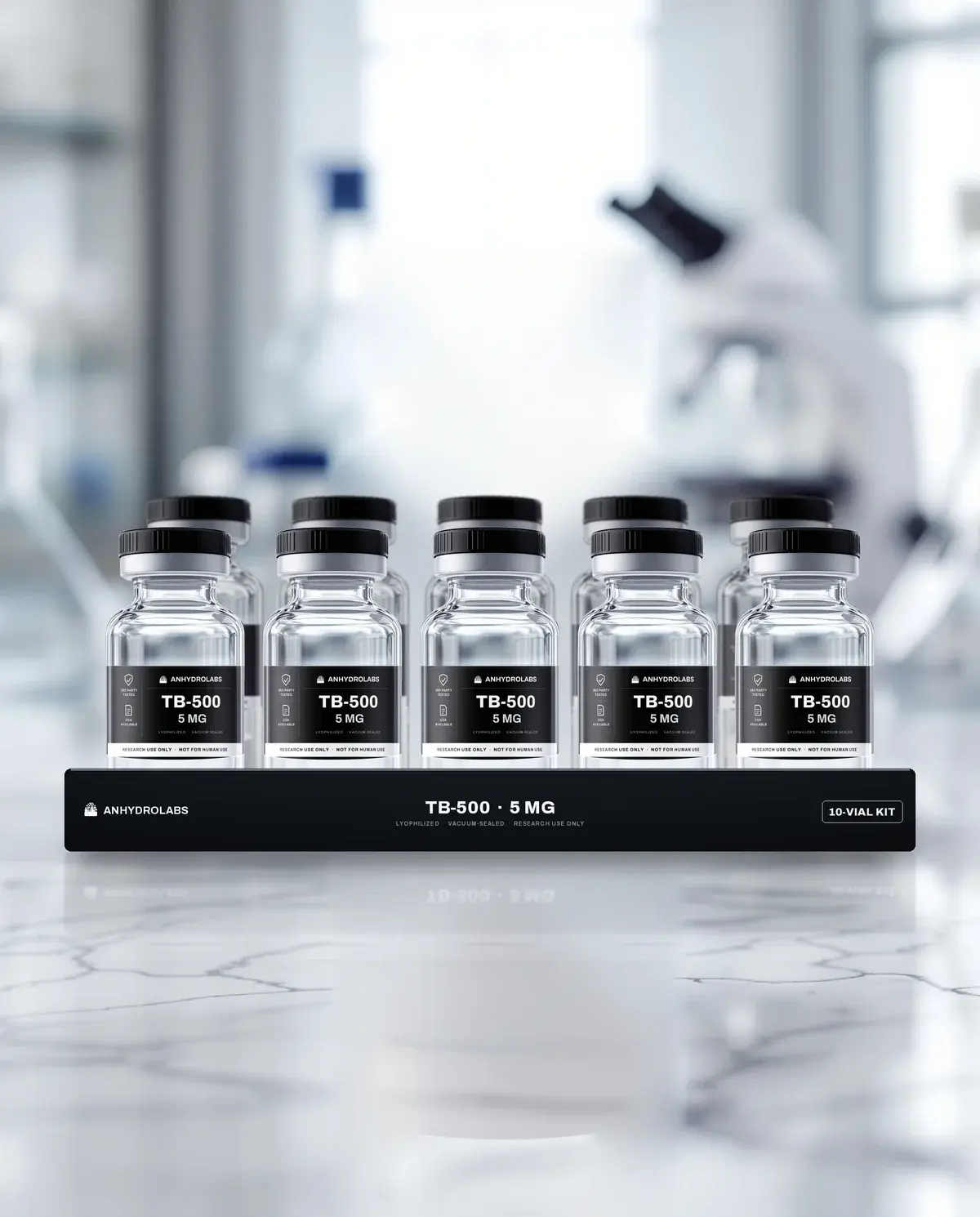
TB-500
Also known as thymosin beta-4 fragment. Lyophilized, vacuum-sealed, single vial.
- CAS
- 885340-08-9
- Form
- Lyophilized powder
- Storage
- Frozen, in the dark
- Ships
- Vials within 1 business day, kits by Dec 12, 2026
- In stock
- Ships within the US
- Pay by card or crypto
- All sales final
TB-500 is a synthetic seven-residue peptide, N-acetyl-Leu-Lys-Lys-Thr-Glu-Thr-Gln, corresponding to residues 17 to 23 of thymosin beta-4, a 43-residue protein that sequesters actin monomers. It is also described as a thymosin beta-4 fragment. The name entered the scientific record in 2012, when anti-doping chemists identified this acetylated heptapeptide in a product sold as TB-500. It is not an approved drug.
Supplied for laboratory research use only. Not for human or veterinary use, and not for diagnostic or therapeutic application.
TB-500: compound data
- Molecular formula
- C38H68N10O14
- Molecular weight
- 889 g/mol
- CAS number
- 885340-08-9
- PubChem
- CID 62707662
- Form supplied
- Lyophilized powder, vacuum-sealed
- Concentration
- mg/mL and molarity calculator
Reference values from PubChem, the chemistry database of the US National Library of Medicine, for the compound as registered there.
About TB-500
Structure of TB-500
PubChem assigns the names TB-500 and TB500 to the heptapeptide Ac-Leu-Lys-Lys-Thr-Glu-Thr-Gln-OH: seven residues with an acetyl group on the N-terminal leucine and a free C-terminal acid. It contains two lysines, two threonines, one glutamate and one glutamine, and no cysteine, methionine or aromatic residue. TB-500 is not full-length thymosin beta-4. The parent protein has 43 residues once its initiator methionine is removed, and the fragment covers only residues 17 to 23 of it. UniProt numbers the same stretch 18 to 24 because it counts from the methionine. PubChem also lists an acetate form.
Where TB-500 comes from
The parent protein, thymosin beta-4, is encoded by the human gene TMSB4X and is recorded in UniProt as P62328, with an N-acetylated serine at the start of the mature chain. The fragment did not originate in a discovery paper. In 2012 Esposito and colleagues at the doping control laboratory of Ghent University used liquid chromatography and high-resolution mass spectrometry to identify the N-terminally acetylated 17 to 23 fragment, Ac-LKKTETQ, in a formulation sold as TB-500. They then made the peptide by solid-phase synthesis as a reference and proposed a method to detect it in plasma and urine.
What TB-500 binds
UniProt states that thymosin beta-4 binds and sequesters actin monomers and so inhibits actin polymerization. Van Troys and colleagues mapped the binding site in 1996 using chemically synthesized full-length variants and described two separate structural elements: an N-terminal part, residues 1 to 16, which must adopt an alpha-helix to bind, and a hexapeptide motif at residues 17 to 22, in which lysine 18 makes an electrostatic contact with actin. TB-500 spans that motif plus glutamine 23. It lacks the N-terminal helix, so the actin affinity of the fragment alone cannot be read off data gathered on the whole protein.
TB-500 in the research literature
Most published biology concerns full-length thymosin beta-4, and those findings do not transfer automatically to the heptapeptide. Work on the fragment itself is largely analytical: the 2012 study characterized it by liquid chromatography and mass spectrometry for detection in plasma and urine. FDA has stated that it has not identified any human exposure data for products containing the fragment. ClinicalTrials.gov lists one study naming TB-500, the 17 to 23 fragment, as an intervention: NCT07487363, a Phase 1 and Phase 2 study of cardiovascular biomarkers, shown as recruiting when this profile was written.
Regulatory status of TB-500
TB-500 is not approved as a drug by the FDA, and no approval by another agency was found. FDA placed thymosin beta-4 fragment (LKKTETQ), also known as TB-500, in Category 2 of its interim policy on bulk substances for compounding, citing a possible immunogenicity risk from aggregation and peptide-related impurities. The entry now sits in the agency's list of Category 2 nominations withdrawn by the nominators, on a page current as of April 22, 2026. The material described here is supplied as a reference reagent for in-vitro laboratory research only.
Handling TB-500 in the laboratory
TB-500 is supplied lyophilized in a vacuum-sealed vial. Keep it frozen at -4 °F and away from light, and allow the vial to reach room temperature before breaking the seal so that the powder does not take up condensation. In solution it keeps for about four weeks at 39 °F. Prepare single-use aliquots instead of putting one stock through repeated freeze-thaw. The sequence has no cysteine or methionine, so there are no disulfides or thioethers in it. No compound-specific stability study from a primary source was located beyond that.
Sources
- PubChem compound summary: TB-500, CID 62707662
- UniProt P62328: Thymosin beta-4 (TMSB4X), human
- The actin binding site of thymosin beta 4 mapped by mutational analysis (Van Troys et al., EMBO J, 1996)
- Esposito et al., Drug Test Anal, 2012. PubMed 22962027
- Certain Bulk Drug Substances for Use in Compounding that May Present Significant Safety Risks
- ClinicalTrials.gov NCT07487363: TB-500 (Thymosin Beta 4 17-23 Fragment) for Cardiovascular Biomarkers in Stable ASCVD
Research notes on TB-500
- Are Peptides Legal? US Law for Research BuyersAre peptides legal in the US? What research use only means, why these are not FDA-approved drugs, which are controlled substances, and how imports work.
- BPC-157 vs TB-500: How the Two Peptides DifferBPC 157 vs TB 500 compared side by side: sequences, origins, molecular weights, proposed mechanisms, research models, regulatory status and lab handling.
- What Is TB-500? Thymosin Beta-4 Fragment ExplainedWhat is TB-500? The acetylated seven-residue fragment Ac-LKKTETQ from thymosin beta-4's actin-binding region: identity, origin, research and status.
TB-500: common questions
Is thymosin beta-4 fragment the same as TB-500?
Yes. thymosin beta-4 fragment is another name for TB-500 (CAS 885340-08-9). It is the same compound, supplied here as a lyophilized powder for in-vitro laboratory research use only.
What is TB-500 supplied as?
TB-500 is supplied as a lyophilized (freeze-dried) powder in a vacuum-sealed vial, in 5 mg and 10 mg, for in-vitro laboratory research use only.
How much does TB-500 cost?
TB-500 is $45.95 for any size, in US dollars. Volume pricing is quoted on request.
Is TB-500 available as a 10-vial kit?
Yes. TB-500 comes in a 10-vial kit: 5 mg for $166.50 ($16.65 per vial); 10 mg for $292.50 ($29.25 per vial), presale prices. A kit is ten sealed vials of the same size, priced below ten single vials.
When do TB-500 presale kits ship?
By Dec 12, 2026. Presale kits are 10% off. If we cannot ship by Dec 12, 2026, we tell you before that date and you can cancel for a full refund.
What is the CAS number of TB-500?
The CAS registry number of TB-500 is 885340-08-9.
How should TB-500 be stored?
Frozen at −4 °F and protected from light, from the day it arrives. Let the vial reach room temperature before breaking the seal; once reconstituted, stability holds for about four weeks refrigerated at 39 °F.
How fast does TB-500 ship?
Presale kits ship from the United States by Dec 12, 2026, to US addresses. Sizes marked in stock ship within 1 business day of payment.
Is TB-500 for human use?
No. It is supplied as a reference reagent for laboratory research use. Not for human or veterinary use, and not for diagnostic or therapeutic application.
How is TB-500 different from thymosin beta-4?
Thymosin beta-4 is a 43-residue protein. TB-500 is a seven-residue synthetic fragment of it, Ac-LKKTETQ, corresponding to residues 17 to 23. PubChem and FDA both define TB-500 as this fragment, and findings made with the full protein cannot be assumed to hold for it.
Who first identified the TB-500 peptide?
Esposito and colleagues at Ghent University reported it in Drug Testing and Analysis in 2012. They identified Ac-LKKTETQ by high-resolution mass spectrometry in a product sold as TB-500, synthesized the peptide by solid-phase synthesis and proposed a way to detect it in plasma and urine.
What does the TB-500 sequence bind?
The sequence comes from the actin-binding region of thymosin beta-4, which sequesters actin monomers. A 1996 mapping study found that the motif at residues 17 to 22 is one of two elements forming the binding site in the intact protein; the other is an N-terminal helix that the fragment lacks.
$45.95
TB-500 · 10 mg