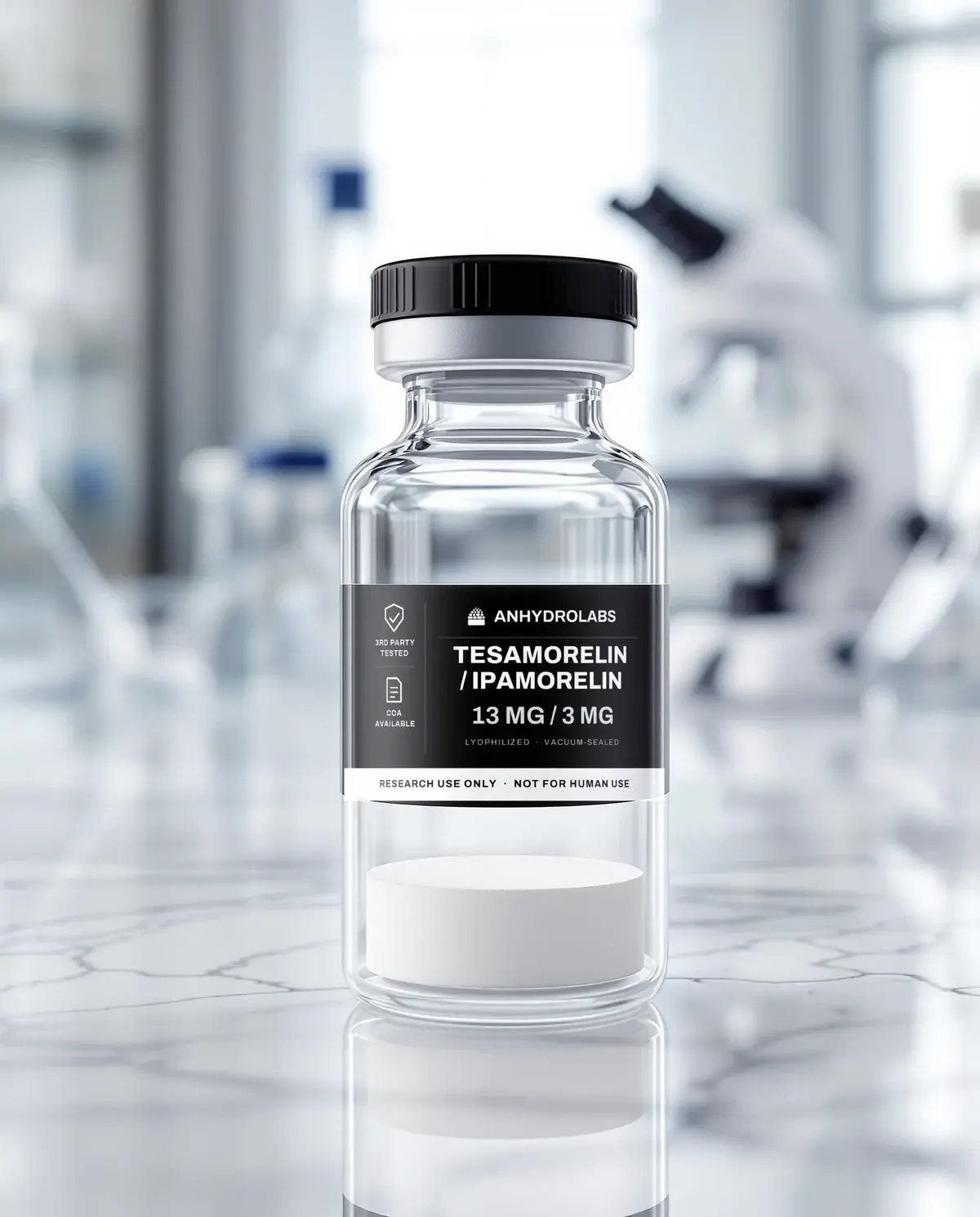
Tesamorelin / Ipamorelin
Also known as Tesa / Ipa. Lyophilized, vacuum-sealed, single vial.
- Form
- Lyophilized powder
- Storage
- Frozen, in the dark
- Ships
- Within the US
Get an email when Tesamorelin / Ipamorelin is available
- Coming soon
- Ships within the US
- Pay by card or crypto
- All sales final
Tesamorelin / Ipamorelin is a two-component blend, sometimes abbreviated Tesa / Ipa: tesamorelin, a 44-residue analog of growth hormone-releasing hormone, and ipamorelin, a synthetic pentapeptide agonist of the ghrelin receptor, lyophilized together in one vial. Each component is well characterized separately and acts at a different receptor. The combination itself has little or no published literature of its own.
Supplied for laboratory research use only. Not for human or veterinary use, and not for diagnostic or therapeutic application.
About Tesamorelin / Ipamorelin
Structure of Tesamorelin / Ipamorelin
The vial holds two unrelated peptides. Tesamorelin is the 44 amino acid sequence of human growth hormone-releasing factor with a hexenoyl group, a six-carbon chain with a double bond at position 3, on the N-terminal tyrosine. Ipamorelin is the pentapeptide Aib-His-D-2-Nal-D-Phe-Lys-NH2, in which Aib is aminoisobutyric acid and two residues, 2-naphthylalanine and phenylalanine, are in the D configuration. The two share no sequence and differ several-fold in molecular mass, so equal masses of each are far from equimolar. No literature describes the blend as a defined entity with properties of its own.
Where Tesamorelin / Ipamorelin comes from
The components come from separate programs. Tesamorelin was developed at Theratechnologies in Montreal under the code TH9507 and described by Ferdinandi and colleagues in 2007 as human GRF(1-44) amide with a trans-3-hexenoyl group added to Tyr1. Ipamorelin came from a chemistry program at Novo Nordisk and was described by Raun and colleagues in 1998; it was identified within a series of compounds lacking the central Ala-Trp dipeptide of growth hormone-releasing peptide 1. No publication was found that introduces the two as a single preparation. The pairing is a catalog format, not a compound with a discovery history.
What Tesamorelin / Ipamorelin binds
The two peptides act at different receptors. The FDA label for tesamorelin states that in vitro it binds and stimulates human growth hormone-releasing factor receptors with similar potency as the endogenous factor. Raun and colleagues used antagonists to show that ipamorelin releases growth hormone through a GHRP-like receptor and not through the GHRH receptor. That receptor is the growth hormone secretagogue receptor type 1 (UniProt Q92847), which UniProt describes as specific to ghrelin, coupled to Gq proteins and signaling through phospholipase C. How the two behave when present together has not been characterized in the sources cited here.
Tesamorelin / Ipamorelin in the research literature
The data are for each component alone. TH9507 was studied in rat, dog and human plasma in vitro and in pigs, rats and dogs, with plasma growth hormone and insulin-like growth factor-1 as readouts. Ipamorelin was characterized in primary rat pituitary cells, anesthetized rats and conscious swine, where the authors also measured FSH, LH, prolactin, TSH, ACTH and cortisol to assess hormone specificity. Ipamorelin was later the subject of one registered Phase 2 study, NCT00672074, listed as completed. No study of the two as a combined intervention was found on ClinicalTrials.gov.
Regulatory status of Tesamorelin / Ipamorelin
The components have different regulatory positions. Tesamorelin is FDA-approved as Egrifta, first in 2010, for a single labeled indication. Ipamorelin is not an FDA-approved drug; the FDA lists ipamorelin acetate in Category 2 under its 503B interim policy on bulk substances for compounding, added September 29, 2023, and also among nominations that were withdrawn. No approved product combines the two. The blend described on this page is supplied as a reference reagent for in-vitro laboratory research only.
Handling Tesamorelin / Ipamorelin in the laboratory
The blend is supplied lyophilized in a vacuum-sealed vial. Keep it frozen at -4 °F and protected from light, and let the vial reach room temperature before breaking the seal. In solution the general guide is about four weeks at 39 °F, with the stock divided into single-use aliquots instead of being frozen and thawed repeatedly. No stability study of the two peptides together was found in a primary source, so those conditions are the general ones for lyophilized peptides and are not specific to this combination.
Sources
- EGRIFTA WR (tesamorelin) for injection, prescribing information (DailyMed)
- Ferdinandi et al., Basic Clin Pharmacol Toxicol, 2007. PubMed 17214611
- Ipamorelin, the first selective growth hormone secretagogue (Raun et al., Eur J Endocrinol, 1998)
- UniProt Q92847: Growth hormone secretagogue receptor type 1 (GHSR), human
- Certain Bulk Drug Substances for Use in Compounding that May Present Significant Safety Risks
- ClinicalTrials.gov NCT00672074
Tesamorelin / Ipamorelin: common questions
Is Tesa / Ipa the same as Tesamorelin / Ipamorelin?
Yes. Tesa / Ipa is another name for Tesamorelin / Ipamorelin. It is the same compound, supplied here as a lyophilized powder for in-vitro laboratory research use only.
What is Tesamorelin / Ipamorelin supplied as?
Tesamorelin / Ipamorelin is supplied as a lyophilized (freeze-dried) powder in a vacuum-sealed vial, in 13 mg / 3 mg, for in-vitro laboratory research use only.
When will Tesamorelin / Ipamorelin be available?
Tesamorelin / Ipamorelin is coming soon. Join the newsletter on this page to get an email as soon as it can be ordered.
How should Tesamorelin / Ipamorelin be stored?
Frozen at −4 °F and protected from light, from the day it arrives. Let the vial reach room temperature before breaking the seal; once reconstituted, stability holds for about four weeks refrigerated at 39 °F.
How fast does Tesamorelin / Ipamorelin ship?
Orders ship from the United States, to US addresses. Sizes in stock ship within 1 business day of payment.
Is Tesamorelin / Ipamorelin for human use?
No. It is supplied as a reference reagent for laboratory research use. Not for human or veterinary use, and not for diagnostic or therapeutic application.
What is in the Tesamorelin / Ipamorelin blend?
Two peptides in one vial. Tesamorelin is the 44-residue human growth hormone-releasing factor sequence with an N-terminal hexenoyl group. Ipamorelin is the synthetic pentapeptide Aib-His-D-2-Nal-D-Phe-Lys-NH2. They are unrelated in sequence and were developed by different companies.
Do tesamorelin and ipamorelin bind the same receptor?
No. Tesamorelin binds the growth hormone-releasing hormone receptor. Ipamorelin acts through the growth hormone secretagogue receptor type 1, the receptor for ghrelin, as shown in 1998 with receptor antagonists in rat pituitary cells. The two receptors are separate proteins with different signaling.
Is there published research on tesamorelin and ipamorelin combined?
Very little, if any. The primary literature found for this profile covers each peptide separately, and no study of the two as one combined intervention was found on ClinicalTrials.gov. Anything said about the blend is therefore a statement about its two components.