Thymosin Alpha-1
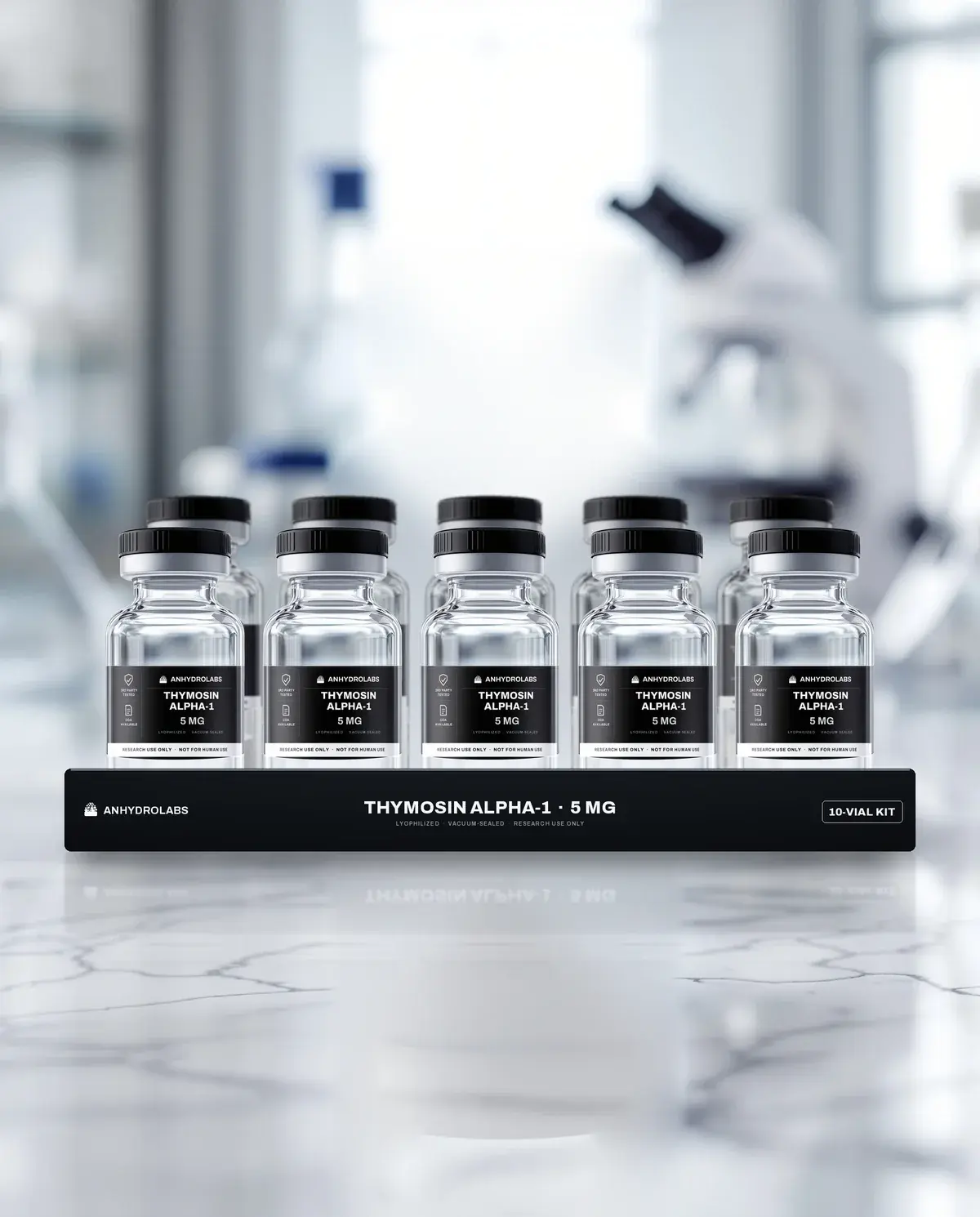
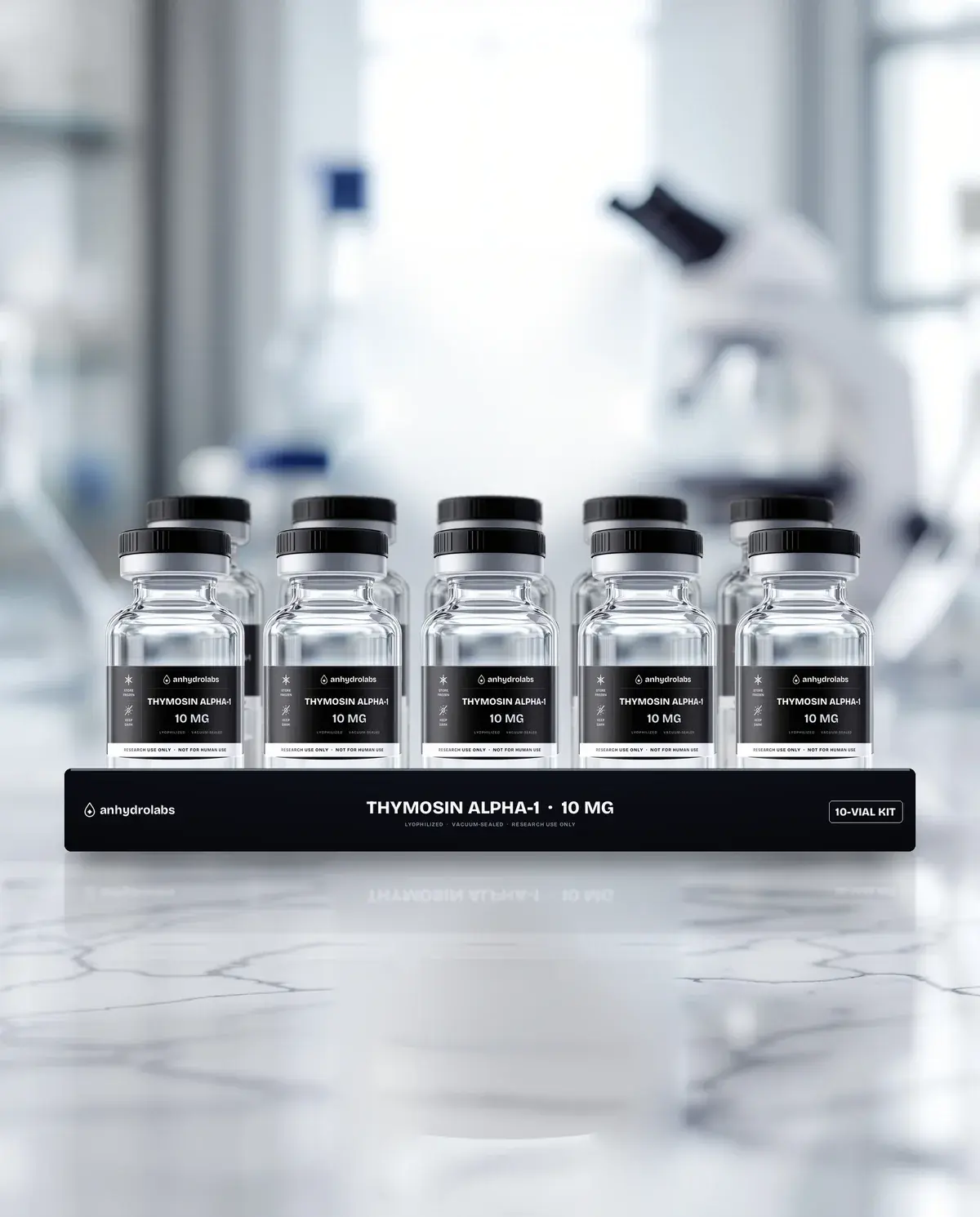
Also known as thymalfasin. Lyophilized, vacuum-sealed, 10-vial kit.
- CAS
- 62304-98-7
- Form
- Lyophilized powder
- Storage
- Frozen, in the dark
- Ships
- Kits by Dec 12, 2026
- Presale
- Ships within the US
- Pay by card or crypto
- All sales final
Thymosin alpha-1 is a 28-residue peptide with an acetylated N-terminal serine, corresponding to residues 2 to 29 of the human protein prothymosin alpha. It was isolated from calf thymus and sequenced by A. L. Goldstein and colleagues in 1977. The chemically synthesized form has the nonproprietary name thymalfasin. In the literature it is studied mainly as a signal acting on dendritic cells through Toll-like receptor 9.
Supplied for laboratory research use only. Not for human or veterinary use, and not for diagnostic or therapeutic application.
Thymosin Alpha-1: compound data
- Molecular formula
- C129H215N33O55
- Molecular weight
- 3,108.3 g/mol
- CAS number
- 62304-98-7
- PubChem
- CID 16130571
- Form supplied
- Lyophilized powder, vacuum-sealed
- Concentration
- mg/mL and molarity calculator
Reference values from PubChem, the chemistry database of the US National Library of Medicine, for the compound as registered there.
About Thymosin Alpha-1
Structure of Thymosin Alpha-1
The PubChem record for thymalfasin gives the sequence as Ac-Ser-Asp-Ala-Ala-Val-Asp-Thr-Ser-Ser-Glu-Ile-Thr-Thr-Lys-Asp-Leu-Lys-Glu-Lys-Lys-Glu-Val-Val-Glu-Glu-Ala-Glu-Asn-OH: 28 residues, an acetyl group on the N-terminal serine and a free acid at the C-terminus. Nine residues are aspartate or glutamate against four lysines, which fits the 1977 description of a highly acidic molecule. The chain has no cysteine, so no disulfide bond, and no aromatic residue. UniProt maps the peptide to positions 2 to 29 of the 111-residue human prothymosin alpha (P06454) and annotates position 2 as N-acetylserine. PubChem describes thymalfasin as identical to human thymosin alpha-1.
Where Thymosin Alpha-1 comes from
The peptide was described by Goldstein, Low, McAdoo and coworkers in the Proceedings of the National Academy of Sciences in February 1977. They isolated it from calf thymus, out of a partially purified preparation called thymosin fraction 5, determined its amino acid sequence, and reported it as heat stable, highly acidic and 28 residues long. The same paper proposed a nomenclature for the family of polypeptides in fraction 5, which is where the alpha-1 label comes from. UniProt now records it as a peptide contained within prothymosin alpha, the product of the human gene PTMA. PubChem lists thymalfasin as the USAN and INN, with Zadaxin as a trade name.
What Thymosin Alpha-1 binds
No dedicated receptor for thymosin alpha-1 is defined in the sources consulted for this profile, and the direct binding partner remains an open question in them. The best characterized pathway is in dendritic cells. Romani and colleagues reported in Blood in 2006 that the peptide primes dendritic cells through Toll-like receptor 9 (TLR9) signaling, and that in murine dendritic cells it induced expression and activity of indoleamine 2,3-dioxygenase, the enzyme that opens tryptophan catabolism. That induction required both TLR9 and type I interferon receptor signaling, and was followed by interleukin-10 production and the appearance of regulatory T cells in culture.
Thymosin Alpha-1 in the research literature
The 1977 work was protein chemistry on calf thymus extracts. The 2006 study used human and murine dendritic cells in culture, T-helper cell priming assays, and cell-transfer experiments in mice. For human studies, a ClinicalTrials.gov search for thymalfasin as an intervention returned 64 registered records in October 2026. Phase 2 was the most common designation, with 27 records, and the remainder ranged from early Phase 1 to Phase 4. Twenty-four were listed as completed, ten as recruiting and seventeen with unknown status. Many of these records use the peptide in combination with other agents, so they are not all studies of thymosin alpha-1 alone.
Regulatory status of Thymosin Alpha-1
Thymalfasin is not the active ingredient of any FDA-approved product; PubChem lists Zadaxin as a trade name used outside the United States. On its page about bulk drug substances that may present significant safety risks in compounding, last updated April 22, 2026, the FDA lists thymosin alpha-1 among substances that were previously in category 2 of its interim policies and whose nominations were then withdrawn by the nominators. The agency's entry cites possible immunogenicity and the difficulty of characterizing peptide-related impurities. Anhydrolabs supplies it as a reference reagent for in-vitro laboratory research only, not for human or veterinary diagnosis, treatment, or consumption.
Handling Thymosin Alpha-1 in the laboratory
The material is a lyophilized powder in a vacuum-sealed vial. Keep it frozen at -4 °F and protected from light. Let the vial reach room temperature before breaking the seal, so that moisture from the air does not condense on the cold powder. Once dissolved for in-vitro work, a solution keeps for about four weeks at 39 °F. Divide a stock solution into single-use aliquots instead of freezing and thawing it repeatedly. No compound-specific solubility figure for thymosin alpha-1 was found in a primary source.
Sources
- UniProtKB P06454: Prothymosin alpha, human (PTMA)
- PubChem compound summary: Thymalfasin, CID 16130571
- Thymosin alpha1: isolation and sequence analysis of an immunologically active thymic polypeptide (Proceedings of the National Academy of Sciences, 1977)
- Blood, 2006. PubMed 16741252
- FDA: Certain Bulk Drug Substances for Use in Compounding that May Present Significant Safety Risks
- ClinicalTrials.gov: registered studies listing thymalfasin as an intervention
Research notes on Thymosin Alpha-1
- Thymosin Alpha-1: Structure and ResearchThymosin alpha 1 peptide profile: the 28-residue N-acetylated sequence, its origin in prothymosin alpha, thymalfasin's regulatory status and lab handling.
Thymosin Alpha-1: common questions
Is thymalfasin the same as Thymosin Alpha-1?
Yes. thymalfasin is another name for Thymosin Alpha-1 (CAS 62304-98-7). It is the same compound, supplied here as a lyophilized powder for in-vitro laboratory research use only.
What is Thymosin Alpha-1 supplied as?
Thymosin Alpha-1 is supplied as a lyophilized (freeze-dried) powder in a vacuum-sealed vial, in 5 mg and 10 mg, for in-vitro laboratory research use only.
Is Thymosin Alpha-1 available as a 10-vial kit?
Yes. Thymosin Alpha-1 comes in a 10-vial kit: 5 mg for $202.50 ($20.25 per vial); 10 mg for $315.00 ($31.50 per vial), presale prices. A kit is ten sealed vials of the same size, priced below ten single vials.
When do Thymosin Alpha-1 presale kits ship?
By Dec 12, 2026. Presale kits are 10% off. If we cannot ship by Dec 12, 2026, we tell you before that date and you can cancel for a full refund.
What is the CAS number of Thymosin Alpha-1?
The CAS registry number of Thymosin Alpha-1 is 62304-98-7.
How should Thymosin Alpha-1 be stored?
Frozen at −4 °F and protected from light, from the day it arrives. Let the vial reach room temperature before breaking the seal; once reconstituted, stability holds for about four weeks refrigerated at 39 °F.
How fast does Thymosin Alpha-1 ship?
Presale kits ship from the United States by Dec 12, 2026, to US addresses. Sizes marked in stock ship within 1 business day of payment.
Is Thymosin Alpha-1 for human use?
No. It is supplied as a reference reagent for laboratory research use. Not for human or veterinary use, and not for diagnostic or therapeutic application.
What is the amino acid sequence of thymosin alpha-1?
Thymosin alpha-1 is Ac-SDAAVDTSSEITTKDLKEKKEVVEEAEN in one-letter code: 28 residues with an acetyl group on the N-terminal serine and a free C-terminal acid. PubChem gives this sequence for thymalfasin, and it matches residues 2 to 29 of human prothymosin alpha in UniProt entry P06454.
How is thymosin alpha-1 related to prothymosin alpha?
Thymosin alpha-1 is a fragment of prothymosin alpha. UniProt annotates human prothymosin alpha, the 111-residue product of the PTMA gene, as containing thymosin alpha-1 at positions 2 to 29, with the initiator methionine removed and the serine at position 2 acetylated.
Who discovered thymosin alpha-1?
A. L. Goldstein and eleven coauthors reported the isolation and sequence of thymosin alpha-1 in the Proceedings of the National Academy of Sciences in 1977. The source was calf thymus, specifically a preparation called thymosin fraction 5, and the same paper proposed the naming scheme for the other polypeptides in that fraction.
$202.50
Thymosin Alpha-1 · 5 mg · 10-vial kit