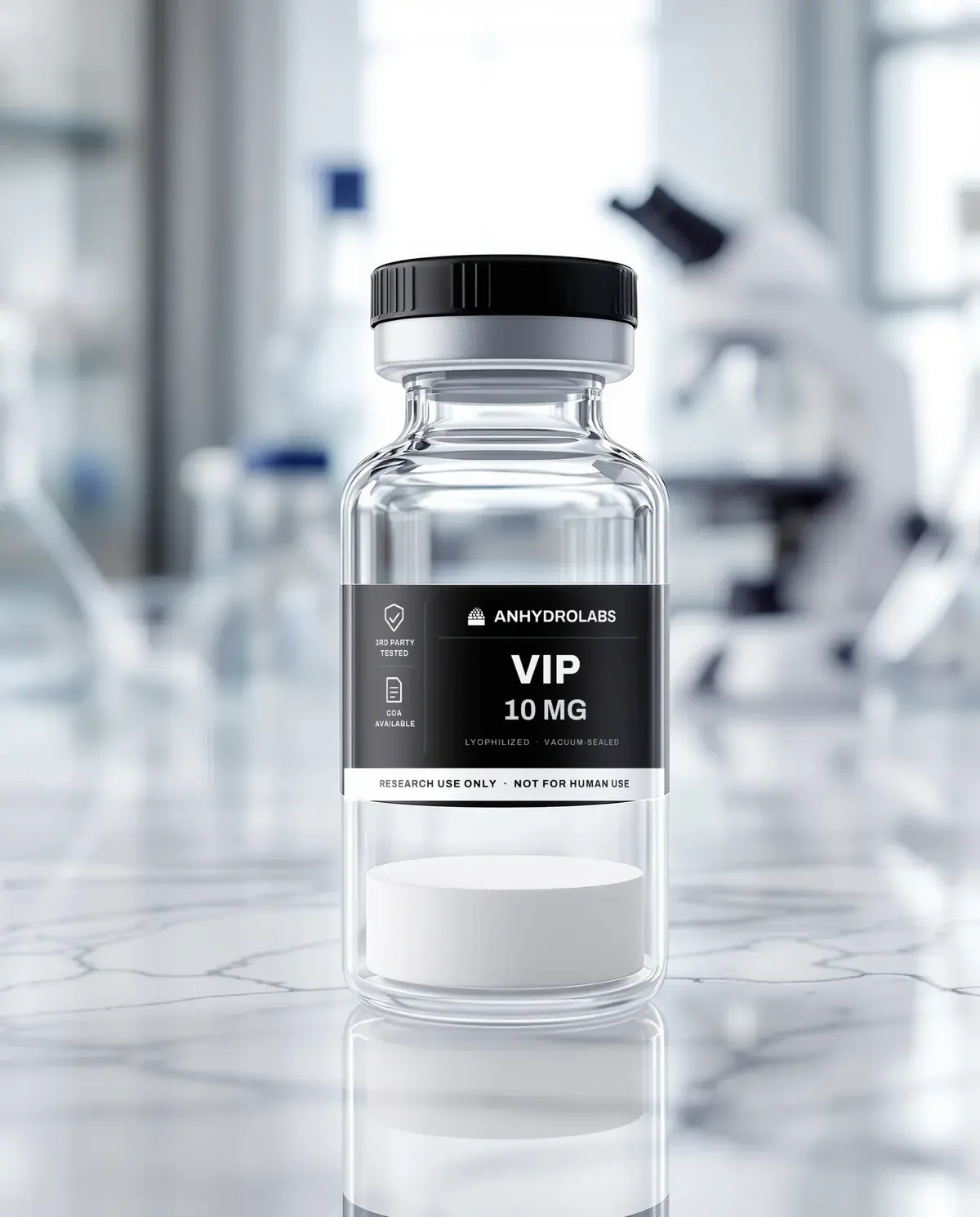
VIP
Also known as vasoactive intestinal peptide. Lyophilized, vacuum-sealed, single vial.
- CAS
- 40077-57-4
- Form
- Lyophilized powder
- Storage
- Frozen, in the dark
- Ships
- Within the US
Get an email when VIP is available
- Coming soon
- Ships within the US
- Pay by card or crypto
- All sales final
VIP is vasoactive intestinal peptide, a 28-residue neuropeptide of the secretin and glucagon superfamily. S. I. Said and V. Mutt isolated it from hog small intestine in 1970. It binds two class B G protein-coupled receptors, VPAC1 and VPAC2, which signal mainly through cyclic AMP. The synthetic peptide has the nonproprietary name aviptadil.
Supplied for laboratory research use only. Not for human or veterinary use, and not for diagnostic or therapeutic application.
VIP: compound data
- Molecular formula
- C147H237N43O43S
- Molecular weight
- 3,326.8 g/mol
- CAS number
- 40077-57-4
- PubChem
- CID 16132300
- Form supplied
- Lyophilized powder, vacuum-sealed
- Concentration
- mg/mL and molarity calculator
Reference values from PubChem, the chemistry database of the US National Library of Medicine, for the compound as registered there.
About VIP
Structure of VIP
The sequence is His-Ser-Asp-Ala-Val-Phe-Thr-Asp-Asn-Tyr-Thr-Arg-Leu-Arg-Lys-Gln-Met-Ala-Val-Lys-Lys-Tyr-Leu-Asn-Ser-Ile-Leu-Asn. UniProt places it at residues 125 to 152 of the 170-residue human precursor (P01282) and annotates the final asparagine as an amide, the form made in tissue. The PubChem record for aviptadil draws the same 28 residues with a free acid at the C-terminus, so it is worth confirming which form a given material is before working out molar concentration. The chain has one methionine, at position 17, and no cysteine. The same precursor also yields the peptides PHM-27 and PHV-42, and a 2012 review notes that the VIP sequence is conserved between most mammals.
Where VIP comes from
Said and Mutt reported the peptide in Science in September 1970 as a polypeptide isolated from the small intestine of the hog, 28 amino acid residues long and chemically distinct from the kinins, substance P, glucagon and secretin. It was later found to be encoded, with other active peptides, by a single precursor called prepro-VIP. Vasoactive intestinal polypeptide and vasoactive intestinal octacosapeptide are older forms of the name. Aviptadil is the USAN, INN and BAN for the synthetic peptide, and PubChem also lists the development names RLF-100 and Zyesami, and Invicorp for a combination of aviptadil with phentolamine.
What VIP binds
VIP acts on class B G protein-coupled receptors, the secretin receptor-like family. The 2012 IUPHAR review names three for VIP and the related peptide PACAP: VPAC1, VPAC2 and PAC1. VPAC1 and VPAC2 bind VIP and PACAP with comparable high affinity, while at most forms of PAC1 the two PACAP peptides are more than 100 times as potent as VIP. For VPAC1, UniProt gives the affinity order as VIP equal to PACAP-27, with PACAP-38 lower, and describes activation of the cyclic AMP pathway. The review adds that VPAC1 paired with the accessory protein RAMP2 shows more phosphoinositide hydrolysis with no change in cyclic AMP.
VIP in the research literature
Early receptor work used intestinal cells and the human SUP-T1 lymphoblast cell line, where a receptor with VPAC2 pharmacology was first reported. VPAC1 was cloned from rat lung and VPAC2 from rat olfactory bulb. Mice lacking VIP, VPAC1 or VPAC2 have been made, and selective tools exist, including the VPAC1 antagonist PG 97-269 and the VPAC2 agonist Ro 25-1392. For human studies, a ClinicalTrials.gov search for aviptadil as an intervention returned nine records in October 2026: Phase 2, Phase 2/3 and Phase 3 trials plus one expanded access record. Four were listed as completed, two as terminated and one as withdrawn.
Regulatory status of VIP
Aviptadil is investigational in the United States. A search of the FDA drug application database for aviptadil as an active ingredient returned no approved product in October 2026, and the trials registered on ClinicalTrials.gov reached Phase 3 without an approval being recorded in the sources cited here. The names Zyesami and RLF-100 in PubChem belong to that development work, and Invicorp names a combination with phentolamine. This profile makes no statement about approvals outside the United States, which were not verified. Anhydrolabs supplies it as a reference reagent for in-vitro laboratory research only, not for human or veterinary diagnosis, treatment, or consumption.
Handling VIP in the laboratory
The material is a lyophilized powder in a vacuum-sealed vial. Keep it frozen at -4 °F and protected from light. Let the vial reach room temperature before breaking the seal, so that moisture from the air does not condense on the cold powder. Once dissolved for in-vitro work, a solution keeps for about four weeks at 39 °F. Divide a stock solution into single-use aliquots instead of freezing and thawing it repeatedly. No compound-specific solubility figure for VIP was found in a primary source.
Sources
- Polypeptide with broad biological activity: isolation from small intestine (Science, 1970)
- Pharmacology and functions of receptors for vasoactive intestinal peptide and pituitary adenylate cyclase-activating polypeptide: IUPHAR Review 1 (British Journal of Pharmacology, 2012)
- UniProtKB P01282: VIP peptides, human (VIP)
- UniProtKB P32241: Vasoactive intestinal polypeptide receptor 1, human (VIPR1)
- PubChem compound summary: Aviptadil, CID 16132300
- ClinicalTrials.gov: registered studies listing aviptadil as an intervention
Research notes on VIP
- VIP: Vasoactive Intestinal Peptide in ResearchWhat the VIP peptide is: the 28-residue sequence, its VPAC1 and VPAC2 receptors, the 1970 isolation, aviptadil's status and lab handling notes.
VIP: common questions
Is vasoactive intestinal peptide the same as VIP?
Yes. vasoactive intestinal peptide is another name for VIP (CAS 40077-57-4). It is the same compound, supplied here as a lyophilized powder for in-vitro laboratory research use only.
What is VIP supplied as?
VIP is supplied as a lyophilized (freeze-dried) powder in a vacuum-sealed vial, in 10 mg, for in-vitro laboratory research use only.
When will VIP be available?
VIP is coming soon. Join the newsletter on this page to get an email as soon as it can be ordered.
What is the CAS number of VIP?
The CAS registry number of VIP is 40077-57-4.
How should VIP be stored?
Frozen at −4 °F and protected from light, from the day it arrives. Let the vial reach room temperature before breaking the seal; once reconstituted, stability holds for about four weeks refrigerated at 39 °F.
How fast does VIP ship?
Orders ship from the United States, to US addresses. Sizes in stock ship within 1 business day of payment.
Is VIP for human use?
No. It is supplied as a reference reagent for laboratory research use. Not for human or veterinary use, and not for diagnostic or therapeutic application.
What is the amino acid sequence of VIP?
VIP is HSDAVFTDNYTRLRKQMAVKKYLNSILN in one-letter code, 28 residues. In the human precursor it occupies positions 125 to 152, and UniProt annotates the C-terminal asparagine as an amide. The PubChem record for aviptadil shows the same residues with a free C-terminal acid.
Which receptors does VIP bind?
VIP binds VPAC1 and VPAC2, two class B G protein-coupled receptors that it shares with the peptide PACAP and that signal through cyclic AMP. Both receptors bind VIP and PACAP with comparable high affinity. A third receptor, PAC1, is selective for PACAP, which is more than 100 times as potent as VIP at most of its forms.
Who discovered VIP?
S. I. Said and V. Mutt reported VIP in the journal Science in 1970. They isolated it from hog small intestine and showed that it had 28 amino acid residues and was chemically distinct from the kinins, substance P, glucagon and secretin.