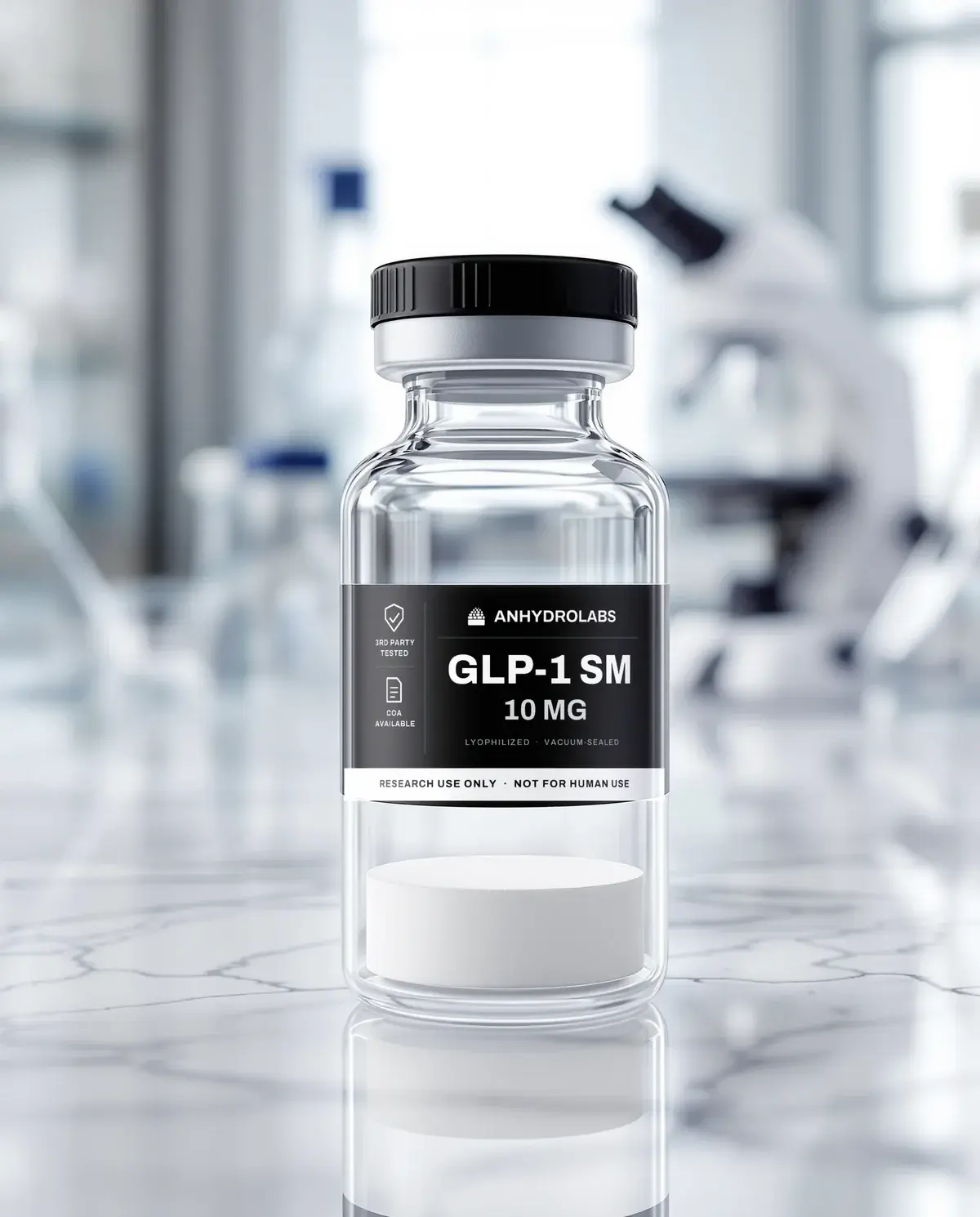
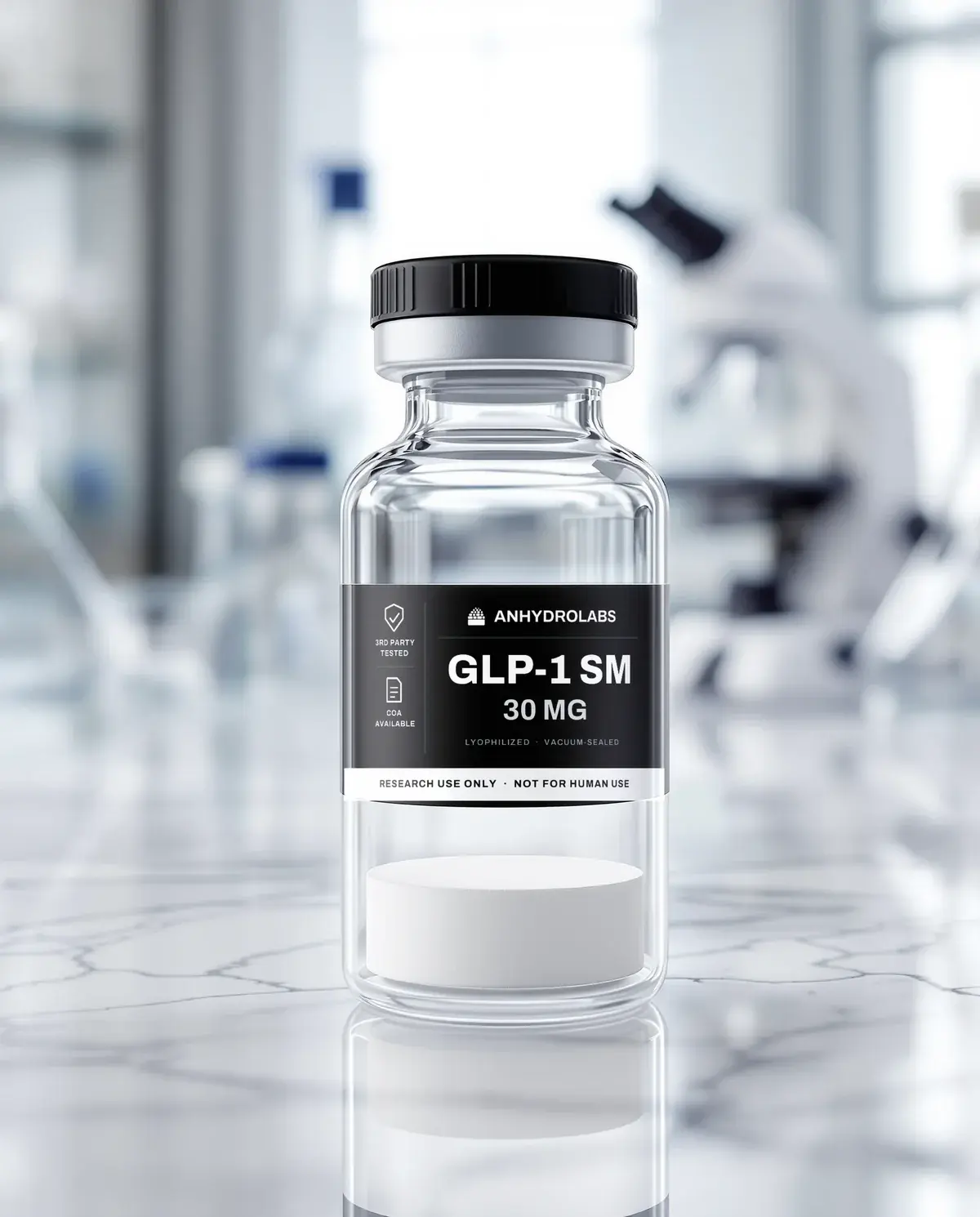
Semaglutide
Also known as Sema. Lyophilized, vacuum-sealed, single vial.
- CAS
- 910463-68-2
- Form
- Lyophilized powder
- Storage
- Frozen, in the dark
- Ships
- Within the US
Get an email when Semaglutide is available
- Coming soon
- Ships within the US
- Pay by card or crypto
- All sales final
Semaglutide is a lipidated 31-residue analog of human glucagon-like peptide-1 from Novo Nordisk, sometimes shortened to Sema, that binds and activates the GLP-1 receptor. Two amino acid substitutions and a C18 fatty diacid on lysine 26 protect it from enzymatic cleavage and let it bind serum albumin, which gives it an elimination half-life of about one week. It was first approved by the FDA in 2017.
Supplied for laboratory research use only. Not for human or veterinary use, and not for diagnostic or therapeutic application.
Semaglutide: compound data
- Molecular formula
- C187H291N45O59
- Molecular weight
- 4,114 g/mol
- CAS number
- 910463-68-2
- PubChem
- CID 56843331
- Form supplied
- Lyophilized powder, vacuum-sealed
- Concentration
- mg/mL and molarity calculator
Reference values from PubChem, the chemistry database of the US National Library of Medicine, for the compound as registered there.
About Semaglutide
Structure of Semaglutide
Semaglutide has a linear backbone of 31 amino acids that follows human GLP-1 closely; the FDA label gives the sequence homology as 94 percent. The discovery paper names two substitutions, α-aminoisobutyric acid (Aib) at position 8 and arginine at position 34, and a derivatized lysine at position 26. The chemical name in PubChem shows what is attached there: a γ-glutamic acid, two short ethylene glycol spacer units and an 18-carbon fatty diacid. The arginine at 34 removes a second lysine, so only one fatty diacid can attach. Liraglutide, its predecessor, is also an acylated GLP-1 analog that binds albumin.
Where Semaglutide comes from
Semaglutide was designed at Novo Nordisk in Denmark as a successor to liraglutide, the company's earlier acylated GLP-1 analog. The discovery paper, by Lau and colleagues in the Journal of Medicinal Chemistry in 2015, states the aim as raising albumin affinity and securing full stability against metabolic degradation, and identifies the fatty acid and its linker chemistry as the features that decided the outcome. Semaglutide was selected from that series. PubChem lists the development codes NN9535 and NNC 0113-0217, and the brand names Ozempic, Rybelsus and Wegovy for finished products.
What Semaglutide binds
Semaglutide is a selective agonist of the GLP-1 receptor, the target of native GLP-1. UniProt describes that receptor as a G protein-coupled receptor whose ligand binding activates adenylyl cyclase and raises intracellular cyclic AMP. The discovery paper measured a receptor affinity of 0.38 nanomolar, about three-fold lower than that of liraglutide, with higher albumin affinity. The label states that albumin binding is the main mechanism of protraction, that more than 99 percent of semaglutide in plasma is bound to albumin, and that the Aib at position 8 stabilizes the peptide against the enzyme dipeptidyl peptidase-4.
Semaglutide in the research literature
The discovery work used receptor-binding and albumin-binding assays to rank a series of acylated analogs, then pharmacokinetic studies in mini-pigs, where the plasma half-life was 46.1 hours. In people, the label gives an elimination half-life of approximately one week and describes elimination by proteolytic cleavage of the backbone followed by beta-oxidation of the fatty acid side chain. When the discovery paper appeared in 2015, semaglutide was in Phase 3 human studies run by Novo Nordisk. UniProt cites that same paper among its sources for the function of the human GLP-1 receptor.
Regulatory status of Semaglutide
Semaglutide is an FDA-approved drug substance. Its initial United States approval was in 2017, and Drugs@FDA lists Novo Nordisk applications for the finished products Ozempic, Rybelsus and Wegovy. Those approvals cover specific finished products made by the application holder, whose label describes a peptide backbone produced by yeast fermentation. A research reagent is a different article: it is not one of those products and has not been reviewed by any agency. Anhydrolabs supplies it as a reference reagent for in-vitro laboratory research only, not for human or veterinary diagnosis, treatment, or consumption.
Handling Semaglutide in the laboratory
The material is a lyophilized powder in a vacuum-sealed vial. Keep it frozen at -4 °F and protected from light. Let the vial reach room temperature before breaking the seal, so that moisture from the air does not condense on the cold powder. Once dissolved for in-vitro work, a solution keeps for about four weeks at 39 °F. Divide a stock solution into single-use aliquots instead of freezing and thawing it repeatedly. No solubility figure for the dry reagent was found in a primary source. Because more than 99 percent of semaglutide binds albumin, apparent potency in a cell assay depends on whether albumin is in the buffer, and that condition should be reported.
Sources
- PubChem compound summary: Semaglutide, CID 56843331
- Discovery of the Once-Weekly Glucagon-Like Peptide-1 (GLP-1) Analogue Semaglutide (Journal of Medicinal Chemistry, 2015)
- WEGOVY (semaglutide) prescribing information, DailyMed
- UniProt P43220: Glucagon-like peptide 1 receptor (GLP1R), human
- Drugs@FDA: FDA-Approved Drugs
Research notes on Semaglutide
- GLP-1 Receptor Agonists: A Research PrimerWhat a GLP-1 receptor agonist is: the receptor, native GLP-1, how exenatide, liraglutide, semaglutide and multi-agonists differ, and lab handling.
Semaglutide: common questions
Is Sema the same as Semaglutide?
Yes. Sema is another name for Semaglutide (CAS 910463-68-2). It is the same compound, supplied here as a lyophilized powder for in-vitro laboratory research use only.
What is Semaglutide supplied as?
Semaglutide is supplied as a lyophilized (freeze-dried) powder in a vacuum-sealed vial, in 10 mg and 30 mg, for in-vitro laboratory research use only.
When will Semaglutide be available?
Semaglutide is coming soon. Join the newsletter on this page to get an email as soon as it can be ordered.
What is the CAS number of Semaglutide?
The CAS registry number of Semaglutide is 910463-68-2.
How should Semaglutide be stored?
Frozen at −4 °F and protected from light, from the day it arrives. Let the vial reach room temperature before breaking the seal; once reconstituted, stability holds for about four weeks refrigerated at 39 °F.
How fast does Semaglutide ship?
Orders ship from the United States, to US addresses. Sizes in stock ship within 1 business day of payment.
Is Semaglutide for human use?
No. It is supplied as a reference reagent for laboratory research use. Not for human or veterinary use, and not for diagnostic or therapeutic application.
How is semaglutide different from native GLP-1?
Semaglutide differs from human GLP-1 at two positions, with Aib at position 8 and arginine at position 34, and it carries a C18 fatty diacid on lysine 26 through a spacer. The Aib blocks cleavage by dipeptidyl peptidase-4 and the lipid binds albumin. The FDA label puts its sequence homology to human GLP-1 at 94 percent.
What receptor does semaglutide bind?
Semaglutide binds and activates the GLP-1 receptor, a G protein-coupled receptor that signals through adenylyl cyclase and cyclic AMP. Its discovery paper reported a binding affinity of 0.38 nanomolar. The FDA label describes it as selective for that receptor.
Why does semaglutide have a half-life of about a week?
Mostly because of albumin binding. The fatty diacid on lysine 26 holds semaglutide on serum albumin, and the label states that more than 99 percent is bound, which lowers renal clearance and protects the peptide from degradation. The Aib at position 8 adds resistance to dipeptidyl peptidase-4.